



Antonio de La Gándara
- portrait
Antonio de La Gándara painted the Belle Époque into permanent record. Born in Paris in 1861[1] to a father of Spanish-Mexican descent and an English mother, he entered the École des Beaux-Arts at fifteen and studied under Jean-Léon Gérôme and Alexandre Cabanel. Within a decade of his 1883[1] Salon debut, where a portrait[1] of Saint Sebastian attracted jury attention, he had become the preferred portraitist of Parisian high society.
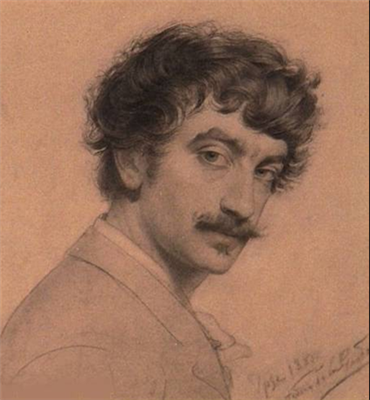
Biography
His sitters read as a directory of the fin-de-siècle: Sarah Bernhardt, Paul Verlaine, Robert de Montesquiou (the aesthete who partly inspired Proust's Baron de Charlus), the poet Anna de Noailles, and Virginie Gautreau, who had already sat for Sargent's notorious Madame X. La Gándara's approach was characterised by economy: commentators noted his ability to achieve simplicity with the finest detail, a quality some traced back to Chardin. He also produced pastels, lithographs, and street scenes of Parisian bridges and parks.
His career brought successive medals at the 1889[1] and 1900 Expositions Universelles, a solo exhibition at Durand-Ruel in New York in 1898, and the Légion d'honneur in 1900. When he died in June 1917[1], the world that had made him possible had just spent three years destroying itself. His reputation faded quickly after the war, though later scholars positioned him as a key witness to the art of his time. He is buried at Père Lachaise cemetery in Paris.
Timeline
- 1861Born in Paris to a father of Spanish-Mexican descent and an English mother.
- 1876Entered the École des Beaux-Arts at fifteen.
- 1883Debuted at the Salon with a portrait of Saint Sebastian, attracting jury attention.
- 1889Received a medal at the Exposition Universelle.
- 1898Held a solo exhibition at Durand-Ruel in New York.
- 1900Received a medal at the Exposition Universelle.
- 1900Awarded the Légion d'honneur.
- 1917Died in Paris in June, and was buried at Père Lachaise cemetery.
Notable Works
Tap to view larger.
Next stop
Browse the movements →
Every movement in the collection, from the Renaissance to Pop art.
Related Artists




Frequently Asked Questions
What is Antonio de La Gándara known for?
Antonio de La Gándara is known as the preferred portraitist of Parisian high society. His sitters included Sarah Bernhardt, Paul Verlaine, Robert de Montesquiou, Anna de Noailles, and Virginie Gautreau.What should I know about Antonio de La Gándara's prints?
Antonio de La Gándara (1862[1]-1917[1]) was a French[1] artist known for portraits and Belle Époque scenes. When considering his prints, it's useful to understand printmaking terminology. Original prints, such as woodcuts, engravings, or lithographs, are produced by hand by the artist. The work is created specifically as a print; the artist directly creates the artwork on the plate, woodblock, or screen. Each print is considered an original. These are often sold through specialised print galleries, frame shops, and fine art galleries. Offset reproductions, also known as posters or image prints, are reproduced by photochemical means. The plates used in offset reproductions do not wear out, so there are no physical limits to the number of prints made. Giclée prints are inkjet fine art prints, and canvas transfers involve transferring the image onto canvas, giving the work the appearance of a painting.What style or movement did Antonio de La Gándara belong to?
Antonio de La Gándara (1861[1]-1917[1]) was active during a period of significant change in the art world; consequently, his work has affinities with several movements. He is primarily known as a portrait[1] painter, and his style aligns with aspects of late Impressionism and early modernism. La Gándara's paintings often feature a muted palette and a focus on capturing the likeness and character of his sitters. Some critics associate his elegant portraits of Parisian society figures with the aestheticism of the Belle Époque. His work also shows an awareness of Symbolism, particularly in its emphasis on mood and atmosphere. La Gándara's artistic approach is not easily categorised, as it incorporates elements from different schools while maintaining his own distinctive sensibility.Where can I see Antonio de La Gándara's work?
Antonio de La Gándara's work can be viewed in several museums and galleries, primarily in Europe. In France, his pieces are held at the Musée des Arts Décoratifs, located on the Rue de Rivoli in Paris, and the Musée des Beaux-Arts in Nancy. Other potential locations include the Musée d’Art et d’Industrie in Roubaix and the Musée de l’Ecole de Nancy. In Spain, the Museo Art Nouveau y Art Deco in Salamanca features art from the period. Additionally, the Museu d’Art Modern (MNAC) in Barcelona may have works on display. The Museu Calouste Gulbenkian in Lisbon, Portugal, also holds relevant collections. Outside continental Europe, the Art Gallery of New South Wales in Sydney, Australia, possesses artworks from a similar period and style.Where was Antonio de La Gándara from?
Antonio de La Gándara was born in Paris, France, in 1861[1]. His father was of Spanish ancestry, while his mother was English. La Gándara spent almost his entire life in France. He began his artistic training at an early age, attending classes at the École des Beaux-Arts in Paris, where he studied with Jean-Léon Gérôme and Isidore Pils. He first exhibited at the Paris Salon in 1883[1] and continued to show his work there regularly. Although he maintained connections with his Spanish heritage, particularly through his father, La Gándara is generally considered a French[1] artist. His upbringing, training, and artistic career were all centred in Paris, and his work reflects the artistic milieu of the French capital during the late 19th and early 20th centuries. He died in Paris in 1917[1].Who did Antonio de La Gándara influence?
Tracing artistic influence is a complex task; however, some artists who absorbed similar lessons as Antonio de La Gándara include Antoine Watteau and Édouard Manet. Watteau (1684-1721[1]) encountered Titian's art indirectly, absorbing his style through other painters' works. Watteau, arguably the greatest artist of 18th-century France, demonstrates Titian's continuing effect on artists long after his death. Another example can be found in the work of Anthony Van Dyck (1599-1641). He spent two years in Rubens’ workshop, but was already a masterful painter. In 1620, he lived for several months in England working for King James I. He then travelled to Italy, where he spent the years 1621-1627 working for aristocratic patrons, mainly in Genoa. Like Rubens, he became an assiduous student of Venetian art and Titian. From Titian, again like Rubens, he learned to use oil paint to perfect scenes of material and atmospheric splendour.Who was Antonio de La Gándara?
Antonio de La Gándara painted the Belle Époque into permanent record. Born in Paris in 1861[1], his father was of Spanish-Mexican descent and his mother was English.Why are Antonio de La Gándara's works important today?
Antonio de La Gándara (1861[1]-1917[1]) was a French[1] artist known for his portraits of Parisian society figures during the Belle Époque. He captured the elegance and atmosphere of the era, and his works provide a glimpse into the cultural milieu of Paris at the turn of the century. La Gándara's portraits often feature women in fashionable attire, posed against atmospheric backgrounds. His style blends academic training with a sensitivity to light and colour, creating a distinctive aesthetic. Although he achieved considerable success during his lifetime, his work later fell out of favour, overshadowed by the rise of modern art movements. Interest in La Gándara has grown in recent decades, with exhibitions and publications dedicated to his art. His portraits offer insights into the social and artistic currents of his time. They document the fashions, manners, and personalities of a bygone era. This makes his work valuable to those interested in the history of portraiture, French culture, and the Belle Époque.What was Antonio de La Gándara's art style?
Commentators noted Antonio de La Gándara's ability to achieve simplicity with the finest detail, a quality some traced back to Chardin. He also produced pastels, lithographs, and street scenes of Parisian bridges and parks.How did Antonio de La Gándara die?
Antonio de La Gándara died in 1917[1] at the age of 56.
Sources
Editorial draws on the following primary and tertiary references for Antonio de La Gándara.
- [1] wikipedia Wikipedia: Antonio de La Gándara Used for: biography, birth dates, death dates, identifiers, movement attribution, nationality.
- [2] book Nina A. Mallory, El Greco to Murillo Used for: biography.
- [3] book Lilian H. Zirpolo, Historical Dictionary of Baroque Art and Architecture Used for: biography, stylistic analysis.
- [4] book Allison Lee Palmer, Historical Dictionary of Neoclassical Art and Architecture Used for: biography, stylistic analysis.
- [5] book Palmer, Allison Lee, Historical Dictionary of Neoclassical Art and Architecture Used for: biography, stylistic analysis.
Editorial overseen by Solis Prints. Sources verified 2026-09-30. Click a source for details, or hover over [N] in the page above to preview.
Editorial standardsMethodologyCorrectionsAI disclosureAbout the editorial team