

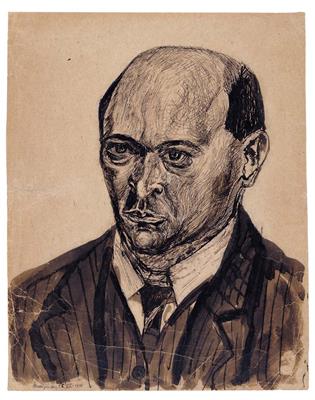
Arnold Schönberg
Kandinsky called Arnold Schoenberg "the only one who currently follows this path of total renunciation of accustomed beauty" after hearing his music for the first time in Munich in January 1911. Within months the two men were corresponding, and Schoenberg's paintings were hanging in the first Der Blaue Reiter exhibition alongside Kandinsky's own.
Biography
Schoenberg (1874-1951[1]) is principally remembered as the Austrian composer who dismantled tonal harmony, from the free atonality of his Piano Pieces Op. 11 (1909) through to the serialist method that shaped twentieth-century music. But his parallel life as a visual artist, pursued without formal training from around 1910, tells a different story. His Self-Portrait, Walking (1911), shown at Der Blaue Reiter in Munich alongside Kandinsky's Composition V, drew comment for its "untrained handling of paint and seemingly naive depiction." The colours were muted; the mood, according to contemporary critics, one of "melancholic lack of energy."
The connection to Der Blaue Reiter went beyond canvas. Schoenberg contributed an essay, "Das Verhaltnis zum Text" (The Relationship to the Text), to the group's 1912 almanac, arguing that the outer resemblance between music and text was superficial compared to their deeper inner correspondence. His ideas about musical dissonance directly shaped the structure of the almanac's image pairings, influencing how Kandinsky and Franz Marc thought about unexpected juxtapositions. August Macke rejected Schoenberg's contributions outright; Marc and Kandinsky adopted them as a foundation.
Schoenberg fled Nazi Germany in 1933 and spent much of his later life in Los Angeles, teaching at UCLA until his death in 1951. The paintings remain a footnote in most accounts, yet they were taken seriously enough by the artists who mattered most at the time.
Timeline
- 1874Born in Austria. He later became a composer and artist.
- 1909Composed Piano Pieces Op. 11, using free atonality.
- 1910Began pursuing visual art without formal training.
- 1911His paintings were exhibited in the first Der Blaue Reiter exhibition in Munich.
- 1911Painted "Self-Portrait, Walking", which was shown at Der Blaue Reiter in Munich.
- 1912Contributed the essay "Das Verhaltnis zum Text" to Der Blaue Reiter's almanac.
- 1933Fled Nazi Germany.
- 1951Died in Los Angeles. He had been teaching at UCLA.
Notable Works
Tap to view larger.
Next stop
Browse the movements →
Every movement in the collection, from the Renaissance to Pop art.
Frequently Asked Questions
What is Arnold Schönberg's most famous work?
It is difficult to name Arnold Schönberg's single 'most famous work', as his notability rests on his wider theoretical and compositional innovations. He is best known as an early Expressionist, and as the inventor of the twelve-tone technique of composition. His early works, such as *Verklärte Nacht* (Transfigured Night) of 1899, are late-Romantic in style, but he soon moved toward atonality. Schönberg's move into atonality can be heard in *Erwartung* (Expectation), a 1909 monodrama. His later adoption of twelve-tone serialism was a move toward a new system of order, after abandoning traditional tonality. *Pierrot Lunaire*, from 1912, is a cycle of Expressionist songs using sprechstimme (a style between song and speech) to surreal and disturbing effect. It is one of his most frequently performed and recorded works. Schönberg's influence on the history of 20th-century music is substantial, and his theoretical writings are nearly as well known as his compositions.What should I know about Arnold Schönberg's prints?
Arnold Schönberg was a member of the Der Blaue Reiter group; the group's Almanac contained three musical scores by Schönberg, Alban Berg, and Anton von Webern. Published in 1912, the Almanac contained 141 reproductions of artworks and artefacts, essays, poetry, a stage play by Kandinsky, and advertisements for exhibitions. Kandinsky and Marc wrote that the Almanac contained works showing an 'inner relationship', born of an 'inner necessity'. Three editions of the book were published in 1912. The standard edition was a run of 1,200 copies; the deluxe edition consisted of fifty copies; and the museum edition was limited to ten copies. A second edition of Der Blaue Reiter was published in 1914, with forewords by the editors.What techniques or materials did Arnold Schönberg use?
Arnold Schönberg's techniques involved a consideration of materials, tools, and their characteristics. The materials used, such as paper, canvas, stucco, stone, or glass, influenced the surface and required appropriate tools and handling. The creation of art relies on technique, which is the means to achieve artistic goals. This includes resourcefulness, the ability to foresee effects, and a feeling for compatibility. Man chooses materials that are constant and unchanging, so he can subject them to his will and create forms. In printmaking, drypoint etching was favoured for its precision. The etching-needle bores into the plate, creating points in the negative space. Colour is applied thickly and wiped off, leaving it in the indentations. The pressure of the press fuses the colour with the paper, creating a small black point. Woodcut uses a metal plane and a wood plate. The effect of an artistic form on the viewer derives from the nature of the medium, its qualities, and basic elements. The organisation of these qualities and the mastery of material for the attainment of this goal comprise artistic creation.What was Arnold Schönberg known for?
Arnold Schönberg (1874-1951[1]) was known for his atonal music and his influence on the Expressionist art movement. Wassily Kandinsky heard Schönberg's music for the first time at a concert in Munich on 1 January 1911. The programme included Schönberg's Second String Quartet, Op. 10, and Three Piano Pieces, Op. 11. Kandinsky was immediately enthusiastic and sent a fervent letter to Schönberg two weeks later. This marked the start of a long correspondence and close intellectual affinity. Schönberg participated in the activities and publications of Der Blaue Reiter. Kandinsky saw in Schönberg's music a process and coherent search that mirrored his own artistic explorations. Kandinsky included high praise for Schönberg in his theoretical text, Concerning the Spiritual in Art. He saw Schönberg as the only one at that time who was fully renouncing conventional beauty and defending all means that lead to self-expression. Kandinsky regarded music as an art form that was liberated from imitation and focused on expressing the artist's inner life. Schönberg's emphasis on formal dissonance between text and music gave Kandinsky a basis for image comparisons.When did Arnold Schönberg live and work?
Arnold Schönberg (sometimes written Schoenberg) was active during a period of significant artistic change. Born in Vienna on 13 September 1874, he died in Los Angeles on 13 July 1951. Schönberg's career began in a Vienna that was a centre for music, from Brahms and Bruckner to Mahler and Richard Strauss. Schönberg was also an amateur painter; he and Kandinsky met in January 1911, and Schönberg's paintings were exhibited alongside Kandinsky, Marc, and Münter in the "First Exhibition by the Editors of the Blue Rider" in December 1911. His artistic development occurred during a period when Vienna was a centre for artistic activity. Schönberg's career spanned from the late nineteenth century into the mid-twentieth, a period encompassing the transition from late Romanticism through expressionism and into the serialist and twelve-tone techniques with which he is most associated.Where can I see Arnold Schönberg's work?
A number of museums maintain collections of work related to the Bauhaus school, where Arnold Schönberg taught. These include the Bauhaus-Archiv, Museum für Gestaltung, located at Klingelhöferstr. 14, D-10785 Berlin, Germany; the Stiftung Bauhaus Dessau, Gropiusallee 38, D-06846 Dessau, Germany; and the Stiftung Meisterhäuser Dessau, Meisterhaus Kandinsky - Klee, Ebertallee 69-71, D-06846 Dessau, Germany. Other institutions with relevant holdings are the Klassik Stiftung Weimar/Bauhaus-Museum, Theaterplatz, D-99423 Weimar, Germany; the Bauhaus-Museum Weimar, Am Theaterplatz, D-99423 Weimar, Germany; and the Zentrum Paul Klee Bern, Monument im Fruchtland 3, Postfach, 3000 Bern 31, Switzerland. Outside of Europe, see the Busch-Reisinger Museum, 32 Quincy Street, Cambridge, MA 02138, USA; the Utsunomiya Museum of Art, 1077 Nagaoka-cho, 320-0004 Utsunomiya, Japan; and the Misawa Bauhaus Collection, 1-1-19 Takaido-nishi, Suginami-ku Tokio, Japan.Who did Arnold Schönberg influence?
Arnold Schönberg's impact is complex, with varied influences across different artistic fields. Within visual art, some artists found inspiration in the work of Henri Matisse as a means of circumventing abstract expressionism. Several artists, including Hans Hofmann, were influenced by Matisse, Cézanne, Kandinsky, and Delaunay's colour theories. Max Weber's introduction to modern art came through Matisse's teaching and study of Cézanne. The German Expressionist group Die Brücke also saw Matisse as an influence on their early woodcuts. In America, Matisse's work resonated from the 1940s through the 1970s, impacting artists such as Hans Hofmann and Sean Scully. Hard-edge painters like Youngerman and Kelly, colourists such as Frankenthaler, Motherwell, and Stella, and figurative artists including Avery and Wesselman all demonstrate Matisse's reach. Lichtenstein created pastiches of Matisse, while Diebenkorn also drew inspiration from him.Who influenced Arnold Schönberg?
Arnold Schönberg's theories of harmony and dissonance influenced a number of painters associated with German Expressionism. Wassily Kandinsky heard Schönberg's atonal music in Munich in January 1911. He befriended the composer soon after, and he adopted ideas from Schönberg's *Theory of Harmony* for his own art theory. Kandinsky reframed his book *Concerning the Spiritual in Art* (1912) on Schönbergian terms, presenting it as a *Theory of Harmony* of painting. Kandinsky quoted Schönberg's commentary on parallel octaves and fifths, writing that artistic freedom cannot exceed the spiritual development of its age. Schönberg's essay 'The Relationship to the Text' and his emphasis on formal dissonance between text and music gave Kandinsky a basis for startling juxtapositions. Kandinsky insisted on inner connections between modern and non-Western art, despite outer dissimilarities. His essay 'On Stage Composition' claims that coordinating the arts results in vibrations of the human soul. Kandinsky's play, *The Yellow Sound*, uses vague chords instead of harmonies; its dialogue consists of contradictory pairings.Who was Arnold Schönberg?
Arnold Schönberg (born in Vienna, 1874; died in Los Angeles, 1951) was an Austrian composer, music theorist, teacher, painter, and writer. He is widely considered one of the most important and influential composers of the 20th century. Schönberg is known for his development of the twelve-tone technique, a method of atonal composition that revolutionised Western art music. This system treats all twelve notes of the chromatic scale as equal, avoiding a tonal centre. Schönberg's work had an impact on visual artists. Vasily Kandinsky, for example, felt an immediate enthusiasm for Schönberg's compositions, especially after hearing pieces such as the Second String Quartet, Op. 10, and the Three Piano Pieces, Op. 11, in 1911. Kandinsky saw in Schönberg's work a process and coherent search that mirrored his own artistic explorations. He included praise for Schönberg in his text, *Concerning the Spiritual in Art*. Kandinsky regarded Schönberg as someone who had abandoned conventional beauty in favour of complete self-expression.Why are Arnold Schönberg's works important today?
Arnold Schönberg's theories about harmony and dissonance influenced the development of musical composition, and also visual art. Schönberg's work, particularly his ideas concerning dissonance, had a strong effect on Wassily Kandinsky. Kandinsky encountered Schönberg's music in 1911 and subsequently befriended the composer. He adopted concepts from Schönberg's *Theory of Harmony* for his own art theory. Kandinsky saw Schönberg as representing a consistent adherence to "inner harmony". Schönberg's emphasis on dissonance between text and music gave Kandinsky a basis for image comparisons. Kandinsky insisted on inner affinities between modern and non-Western art, despite outer dissimilarities; this can be understood as a response to Schönberg's embrace of juxtaposition and dissonance. Schönberg contributed to making compositional dimensions uniform. He articulated this formally in a theory of musical cohesion, where all particular aspects of musical work were to be subordinated to it. Schönberg standardised technical means for creating cohesive contexts.When was Arnold Schönberg born?
Arnold Schönberg was born in 1864[1].
Sources
Editorial draws on the following primary and tertiary references for Arnold Schönberg.
- [1] wikipedia Wikipedia: Arnold Schönberg Used for: biography, birth dates, death dates, identifiers, movement attribution, nationality.
- [2] book Dorothy Price, German Expressionism: Der Blaue Reiter and Its Legacies Used for: stylistic analysis.
- [3] book Gustav Klimt, Federico Zeri, Marco Dolcetta, Klimt, Gustav, Klimt_ Judith I (One Hundred Paintings Series) Used for: biography.
- [4] book Gustav Klimt, Federico Zeri, Marco Dolcetta, Klimt, Gustav, Klimt_ Judith I (One Hundred Paintings Series) Used for: biography.
- [5] book Gustav Klimt, Federico Zeri, Marco Dolcetta, Klimt, Gustav, Klimt_ Judith I (One Hundred Paintings Series) Used for: biography.
- [6] book Barasch, Moshe; , Modern Theories of Art 2 Used for: stylistic analysis.
- [7] book Charlene Spretnak (auth.), The Spiritual Dynamic in Modern Art _ Art History Reconsidered, 1800 to the Present Used for: stylistic analysis.
Editorial overseen by Solis Prints. Sources verified 2026-09-30. Click a source for details, or hover over [N] in the page above to preview.
Editorial standardsMethodologyCorrectionsAI disclosureAbout the editorial team