



Arthur Pan
- portrait
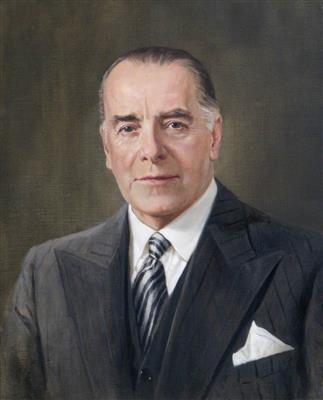
Arthur Pan painted Winston Churchill's portrait[1], and the image appeared on the cover of The Illustrated London News on Christmas Day 1943[1]. A replica hangs in the American Embassy in London. That commission, arriving while Britain was mid-war, placed Pan at the centre of the country's portrait establishment despite his having arrived as a refugee from Nazi-occupied Europe.
Biography
Pan was born in Timisoara in 1894[1], then part of Austria-Hungary, into a Jewish family. He trained at the Budapest Academy of Art and later at the Académie Julian in Paris, absorbing the technical rigour of both traditions. By the time he settled in England, he had established himself as a capable portraitist with access to senior military and political figures. His 1945[1] portrait[1] of Lieutenant General Miles Dempsey appeared on the front page of The Illustrated London News, and his portrait of Field Marshal Jan Smuts hangs at Christ's College, Cambridge.
In the 1950s Pan accepted a commission to paint portraits for the Iraqi Royal Family, spending two years at the Baghdad Palace of King Faisal II. Every work produced during that residency was destroyed in the 1958[1] coup.
He continued painting until late in life, dying in 1983[1]. His career traced a path taken by many Central European émigré artists: classical training in Budapest or Vienna, refinement in Paris, and a late resettlement in Britain where the demand for formal portrait[1] painting remained strong well into the postwar decades.
Timeline
- 1894Born in Timisoara, Austria-Hungary, into a Jewish family.
- 1943Painted Winston Churchill's portrait, which appeared on the cover of The Illustrated London News on Christmas Day.
- 1945Painted a portrait of Lieutenant General Miles Dempsey, which appeared on the front page of The Illustrated London News.
- 1950Accepted a commission to paint portraits for the Iraqi Royal Family.
- 1950Spent two years at the Baghdad Palace of King Faisal II.
- 1958Every work produced during his residency in Baghdad was destroyed in the coup.
- 1983Died in England.
Notable Works
Tap to view larger.
Next stop
Browse the movements →
Every movement in the collection, from the Renaissance to Pop art.
Related Artists



Frequently Asked Questions
What is Arthur Pan known for?
Arthur Pan is known for his portraiture, especially his portraits of senior military and political figures. His 1945[1] portrait[1] of Lieutenant General Miles Dempsey appeared on the front page of The Illustrated London News, and his portrait of Field Marshal Jan Smuts hangs at Christ's College, Cambridge.What is Arthur Pan's most famous work?
Pan Tianshou (1898[1]-1971[1]) was an innovator in twentieth-century Chinese painting. Although his work was criticised during the Cultural Revolution, he is now considered a major master. Pan was born in Ninghai, Zhejiang Province. He studied under Li Shutong at the Zhejiang First Normal School in Hangzhou. From 1923 to 1928, he taught in Shanghai. Apart from a short trip to Japan in 1929, he spent his career as an art teacher, especially at the National Hangzhou Academy. He became president of the Academy in 1958. Pan painted flowers, birds, fish, human figures, and also landscapes. His style features clear forms and bold lines, influenced by Zhu Da, Wu Changshi, and Huang Binhong. *Black Chicken*, painted in 1948, is considered his first painting to demonstrate his unique personal style. His concern with formal organisation and minimal interest in subject matter mark his modernity. His use of colour reinforces these formalist qualities.What should I know about Arthur Pan's prints?
When considering Arthur Pan's prints, it is useful to understand some basic principles of printmaking. An original print is conceived as a print, and executed solely as a print, often in a numbered edition, and signed by the artist. Each print in the edition is an original, printed from a plate, stone, screen, block or other matrix created for that purpose. The artist decides the number of prints in the edition. The prints are then numbered to provide an accounting; for example, 12/25 means it is print number 12 of an edition of 25. A reproduction, on the other hand, is a copy of a work of art initially created in another medium, such as painting or watercolour. It is usually made by photomechanical means. Numbering and signing a reproduction does not make it an original print. Prints are sold in limited editions, commanding higher prices than posters, which are not numbered. The number of prints is limited by the number of impressions that can be made before the plate wears out. Some publishers impose their own limits on the number of impressions to increase a print’s value. These limits may be set as high as 700 to 1,000 impressions, but some prints are limited to just 250 to 500, making them highly prized by collectors.What style or movement did Arthur Pan belong to?
Arthur Pan's artistic style relates to the depiction of movement, a concern shared with movements such as Futurism. Futurism explored how to represent dynamism in static mediums, such as painting and photography. One technique for implying motion involves suspended movement, where a camera freezes a split second of action. The photograph captures details that the eye cannot perceive, giving a sense of motion. Motion blur, action sequencing, and visual flow can also contribute to representations of dynamism. The photographer Anton Giulio Bragaglia created "photodynamic" images using blurring to suggest the essence of movement, specifically what occurs between instants. His images might show successive stages of a movement, such as a person sitting, standing, and bowing, with blurring connecting these stages. Bragaglia sought to dematerialise the agent performing the action, presenting pure movement. He valued the sensation of motion over accurate reproduction, aligning with Futurist ideas about freeing art from representational demands.What was Arthur Pan known for?
Arthur Pan was a cultural critic active in China during the 1920s and 1930s. He is known for his withering attacks on what he termed "Chinese culture". Pan reversed inherited norms in the name of modernity, science, democracy, freedom, and the social contract. His critique was part of the "May Fourth" theory movement. Zhang Jingyuan has emphasised the psychoanalytic dimension of Pan’s concept of female narcissism. Pan examined the case of Xiaoqing, a figure who chose not to remarry or become a nun, but instead, opened her own pathway. Pan argued that Xiaoqing suffered from "abnormal psychology", exhibiting a stunted version of normal psychology. He viewed her perverse erotic drives as creating a singular agency, even under difficult conditions. Pan used this case history to publicise his view that evolutionary eros worked as forcefully in women as he knew it worked in men.Where can I see Arthur Pan's work?
Arthur Pan's work can be viewed in several museums around the world. In the United States, notable collections are held at the Art Institute of Chicago, which has a wide-ranging Asian collection; the Asian Art Museum of San Francisco, which specialises in art from across Asia; the Boston Museum of Fine Arts, which includes Chinese paintings, sculpture and ceramics; the Cleveland Museum of Art, which has over 1,600 Chinese artworks viewable online; and the Metropolitan Museum of Art in New York. Other US museums include the Charles Hosmer Morse Museum of American Art, the Los Angeles County Museum of Art (LACMA), the Minneapolis Institute of Arts, the Museum of Modern Art in New York, the Virginia Museum of Fine Arts, and the Wolfsonian at Florida International University. Outside of the US, the Art Gallery of New South Wales in Sydney, Australia, has a collection covering 7,000 years of Chinese artistic evolution. The Asian Civilisations Museum in Singapore has galleries focusing on contributions to Singapore's cultural diversity, including Chinese art. The Hong Kong Museum of Art has galleries focusing on Chinese antiquities, while the Tokyo National Museum in Japan has a collection of Chinese art from the pre-Han to the Qing Dynasty. In the UK, the Ashmolean Museum at the University of Oxford has a collection of early Chinese ceramics and seals, and the British Museum in London has an extensive Chinese collection.Where was Arthur Pan from?
Arthur Pan was born in Ninghai, Zhejiang Province. He received his initial art instruction from Li Shutong, a well-known scholar, at the Zhejiang First Normal School in Hangzhou. From 1923[1] to 1928, he taught in Shanghai. Apart from a short visit to Japan in 1929, Pan spent his life as an art teacher at various art schools, most notably the National Hangzhou Academy. In 1932, he co-founded the Baishe Painting Society and its journal, Baishe Pictorial. He also helped organise the 1937 National Art Exhibition in Nanjing. During World War II, he accompanied the Hangzhou Academy as it moved throughout western China. After 1949, he continued teaching in Hangzhou and became president of the Academy in 1958.Who did Arthur Pan influence?
Arthur Pan (1898[1]-1971[1]) was a Chinese painter and art teacher. He is considered a major master who influenced many younger painters. Li Kuchan (1898-1983[1]) and Cui Zifan (born 1915) are among the artists who were influenced by Pan. Pan, born in Ninghai, Zhejiang Province, received early art training from Li Shutong at the Zhejiang First Normal School in Hangzhou. He later taught in Shanghai from 1923 to 1928. After 1949, he continued teaching in Hangzhou and became president of the Academy in 1958. Pan's paintings include flowers, birds, fish, human figures and, also, landscapes. His style features clearly articulated forms and bold lines, influenced by Zhu Da, Wu Changshi, and Huang Binhong. His concern with formal organisation and simple colour use distinguish his work.Who influenced Arthur Pan?
Pan Tianshou (1898[1]-1971[1]) received early art instruction from Li Shutong, a scholar at the Zhejiang First Normal School in Hangzhou. Later, Pan taught in Shanghai from 1923 to 1928. Pan's paintings of flowers, birds, fish, human figures and landscapes show the influence of Zhu Da, Wu Changshi, and Huang Binhong. His style is characterised by clearly articulated forms and bold, energetic lines. Black Chicken, painted in 1948, is considered his first painting to demonstrate his unique personal style, which he developed throughout his life. Pan's concern with the formal organisation of the pictorial surface and his minimal interest in subject matter contributed to the modernity of his painting. His simple use of colour reinforces these formalist qualities. His forceful brushwork and daring composition impart a freshness and graphic power. Pan Tianshou, along with Qi Baishi, is considered one of China's greatest modern innovators. He influenced many younger painters, including Li Kuchan (1898-1983[1]) and Cui Zifan (born 1915).Who was Arthur Pan?
Arthur Pan (1898[1]-1971[1]) was a Chinese artist and educator, also known as Pan Tianshou. Born in Ninghai, Zhejiang Province, he received early art training from Li Shutong at the Zhejiang First Normal School in Hangzhou. He then taught in Shanghai from 1923 to 1928. He briefly visited Japan in 1929. Afterward, he spent his career teaching at various art schools, particularly the National Hangzhou Academy. He co-founded the Baishe Painting Society in 1932 and helped organise the 1937 National Art Exhibition in Nanjing. After 1949, he continued teaching in Hangzhou and became president of the Academy in 1958. Pan painted flowers, birds, fish, human figures, and scenery. His style features clear forms and bold lines, influenced by artists such as Zhu Da and Wu Changshi. His 1948 painting, Black Chicken, is considered his first work displaying his unique style, which he developed throughout his life. During the Cultural Revolution, his paintings were criticised for being too abstract and individualistic, leading to his persecution.How did Arthur Pan die?
Arthur Pan died in 1983[1] at the age of 89.
Sources
Editorial draws on the following primary and tertiary references for Arthur Pan.
- [1] wikipedia Wikipedia: Arthur Pan Used for: biography, birth dates, death dates, identifiers, movement attribution, nationality.
- [2] book Martin J. Powers, Katherine R. Tsiang (eds.), A Companion to Chinese Art (Blackwell Companions to Art History) Used for: stylistic analysis.
- [3] book guggenheim-centuryincrisism00andr Used for: biography.
- [4] book Katharine Persis Burnett, Shaping Chinese Art History_ Pang Yuanji and His Painting Collection (Cambria Sinophone World) Used for: biography, stylistic analysis.
Editorial overseen by Solis Prints. Sources verified 2026-10-22. Click a source for details, or hover over [N] in the page above to preview.
Editorial standardsMethodologyCorrectionsAI disclosureAbout the editorial team