



Asgrimur Jonsson
Shortly before his death in 1958[2], Ásgrímur Jónsson gave away everything: his Reykjavík house and a collection of 192 oil paintings and 277 watercolours was handed to the Icelandic[2] government, forming what became the Ásgrímur Jónsson Collection, now a permanent holding of the National Gallery of Iceland. The gesture suited an artist who had spent his career building the infrastructure of Icelandic art from almost nothing.
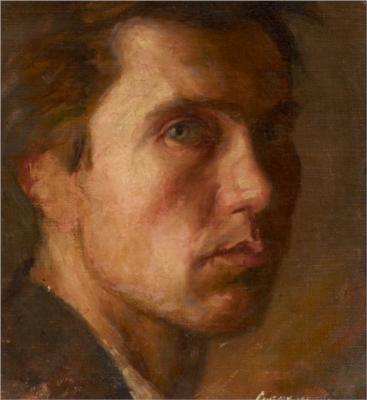
Biography
Born in Ásólfsskáli in the south of Iceland in 1876[2], Jónsson left for Copenhagen in 1900[2] to study at the Royal Danish Academy of Fine Arts, training there until 1903. The experience gave him the conventions of European landscape painting, and he brought that language home to Iceland, applying it to the country's volcanic mountains, rivers, and skies. His technique drew comparisons to Corot, with a soft atmospheric quality suited to the particular light of the northern landscape.
Over a long career he also painted murals for several Icelandic[2] churches and produced illustrations of the old sagas, connecting the country's mythological past to a contemporary visual culture. He taught widely; his student Jóhannes Sveinsson Kjarval became the most celebrated Icelandic artist of the twentieth century. The University of Iceland made him an honorary professor, and he received the Grand Cross of the Order of the Falcon in 1933[2]. He died in Reykjavík on 5 April 1958[2].
Timeline
- 1876Born in Ásólfsskáli, Iceland.
- 1900At 24, he moved to Copenhagen to study at the Royal Danish Academy of Fine Arts.
- 1903Completed his studies at the Royal Danish Academy of Fine Arts.
- 1933Received the Grand Cross of the Order of the Falcon.
- 1958Died in Reykjavík on 5 April. He was 82 years old.
- 1958Shortly before his death, he donated his house, 192 oil paintings, and 277 watercolours to the Icelandic government; this became the Ásgrímur Jónsson Collection at the National Gallery of Iceland.
Notable Works
Tap to view larger.
Next stop
Browse the movements →
Every movement in the collection, from the Renaissance to Pop art.
Frequently Asked Questions
What is Asgrimur Jonsson known for?
Ásgrímur Jónsson is known for his landscape paintings of Iceland's volcanic mountains, rivers, and skies. He also painted murals for Icelandic[2] churches and produced illustrations of the old sagas.What should I know about Asgrimur Jonsson's prints?
Asgrimur Jonsson (1876[2]-1958[2]) was an Icelandic[2] artist, born in southern Iceland. He is known for paintings inspired by Icelandic folk tales. Jonsson was among the first Icelanders to make a career as a professional painter. Jonsson studied at the Royal Danish Academy of Fine Arts in Copenhagen from 1903[2] to 1908. He travelled around Europe, studying art and painting. He is known to have produced a number of illustrations. Jonsson's work often depicts figures from Icelandic folklore, such as elves and trolls. These subjects reflect an interest in Iceland's cultural heritage. Jonsson's art is accessible to a wide audience because of its narrative content. He aimed to interpret Icelandic folk material for the general public. Jonsson's house in Reykjavik, built in 1933, was one of the first buildings designed specifically as a studio and exhibition space. It is now a museum dedicated to his art.What style or movement did Asgrimur Jonsson belong to?
Asgrimur Jonsson (1876[2]-1958[2]) is considered Iceland's first professional painter. He is best known for his paintings inspired by Icelandic[2] folk tales. Jonsson's style has been linked to several movements; these include symbolism and expressionism. Some consider his work to be naivism. These categorisations reflect the varied nature of his artistic output. Jonsson's art often incorporated mystical and nationalistic elements. These interests align with the symbolist movement, which explored dreamlike and spiritual subjects. His use of bold colours and simplified forms also connects to expressionism, which sought to convey emotion over realistic representation. The designation of 'naivism' acknowledges the self-taught or folk-art-influenced quality of some of his paintings. These qualities contribute to his unique position in Icelandic art history.What techniques or materials did Asgrimur Jonsson use?
Information regarding Asgrimur Jonsson's techniques is scarce; however, some sources discuss related methods used by other artists. Some artists working with glass developed new types of pictures using opaque glass, rather than transparent window glass held together with lead. This allowed the work to be hung on a wall or mounted as part of the architecture. The technique involved sandblasting flashed glass; this type typically had a milk-glass body covered with a thin film of another colour, such as black or red. Sandblasting was used to grind a relief into the glass, similar to the way a tombstone carver engraves names. Glass-painter colours could also be applied and made permanent by burning in a kiln, although this limited the colour possibilities. In sculpture, artists sometimes combined materials, using nails to represent hair in ancient-seeming heads. The selection of materials influenced both the techniques and the forms used to symbolise body parts.What was Asgrimur Jonsson known for?
Asgrimur Jonsson (born in 1876[2], died in 1958[2]) was an Icelandic[2] artist. In 1954[2], the Icelandic Printmaker's Association (IPA) was founded by artists who had gained experience with printmaking abroad. The association was revitalised in 1969 and, today, has forty-one members. They qualify by holding advanced degrees in printmaking or by having established reputations and extensive experience in the medium. Central to the aims of the association is the introduction of Icelandic prints in the country and abroad. Since 1969, it has organised biannual exhibitions of members' work in Reykjavik, alternated with publishing suites of prints by members. Exhibitions of Icelandic prints have also been shown in Germany, France, the United States, and Japan, as well as in the Scandinavian countries. A member of the Nordic Graphic Union (including Norway, Sweden, Denmark, and Finland), the IPA has participated in their biennale since 1969. Today, a number of Icelandic printmakers have international reputations and have received awards at major international print biennales.Where can I see Asgrimur Jonsson's work?
It is difficult to say with certainty where you can view the work of Asgrimur Jonsson. However, research concerning other Icelandic[2] artists, such as Sigurdur Gudmundsson and Hreinn Fridfinnsson, provides some insight into possible locations. Both Gudmundsson and Fridfinnsson co-founded the artists' group SUM and Gallery SUM. Gudmundsson's work is represented in the Living Art Museum and the Municipal Collection, both in Reykjavik; the Stedelijk Museum, Amsterdam; the Rijksmuseum Kraller-Muller, Otterlo, The Netherlands; the Musee National d'Art Moderne, Centre Georges Pompidou, Paris; and the Moderna Museet, Stockholm. Fridfinnsson has works represented in the National Museum, Reykjavik; the Living Art Museum, Reykjavik; the Municipal Collection, Reykjavik; The Workers' Union's Museum, Reykjavik; the Moderna Museet, Stockholm; the Musee National d'Art Moderne, Centre Georges Pompidou, Paris; the Netherlands Government Collection; and the Municipal Collection, Amsterdam. It is possible that Jonsson's work may be found in these same institutions.Where was Asgrimur Jonsson from?
Asgrimur Jonsson was Icelandic[2]. The Icelandic Printmakers' Association was founded in 1954[2] by artists who had gained experience with printmaking abroad. The association was revitalised in 1969 and, today, has forty-one members. They qualify by holding advanced degrees in printmaking or by having established reputations and extensive experience in the medium. Central to the aims of the association is the introduction of Icelandic prints in the country and abroad. Since 1969, it has organised biannual exhibitions of members' work in Reykjavik, alternated with publishing suites of prints by members. Exhibitions of Icelandic prints have also been shown in Germany, France, the United States, and Japan, as well as in the Scandinavian countries. A member of the Nordic Graphic Union (including Norway, Sweden, Denmark, and Finland), the IPA has participated in their biennale since 1969. Today, a number of Icelandic printmakers have international reputations and have received awards at major international print biennales.Who did Asgrimur Jonsson influence?
Asgrimur Jonsson's influence is complex. Iceland's geographical position has meant that Icelandic[2] artists have sought contacts in the United States, Britain, and continental Europe, as well as Scandinavia. Young Icelandic artists have sometimes felt isolated, experiencing a divide between themselves, older artists, and the public. Some have sought opportunities abroad, for example in Copenhagen, France, Germany, and the Netherlands. The Living Art Museum (Nylistasafn) was created by older artists from the SUM group, along with younger artists. It aimed to preserve and document the central segment of new Icelandic art that SUM represents. Dieter Rot, who lived in Iceland almost continuously from 1957[2] to 1964, donated a large body of work to the museum. Works by Daniel Spoerri, Richard Hamilton, Joseph Beuys, and other artists who had been in Iceland and worked with SUM artists were also donated.Who influenced Asgrimur Jonsson?
Identifying Asgrimur Jonsson's influences requires some care. Iceland, though geographically isolated, maintains awareness of international artistic developments. Many Icelandic[2] artists pursue education abroad, and those who settle elsewhere often return to Iceland to exhibit and maintain connections. This, in turn, exposes Icelandic culture to new ideas. Halldor Laxness wrote of Alfred Barr, Jr.'s visit to Reykjavik. Barr sought to understand how Icelandic artists reacted to influences, such as Jon Stefansson's studies with Matisse before the First World War. Laxness questioned whether training in Paris could transform a Scandinavian artist into a "Matisse no. 2". In the 1970s, Magnus Palsson significantly impacted the art scene and education at the Icelandic College of Arts and Crafts in Reykjavik. He invited visiting teachers, including Robert Filliou, Dieter Rot, Bakker, and Dick Higgins.Who was Asgrimur Jonsson?
Asgrimur Jonsson (dates unknown) was an Icelandic[2] artist. Iceland's first commercial printing house was established in 1575; however, it was not until the twentieth century that Icelandic artists began to use printing as a fine art. In 1954[2], the Icelandic Printmaker's Association was founded by artists who had gained experience with printmaking abroad. The association was revitalised in 1969 and, today, has forty-one members. They qualify by holding advanced degrees in printmaking or by having established reputations and extensive experience in the medium. Central to the aims of the association is the introduction of Icelandic prints in the country and abroad. Since 1969, it has organised biannual exhibitions of members' work in Reykjavik, alternated with publishing suites of prints by members. Exhibitions of Icelandic prints have also been shown in Germany, France, the United States, and Japan, as well as in the Scandinavian countries.Why are Asgrimur Jonsson's works important today?
Asgrimur Jonsson (born 1876[2], died 1958[2]) was part of a generation of Icelandic[2] artists who sought to define national identity through their work. Iceland's geographic isolation meant that Icelandic artists often looked to the United States, Britain, and continental Europe, as well as Scandinavia, for artistic contacts and influence. Jonsson's work gains importance when viewed in the context of the Living Art Museum (Nylistasafn), started by artists from the SUM group. The SUM group was formed from dissatisfaction with the conservative Icelandic art scene. They sought to preserve and document new Icelandic art. Jon Stefansson, an Icelandic painter, studied with Matisse before the First World War. Alfred Barr, Jr., once visited Reykjavik to see Stefansson's work and assess how an Icelandic artist reacted to such influences. This highlights the ongoing interest in understanding how Icelandic artists engage with international movements while maintaining their unique perspective.What was Asgrimur Jonsson's art style?
Ásgrímur Jónsson's technique has been compared to Corot, with a soft atmospheric quality. He used the conventions of European painting to depict the light of the northern landscape.
Sources
Editorial draws on the following primary and tertiary references for Asgrimur Jonsson.
- [1] museum Victoria and Albert Museum Used for: museum holdings.
- [2] wikipedia Wikipedia: Asgrimur Jonsson Used for: biography, birth dates, death dates, identifiers, movement attribution, nationality.
- [3] book guggenheim-handboo00pegg Used for: biography.
- [4] book guggenheim-northernvisionss03solo Used for: biography.
- [5] book Jule, Walter, Precarious Balance Used for: biography.
Editorial overseen by Solis Prints. Sources verified 2026-09-30. Click a source for details, or hover over [N] in the page above to preview.
Editorial standardsMethodologyCorrectionsAI disclosureAbout the editorial team