

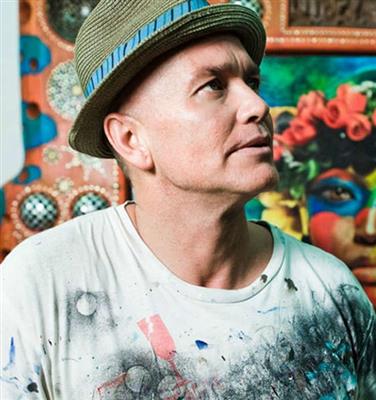
Ashley Bickerton
Ashley Bickerton emerged from CalArts in 1982[1] and the Whitney Independent Study Program to become one of four artists branded "The Hot Four" by New York magazine in 1986. That autumn, his debut alongside Jeff Koons, Peter Halley, and Meyer Vaisman at Sonnabend Gallery, SoHo, was the defining moment of Neo-Geo: a movement whose central paradox Bickerton embodied more literally than anyone else, selling art that critiqued the selling of art.
Biography
His signature early works were assemblages modelled on packing crates, their surfaces encrusted with corporate logos, registered trademarks, and sponsor patches. He called them Self-Portraits. The branding was not ironic decoration but the subject: identity mediated by consumer culture, the artist as product. Abstract Painting for People 4 (1987[1]) entered François Pinault's collection; The Patron (1997), oil, acrylic, pencil, and aniline dye on wood at 167.5 x 228.5 cm, was purchased by Charles Saatchi. Scholars have described that transaction as a damning critique of the collector's own cultural investment turned into the purchase itself.
In 1993[1], after twelve years establishing his New York reputation, Bickerton relocated to Bali, where he lived until his death. The move recalibrated his practice around different anxieties: the island's environmental degradation, the collision of myth and mass tourism, what he termed tropical surrealism. Later work referenced Gauguin's South Seas escape while refusing its romanticism. His 2017 Newport Street Gallery retrospective, Ornamental Hysteria, brought together 51 works across three decades.
Works are held at MoMA, Tate, the Fondation Cartier, and the Stedelijk Museum. Bickerton died on 30 November 2022[1], aged 63, from complications of ALS.
Timeline
- 1959Born in 1959.
- 1982Graduated from CalArts.
- 1986Featured as one of "The Hot Four" by New York magazine.
- 1986Debuted at Sonnabend Gallery, SoHo, alongside Jeff Koons, Peter Halley, and Meyer Vaisman.
- 1987His work "Abstract Painting for People 4" entered François Pinault's collection.
- 1993Relocated to Bali after twelve years in New York.
- 1997His work "The Patron" was purchased by Charles Saatchi.
- 2017His retrospective, "Ornamental Hysteria", was held at Newport Street Gallery.
- 2022Died on 30 November, aged 63, from complications of ALS in Bali.
Notable Works
Tap to view larger.
Next stop
Browse the movements →
Every movement in the collection, from the Renaissance to Pop art.
Related Artists
_%E2%80%93_LOC.jpg)



Frequently Asked Questions
What is Ashley Bickerton known for?
Ashley Bickerton is known for being one of the four primary practitioners of Neo-Geo. In the autumn of 1986[1], he debuted alongside Jeff Koons, Peter Halley, and Meyer Vaisman at Sonnabend Gallery, SoHo. This was a defining moment of the Neo-Geo movement.What is Ashley Bickerton's most famous work?
It is difficult to name Ashley Bickerton's single "most famous" work, as fame is subjective and fluctuates. However, some of his pieces have received considerable attention and are frequently discussed in the context of his artistic output. Bickerton emerged in the 1980s as part of the Neo-Geo movement, which questioned originality and authorship. His early works often combined painting and sculpture, incorporating industrial materials and commercial logos. One notable example is his series of "Self-Portraits", which are not traditional portraits but rather constructions of materials and symbols that represent the artist's identity in a consumerist society. These works often feature bright colours, geometric shapes, and brand names, reflecting the influence of advertising and mass media. Other significant works include his "Tormented Self-Portrait (Susie Culturelux)" from 1987[1]-88, which further explores themes of identity, commodification, and the self in a media-saturated world. Bickerton's work continues to evolve, but these early pieces remain important examples of his contribution to contemporary art.What should I know about Ashley Bickerton's prints?
Ashley Bickerton is an American[1] artist whose prints are sold internationally. When acquiring a print, it is useful to understand some basic facts about the market. An "original print" is conceived as a print, executed solely as a print, and usually numbered and signed by the artist. Each print in the edition is an original, printed individually from a plate, stone, screen, or block created for that purpose. A reproduction is a copy of a work of art conceived in another medium, such as painting or watercolour, and made by photo-mechanical means. Numbering and signing a reproduction does not change its essence; it is still a reproduction, not an original print. The edition claim is usually written as a pair of numbers on the bottom left margin of the print; it consists of a print number and an edition number written as a group with a short separating line between them. The title of the print is written in the middle of the bottom margin, and the signature is on the right. Printmaking is an unregulated activity, but claims and product descriptions are subject to the Trade Descriptions Act 1968[1] Section 2, which requires truthful descriptions.What style or movement did Ashley Bickerton belong to?
Ashley Bickerton is associated with Neo-Geo, a movement that emerged in the 1980s. The name is short for Neo-Geometric Conceptualism; the style is also known as Neo-Conceptualism, Neo-Futurism, Neo-Op, Neo-Pop, New Abstraction, Neo-Minimalism, Simulationism, and Smart Art. Neo-Geo describes the work of a loose group of artists who critiqued mechanisation and commercialism. Paradoxically, the movement's popularity was fuelled by marketing. Artists linked to Neo-Geo include Peter Halley, Jeff Koons, and Haim Steinbach. Styles varied among these artists, but all began from similar standpoints. They drew on earlier movements including Minimalism, Abstract Expressionism, Pop art, and Op art. They developed a geometric style of painting and three-dimensional work; some pieces are bright and colourful, some austere. Their works sometimes feature items such as microchips and circuit boards.What techniques or materials did Ashley Bickerton use?
Ashley Bickerton's practice involved a range of materials and methods. He combined photography with painting, exploring the interplay between the two. He was interested in how photographic images could be modified and manipulated by hand, using pigments, stains, and other materials. Bickerton was known to incorporate real or simulated objects into his work, adding layers of meaning. His approach involved mixing conventions, such as diagrams, photographs, and sensuous paint, to create complex surfaces. He also explored the use of colour, sometimes in negative form, to question reality and challenge perceptions. His working methods included techniques of enlargement and magnification, drawing attention to the characteristics of the medium itself, such as emulsion and half-tone screens. He often used found images, such as postcards, as source material, manipulating and exaggerating their qualities.What was Ashley Bickerton known for?
Ashley Bickerton (born 1959[1]) is an American[1] artist associated with Neo-Geo and Simulationism. These movements questioned originality, instead examining commodity culture and appropriation. Bickerton's early work, from the mid-1980s, consisted of what he termed "Self-Portraits": wall-mounted constructions that resembled minimalist sculpture. These pieces incorporated commercial materials, corporate logos, and brand names. They acted as ironic commentaries on identity and consumerism. Examples include "Tormented Self-Portrait (Susie)" (1987[1]) and "Commercial Self-Portrait" (1988). Later, in the early 1990s, Bickerton moved to Bali. This relocation influenced his art, leading to works that explored themes of artificial paradise and cultural commodification. He created paintings and sculptures incorporating found objects and local craftsmanship. These later works often feature imagined characters and hybridised cultural symbols.When did Ashley Bickerton live and work?
Ashley Bickerton's exhibition record indicates that he was active as an artist from the mid-1980s through the 1990s. Bickerton participated in a number of group exhibitions in 1986[1], including Contemporary Issues III: Works from the Collection of Robert and Nana/Kaye at Holman Hall An Gallery, Trenton State College, New Jersey; Sixth Biennale of Sydney: Origins, Originality and Beyond An Gallery of New South Wales; and Linen Attitudes Become Form, Bess Cutler Gallery, New York. In 1987, he was in Modern Art since 1984, Nexus Contemporary An Center, Atlanta; Avant Garde in the Eighties, Los Angeles County Museum of Art; and Hybrid Products, S. L. Simpson Gallery, Toronto. His work was included in the 1988 Australian Bicentennial Perspecta, An Gallery of New South Wales, Sydney; and An Gallery of Western Australia, Penh; and The Australian Exhibition Zeitgendssische Kunst aus Australien, Frankfurter Kunstverein.Where can I see Ashley Bickerton's work?
Ashley Bickerton's artworks have been exhibited extensively in both solo and group exhibitions. These shows have occurred internationally in various galleries and museums. Major institutions that have held solo exhibitions of Bickerton's work include the Museum of Contemporary Art, Sydney; Groninger Museum, Netherlands; and the Museo d’Arte Contemporanea, Rome. His art has also been included in group exhibitions at the Museum of Modern Art, New York; the Stedelijk Museum, Amsterdam; and the Centre Pompidou, Paris. To find current or upcoming exhibitions, it is best to check the websites of major museums and galleries that specialise in contemporary art. Artnet and similar online resources also maintain artist pages that list exhibition histories and upcoming shows. Checking with reputable art dealers who represent Bickerton may also provide information on where his pieces are being displayed.Where was Ashley Bickerton from?
Ashley Bickerton was associated with Neo-Geometric Conceptualism, along with artists like Peter Halley and Jeff Koons. Halley, born in New York City in 1953, began exploring art at Phillips Academy in Andover, Massachusetts. He studied the writings of Robert Smithson and earned a Master of Fine Arts from the University of New Orleans in 1978[1]. Halley's first solo exhibition was at the Contemporary Art Center in New Orleans. In 1980, Halley returned to New York, where he engaged with Pop themes and social issues from New Wave music, using them as inspiration for his art. Inspired by Jean Baudrillard's simulation theory, Halley's philosophy became the foundation for Neo-Geometric Conceptualism, a term linked to Halley, Bickerton, and Koons. This movement critiqued originality and explored the decentralised nature of culture, particularly relevant in places geographically and psychologically distant from cultural centres.Who did Ashley Bickerton influence?
Ashley Bickerton is associated with Neo-Geo, a conceptual movement from the 1980s. The Neo-Geo artists critiqued mechanisation and commercialism, but, paradoxically, their popularity was increased by marketing. Other artists linked to Neo-Geo include Peter Halley, Jeff Koons, Meyer Vaisman, and Haim Steinbach. These artists worked figuratively, drawing on earlier movements including Minimalism, Abstract Expressionism, Pop art, and Op art. They developed geometric painting and three-dimensional work, some colourful, some austere, often featuring items such as microchips and circuit boards. It is difficult to name artists directly influenced by Bickerton. The art world is pluralistic, and no single artist dominates. However, Bickerton, along with Halley, Koons, and Vaisman, were identified as "The Hot Four" in a 1986[1] New York magazine article. The group moved from International with Monument, a young gallery, to Sonnabend Gallery. This move signalled commoditisation.Who influenced Ashley Bickerton?
Ashley Bickerton's influences are diverse, spanning various movements and individual artists. Expressionism is a general direction for his work. As a student, Surrealism, Francis Bacon, Hieronymus Bosch, Michelangelo, and Baroque artists all influenced him. Pablo Picasso was an idol; Bickerton admired his ability to assimilate and personalise other artists' work. Bickerton also acknowledges the impact of contemporary figures. Robert Rauschenberg's handling of objects, paintings, illusion, and reality had a dominant effect. Jasper Johns and Cy Twombly are also influences, as is Joseph Beuys. More recently, Bickerton has looked at earlier abstract European art such as Cubism, Piet Mondrian, and Paul Klee. He appreciates Klee's work because it is not purely formalistic. Klee deals with art, reality, and symbolism on different levels, and even has a literary element that Bickerton finds appealing. He makes a deliberate effort to establish references to other artists, building on their achievements and integrating them into his own work.Who was Ashley Bickerton?
Ashley Bickerton (born 1959[1]) is an American[1] artist known for his sculptural paintings and other mixed-media works. He emerged during the 1980s, associated with a group of artists who explored themes of commodity culture and simulation. Bickerton's early work often combined painting with industrial materials, creating wall-based constructions. These pieces critiqued the commodification of art and the pervasive influence of advertising. His "Self-Portraits" series, for example, used corporate logos to represent the artist's identity as a brand. In the 1990s, Bickerton moved to Bali, Indonesia. This relocation marked a shift in his artistic practice. His work began to incorporate elements of Balinese culture and address themes of globalisation and environmentalism. He developed a distinctive style characterised by colourful, textured surfaces and hybrid, often grotesque, figures. These later works reflect his engagement with the local environment and his observations on the impact of tourism and development. Bickerton continues to live and work in Bali.
Sources
Editorial draws on the following primary and tertiary references for Ashley Bickerton.
- [1] wikipedia Wikipedia: Ashley Bickerton Used for: biography, birth dates, death dates, identifiers, movement attribution, nationality.
- [2] book Titia Hulst (editor), A History of the Western Art Market _ A Sourcebook of Writings on Artists, Dealers, and Markets Used for: stylistic analysis.
- [3] book guggenheim-antipod00benj Used for: biography.
- [4] book guggenheim-australianvision00wald Used for: biography.
- [5] book guggenheim-refigur00kren Used for: biography.
- [6] book Fred S. Kleiner, Helen Gardner, Kleiner & Mamiya, Gardner's Art through the Ages, Western Perspective, 16th edition, Vol. 2, Harcourt Brace Jovanovich, Used for: stylistic analysis.
- [7] book Masterpieces of western art : a history of art in 900 individual studies from the Gothic to the present day Used for: biography.
- [8] book Carol Strickland and John Boswell, The Annotated Mona Lisa Used for: stylistic analysis.
Editorial overseen by Solis Prints. Sources verified 2026-10-07. Click a source for details, or hover over [N] in the page above to preview.
Editorial standardsMethodologyCorrectionsAI disclosureAbout the editorial team