



August Friedrich Schenck
- École d'Écouen
Anguish (1878[1]) is one of the most arresting animal paintings in any public collection: a ewe stands over her dead lamb in the snow while crows gather around them. The National Gallery of Victoria in Melbourne acquired it in 1880, just two years after it was completed, making it an early trophy of that institution's ambitious collecting programme.
Biography
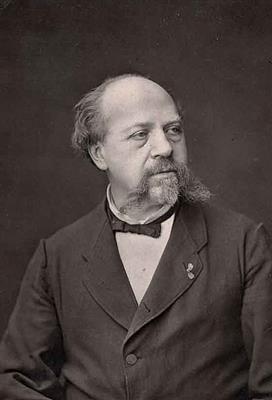
August Friedrich Schenck was born in Glückstadt, Holstein, on 23 April 1828[1], then under Danish rule. His route to painting was roundabout: he spent years as a wine traveller across Germany, Russia, and Portugal before committing to art. He trained under Léon Cogniet at the École des Beaux-Arts in Paris and made his public debut at the Paris World Exhibition in 1855[1]. By 1862 he had settled in Écouen, the village north of Paris that had become a colony for landscape and animal painters.
Within that milieu he carved out a specialism in farm animals, particularly sheep, painted with careful attention to their posture and emotional state. At his peak he shared the market for large-scale animal subjects with Rosa Bonheur and was considered among the most sought-after painters in the genre. His approach was consistently elegiac: where Bonheur celebrated animal power and energy, Schenck returned again and again to vulnerability and loss.
His painting of a flock caught in a blizzard, known as Lost, entered the Metropolitan Museum of Art in New York. He was awarded the Legion of Honour in 1885[1] and died in Écouen on 1 January 1901[1]. The town renamed a street in his honour five years later.
Timeline
- 1828Born in Glückstadt, Holstein on 23 April, which was then under Danish rule.
- 1855Made his public debut at the Paris World Exhibition.
- 1862Settled in Écouen, a village north of Paris known as a colony for painters of animals and the countryside.
- 1878Painted "Anguish", depicting a ewe standing over her dead lamb in the snow.
- 1880The National Gallery of Victoria in Melbourne acquired "Anguish".
- 1885Awarded the Legion of Honour.
- 1901Died in Écouen on 1 January at 72 years old.
Notable Works
Tap to view larger.
Next stop
Browse the movements →
Every movement in the collection, from the Renaissance to Pop art.
Related Artists


Frequently Asked Questions
What is August Friedrich Schenck known for?
August Friedrich Schenck is known for his paintings of farm animals, particularly sheep, with attention to their posture and emotional state. He specialised in these subjects within the Écouen art colony north of Paris.What is August Friedrich Schenck's most famous work?
Although August Friedrich Schenck produced many paintings, he is best known for "Anguish" (also known as "Sorrow"), completed in 1878[1]. The painting depicts a flock of sheep huddled together in a snow-filled field. A dead lamb lies on its back in the centre. The composition and subject matter evoke feelings of despair and loss. Schenck was born in Glückstadt, Holstein, in 1828[1] and studied in Paris. He specialised in animal painting, and his works often presented animals in emotional situations. "Anguish" is one such example; its stark depiction of the harsh realities of nature resonated with viewers. The painting's success cemented Schenck's reputation. He continued to paint scenes of animal life until his death in 1901[1]. Other works include "The Shepherd's Grief".What should I know about August Friedrich Schenck's prints?
August Friedrich Schenck (1828[1]-1901[1]) was a painter, best known for his works featuring sheep. He was born in Glückstadt, Holstein, and studied in Paris. Schenck spent most of his career in France. His prints often relate to his paintings, repeating similar compositions. Schenck's style is associated with realism and animal painting. His compositions frequently evoke sentimental or allegorical themes, such as loss, motherhood, or the vagaries of fate. His most well-known work, *Anguish* (1878[1]), depicts a ewe standing over the body of a lamb, menaced by crows. This painting exists in several versions and was widely reproduced as a print. Schenck's prints would appeal to collectors interested in animal subjects or in sympathetic depictions of rural life.What style or movement did August Friedrich Schenck belong to?
August Friedrich Schenck is associated with the Naturalist movement. Naturalism emerged in the late 19th century, particularly flourishing from approximately 1870[1] to 1890. It was a development of Realism, and it sought to depict subjects, particularly everyday life, with accuracy and without idealisation. Naturalism, as a broader artistic and literary tendency, aimed to portray life as it is, often focusing on the harsh realities and social issues of the time. It was influenced by scientific thought and sociological observation. The Naturalist style is characterised by its attention to detail, objective representation, and often a focus on the working classes or rural settings. In Germany, Realism and Naturalism were significant artistic movements; Munich and Dachau became centres for artists working *en plein air* (outdoors).What techniques or materials did August Friedrich Schenck use?
August Friedrich Schenck was a painter, so he would not have used techniques such as woodcut, etching, or lithography; these are graphic techniques used in printmaking. Etching uses an etching-needle, a pointed metal tool, to bore into a smooth copper plate. Woodcut uses a metal plane on a wood plate. Lithography is a third graphic technique. For sculptures, techniques include bronze casting, where molten zinc is poured into bronze moulds. Excess molten zinc is immediately poured back out, leaving a layer of zinc. This process allows for many copies to be made that retain fine details from the bronze moulds. Sand moulds might have been remade for each casting. Stamping ornaments from sheet zinc was discovered in France in 1849[1] and was common by 1865. Dies were made from plaster models, with the lower die of cast zinc and the upper die of lead. The metal was heated, then placed between the dies and smashed into shape with a drop hammer.When did August Friedrich Schenck live and work?
August Friedrich Schenck was born on 23 April 1828[1] in Glückstadt, Holstein. He died on 1 January 1901[1] in Écouen, Val-d'Oise. Schenck was a painter of animals and figures, and he is associated with the École de Écouen, a group of artists who worked in the French countryside. Schenck studied in Paris with Léon Cogniet, a painter of historical subjects and portraits. He began exhibiting at the Paris Salon in 1855[1]. His paintings often depicted scenes of sheep in distress, such as "Moutons égarés" (Lost Sheep), a work that brought him considerable attention. Schenck spent much of his career in France, becoming a naturalised citizen. He is best known for his emotional and sometimes sentimental depictions of animals, particularly sheep, in settings that evoke feelings of loneliness and vulnerability. His work was popular during his lifetime, and it can be found in museum collections in Europe and elsewhere.Where can I see August Friedrich Schenck's work?
It is difficult to pinpoint exactly where August Friedrich Schenck's works are currently held, as many are in private collections. However, some pieces can be found in public museums. In Germany, you might find his work at the Kunsthalle in Bremen, the Ludwig Museum or Wallraf-Richartz Museum in Cologne, the Folkwang Museum in Essen, or the Kunsthalle in Hamburg. Other German locations include the Nationalgalerie in Berlin, the Von der Heydt Museum in Wuppertal, and the Niedersachsisches Landesmuseum in Hanover. Outside of Germany, Schenck's art has been located in museums such as the Metropolitan Museum of Art in New York, the Los Angeles County Museum of Art, and the Royal Ontario Museum in Toronto. These are just a few places where his work may be viewed; checking museum catalogues directly is advisable for the most up-to-date information.Where was August Friedrich Schenck from?
August Friedrich Schenck was German. Karl Friedrich Schinkel, a well-known German architect of the 18th and 19th centuries, was born in Prussia, in the province of Brandenburg, near Poland. Arthur Schopenhauer, the German philosopher, was born in Danzig, now in present-day Poland, to a wealthy German family. When the city came under Prussian control in 1793, his family relocated to Hamburg. Christian Daniel Rauch, a sculptor, was born in Arolsen, the Residenz town of the principality of Waldeck, near Kassel. These examples show that many artists who are considered German were born in areas that are now part of other countries, or in small principalities that later became part of a unified Germany.Who did August Friedrich Schenck influence?
It is difficult to identify specific artists who were directly influenced by August Friedrich Schenck. Schenck painted sentimental scenes of animal life, particularly sheep. He had a long and successful career, exhibiting frequently at the Paris Salon. His work was popular with the public, and he achieved commercial success. However, he was not associated with any particular school or movement, and his art did not attract much critical attention. Some scholars suggest Schenck's work, along with that of Abraham Mignon, was imitated up to the Biedermeier period in the late nineteenth century. Others suggest that Johann Heinrich Schonfeld had many followers in southern Germany. Karl Schmidt-Rottluff's early work was under the influence of Neo-Impressionism. Egon Schiele admired van Gogh and Toulouse-Lautrec and was influenced by Munch and Hodler.Who influenced August Friedrich Schenck?
Without more specific information, it is difficult to say exactly who influenced August Friedrich Schenck. However, some general artistic movements and individual artists can be mentioned in relation to possible influences. Schenck was active during a time when artists often drew inspiration from earlier masters and contemporary trends. Academic training in the 19th century typically involved studying the works of celebrated artists from the Renaissance and Baroque periods. Artists such as David Teniers the Younger and Jan Fyt may have been of interest. The art of Schenck's contemporaries, such as Théodore Géricault, could also have played a role in the development of his style and subject matter. Without more specific biographical information, it is difficult to provide a more detailed answer.What was August Friedrich Schenck's art style?
August Friedrich Schenck's approach was consistently elegiac. Where Rosa Bonheur celebrated animal power, he returned again and again to vulnerability and loss.
Sources
Editorial draws on the following primary and tertiary references for August Friedrich Schenck.
- [1] wikipedia Wikipedia: August Friedrich Schenck Used for: biography, birth dates, death dates, identifiers, movement attribution, nationality.
- [2] book Penny Olsen, Collecting Ladies: Ferdinand Von Mueller and Women Botanical Artists Used for: biography, stylistic analysis.
- [3] book guggenheim-expger00neug Used for: biography.
- [4] book Palmer, Allison Lee, Historical Dictionary of Neoclassical Art and Architecture Used for: biography.
- [5] book Masterpieces of western art : a history of art in 900 individual studies from the Gothic to the present day Used for: biography.
Editorial overseen by Solis Prints. Sources verified 2026-09-30. Click a source for details, or hover over [N] in the page above to preview.
Editorial standardsMethodologyCorrectionsAI disclosureAbout the editorial team