

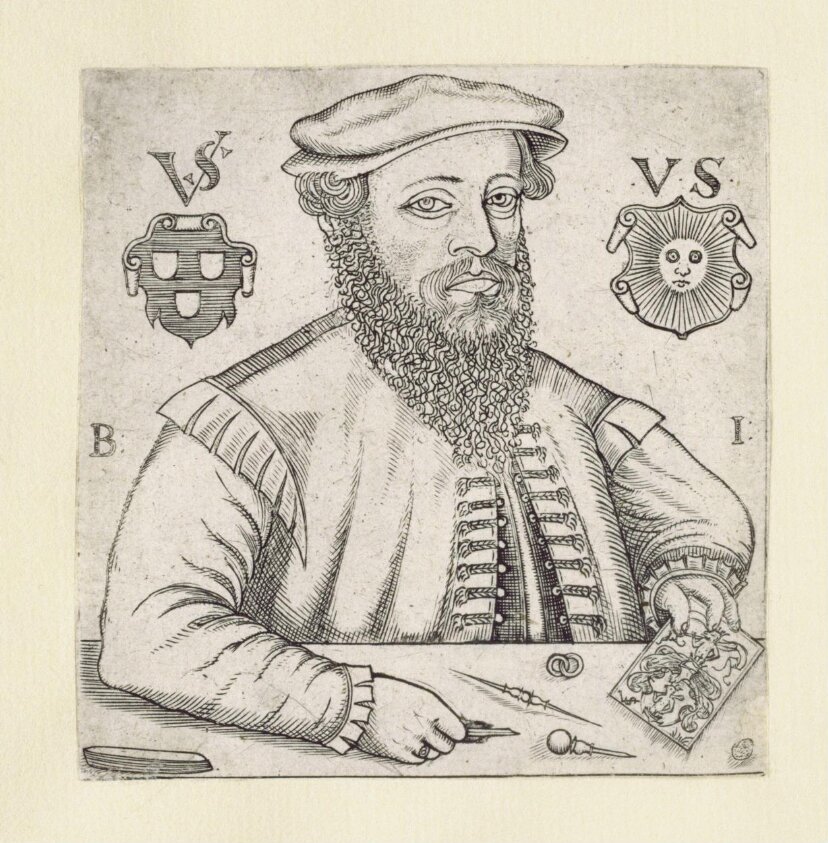


Balthasar Jenichen
Balthasar Jenichen lived for over a century, a rare feat in sixteenth-century Nuremberg. He worked as an engraver and goldsmith during a period when the city was a major centre for metalwork and print production. While many of his contemporaries focused on religious scenes, Jenichen became a specialist in capturing the likenesses of his peers. He even produced a portrait of Virgil Solis, the artist whose workshop and style influenced much of his early output.
Biography
His artistic approach relied on the precision of the burin and the clarity of the etched line. Jenichen often depicted figures of authority, including the Duke of Alva and Philip II of Spain. His work extends beyond European subjects to include the Equestrian Portrait of Sultan Selim II. This interest in foreign leaders suggests a curiosity about the wider world that went beyond local German politics. He also produced heraldic designs, such as the Coat of Arms of Saxony, which required a strict adherence to formal rules.
Modern collectors appreciate these prints for their factual recording of Renaissance dress and social status. The small dimensions of his engravings allow for detailed study at a close range. These works provide a direct connection to the Reformation era through portraits of figures like Johannes Agricola. Because Jenichen focused on specific individuals and clear heraldry, his prints remain legible and decorative in contemporary interiors.
Notable Works
Tap to view larger.
Next stop
Browse the movements →
Every movement in the collection, from the Renaissance to Pop art.
Related Artists


Frequently Asked Questions
When was Balthasar Jenichen born?
Balthasar Jenichen was born in 1505 and died in 1621.What is Balthasar Jenichen known for?
Balthasar Jenichen is known for balthasar Jenichen was a Nuremberg engraver and goldsmith known for his precise portraits of sixteenth-century European leaders and Reformation figures.