



![[Unkown] by Balthasar van der Ast](https://cdn.shopify.com/s/files/1/0833/9292/1935/files/artwork-balthasar-van-der-ast-unkown.jpg?width=480)


Balthasar van der Ast
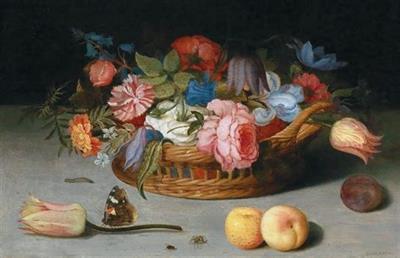
When Balthasar van der Ast arrived in Delft in 1632[2], he had spent two decades refining an approach to still life that his teacher, and brother-in-law, Ambrosius Bosschaert the Elder had pioneered in Middelburg. Bosschaert's method was essentially taxonomic: each flower, fruit, shell, or insect rendered as a discrete entity, the whole composition a careful sum of its parts. Van der Ast's departure was significant. He subordinated the individual elements to the whole, adding what the art historian John Michael Montias described as "a more painterly touch" to his teacher's linear precision.
Biography
Born in Middelburg, Zeeland, around 1594[2], van der Ast trained in the city that had become a Protestant refuge after the fall of Antwerp in 1585. Middelburg was also a centre of the Dutch[2] East India Company, which meant that exotic shells from the Indo-Pacific were available to study, and paint, long before they reached painters elsewhere in the Netherlands. After moving to Utrecht in 1619[2], he settled in Delft in 1632, where he produced the shell paintings for which modern connoisseurs most prize his work.
These late compositions have a quality distinct from the hard-edged botanical precision of the Bosschaert school. Conches and spiral forms are laid out on reddish-brown tablecloths in palettes of subdued pinks, browns, and pearly greys, lit by diffused, even light rather than the sharp dramatic contrasts favoured elsewhere in Dutch[2] still life. Where contemporaries such as Jan Baptista van Fornenburgh used similar subjects to invoke the transience of life, van der Ast's approach was more frankly decorative, a choice that reads, in retrospect, as compositional confidence rather than philosophical restraint.
He died in Delft in 1657[2]. The shell paintings remain among the most technically demanding and visually distinctive works produced in the Dutch[2] Golden Age tradition.
Timeline
- 1594Born in Middelburg, Zeeland.
- 1619Moved to Utrecht.
- 1632Moved to Delft, where he produced shell paintings.
- 1632Arrived in Delft and refined his still life approach, influenced by Ambrosius Bosschaert the Elder.
- 1657Died in Delft.
Notable Works
Tap to view larger.
Where to See Balthasar van der Ast
1 museum worldwide.
-
 2 works
Temple Newsam
Leeds, United Kingdom
House: Tue–Sun 10:30–17:00; Home Farm: daily 10:00–17:00; Play Barn: daily 09:00–17:00 · £10.50 adults (House only), £9.00 adults (Home Farm only), £17.55 adults (Joint)
Next stop
Baroque →
Explore the artists and ideas of Baroque.
Related Artists


Frequently Asked Questions
What is Balthasar van der Ast known for?
Balthasar van der Ast is known for his shell paintings, particularly those produced after he settled in Delft in 1632[2]. Modern connoisseurs especially prize these late compositions, which have a quality distinct from the hard-edged botanical precision of the Bosschaert school.What was Balthasar van der Ast's art style?
Balthasar van der Ast's art style involved subordinating individual elements to the whole, adding what John Michael Montias described as "a more painterly touch" to his teacher's linear precision. His compositions featured conches and spiral forms laid out on reddish-brown tablecloths in palettes of subdued pinks, browns, and pearly greys, lit by diffused, even light.How did Balthasar van der Ast die?
Balthasar van der Ast died in 1657[2] at the age of 63.
Sources
Editorial draws on the following primary and tertiary references for Balthasar van der Ast.
- [1] museum Temple Newsam Used for: museum holdings.
- [2] wikipedia Wikipedia: Balthasar van der Ast Used for: biography, birth dates, death dates, identifiers, movement attribution, nationality.
- [3] book John Michael Montias, Vermeer and His Milieu _ A Web of Social History Used for: biography, stylistic analysis.
- [4] book John Michael Montias, Vermeer and His Milieu _ A Web of Social History Used for: biography, stylistic analysis.
- [5] book John Michael Montias, Vermeer and His Milieu _ A Web of Social History Used for: biography, stylistic analysis.
Editorial overseen by Solis Prints. Sources verified 2026-09-22. Click a source for details, or hover over [N] in the page above to preview.
Editorial standardsMethodologyCorrectionsAI disclosureAbout the editorial team