



Barbara Jones-Hogu
- Black Aesthetic
In 1967[1], Barbara Jones-Hogu contributed to the Wall of Respect on Chicago's South Side, the first collective street mural in the United States. Two years later, she helped found AFRICOBRA, the African Commune of Bad Relevant Artists, alongside Jeff Donaldson, Wadsworth Jarrell, Jae Jarrell, and Gerald Williams. The group became one of the most politically engaged art collectives to emerge from the Black Arts Movement.
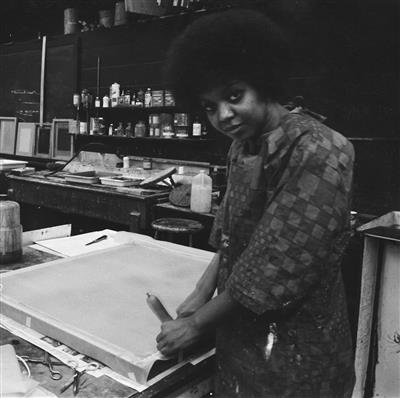
Biography
Within AFRICOBRA, Jones-Hogu was as much theorist as practitioner. Her 1973[1] statement of aesthetic principles remains one of the clearest articulations of the group's visual philosophy: figures must be frontal and direct to stress strength and directness; lettering should be integrated into the composition as a visual element rather than a headline; the image must identify problems and offer solutions. Her five formal principles, including free symmetry (syncopated rhythmic repetition) and mimesis at midpoint (the exact point between abstraction and naturalism), drew on parallels with Yoruba art criticism identified by scholar Robert Farris Thompson.
Her printed works from the late 1960s and early 1970s combine bold colour, repeated text, and figurative imagery in a mode closer to agitprop than fine-art printmaking. Unite (1969[1], revised 1971), partly inspired by the Black Power salute at the 1968 Olympics, entered the collection of the Tate Modern. Relate to Your Heritage (1971), a large-format screenprint, is held at the Brooklyn Museum. Around 1973, she switched from painting to printmaking after paint fumes affected her son's health, and later opened her own print shop.
Jones-Hogu taught printmaking for decades. Her first solo museum retrospective was held at the DePaul Art Museum in Chicago in 2018, the year after her death. Work from her estate is held at the Art Institute of Chicago, the Brooklyn Museum, and the National Museum of African American[1] History and Culture.
Timeline
- 1938Born in 1938.
- 1967Contributed to the Wall of Respect on Chicago's South Side.
- 1969Helped found AFRICOBRA (African Commune of Bad Relevant Artists) with Jeff Donaldson, Wadsworth Jarrell, Jae Jarrell, and Gerald Williams.
- 1969Created "Unite", partly inspired by the Black Power salute at the 1968 Olympics.
- 1971Revised "Unite".
- 1971Created the screenprint "Relate to Your Heritage".
- 1973Published a statement of aesthetic principles for AFRICOBRA.
- 1973Switched from painting to printmaking due to her son's health.
- 2017Died in 2017.
- 2018Her first solo museum retrospective was held at the DePaul Art Museum in Chicago.
Notable Works
Tap to view larger.
Next stop
Browse the movements →
Every movement in the collection, from the Renaissance to Pop art.
Related Artists
_%E2%80%93_LOC.jpg)



Frequently Asked Questions
What is Barbara Jones-Hogu known for?
Barbara Jones-Hogu is known for helping to found AFRICOBRA, one of the most politically engaged art collectives to emerge from the Black Arts Movement. She was also known for her 1973[1] statement of aesthetic principles, which articulated the group's visual philosophy. Her printed works from the late 1960s and early 1970s combined bold colour, repeated text, and figurative imagery.Who was Barbara Jones-Hogu?
Barbara Jones-Hogu was an artist who contributed to the Wall of Respect in Chicago and helped found AFRICOBRA, the African Commune of Bad Relevant Artists. She was a theorist as well as a practitioner within AFRICOBRA. Her 1973[1] statement on aesthetic principles is one of the clearest articulations of the group's visual philosophy.How did Barbara Jones-Hogu die?
Barbara Jones-Hogu died in 2017[1] at the age of 79.
Sources
Editorial draws on the following primary and tertiary references for Barbara Jones-Hogu.
- [1] wikipedia Wikipedia: Barbara Jones-Hogu Used for: biography, birth dates, death dates, identifiers, movement attribution, nationality.
- [2] book guggenheim-19artistsemergen00solo Used for: biography.
- [3] book guggenheim-refigur00kren Used for: biography.
- [4] book Unknown, Reclaiming female agency : feminist art history after postmodernism Used for: biography.
- [5] book Hodge, Susie, 1960- author, The short story of women artists : a pocket guide to movements, works, breakthroughs, & themes Used for: biography.
Editorial overseen by Solis Prints. Sources verified 2026-09-30. Click a source for details, or hover over [N] in the page above to preview.
Editorial standardsMethodologyCorrectionsAI disclosureAbout the editorial team