



Bartholomeus Spranger
- Northern Mannerism
The mythological paintings Bartholomeus Spranger produced for Rudolf II at Prague Castle are among the most self-consciously sensual works of the sixteenth century. Born in Antwerp on 21 March 1546[1], he trained under Jan Mandijn and Cornelis van Dalem before heading south through France and into Italy, working in Milan, Parma (briefly assisting Bernardino Gatti), and Rome, where Giulio Clovio became his patron. Pope Pius V appointed him court painter in 1570[1], an appointment that announced his arrival at the highest level of European patronage.
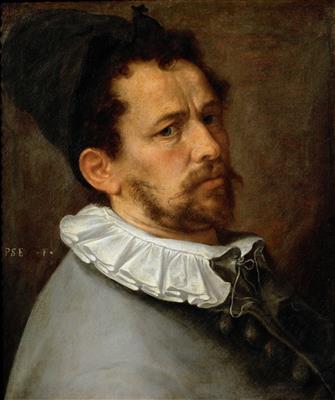
Biography
Rudolf II, who had retreated to the Hradschin in Prague to live among astrologers, alchemists, and artists, required exactly the kind of painting Spranger excelled at: mythological scenes charged with elegant eroticism, figures smoothly modelled with elongated proportions, a nude seen from behind posed against elaborate drapery and landscape. Works such as Hercules, Deianira and the Centaur Nessus and Mercury Carrying Psyche to Mount Olympus are quintessential examples of Northern Mannerism[1] pushed to its furthest refinement. Rudolf bestowed a coat of arms on him in 1588[1] and hereditary status in 1595, recognition that he was not merely a court employee but a central ornament of the imperial collection.
His influence spread rapidly beyond Prague through the prints of Hendrik Goltzius and Aegidius Sadeler, which carried his style to the Dutch[1] Republic and across northern Europe. The art historian Arnold Hauser, writing of the Prague circle, described Rudolf's patronage as driven by 'aesthetic hedonism' rather than political display, and Spranger's paintings embody that description more fully than those of any other artist at the court. He died in Prague on 27 June 1611[1], having spent thirty years defining the visual culture of one of Europe's most unusual courts.
Timeline
- 1546Born in Antwerp on 21 March.
- 1546Trained under Jan Mandijn.
- 1546Trained under Cornelis van Dalem.
- 1546Briefly assisted Bernardino Gatti in Parma.
- 1570Appointed court painter by Pope Pius V in Rome.
- 1588Rudolf II bestowed a coat of arms on him.
- 1595Granted hereditary status by Rudolf II, recognising his importance to the imperial collection.
- 1611Died in Prague on 27 June, after 30 years defining the court's visual culture; he was 65.
Notable Works
Tap to view larger.
Next stop
Browse the movements →
Every movement in the collection, from the Renaissance to Pop art.
Bartholomeus Spranger prints
Hand-finished archival prints from Bartholomeus Spranger's body of work.


Related Artists


Take Bartholomeus Spranger home.
See all Bartholomeus Spranger prints →Frequently Asked Questions
What is Bartholomeus Spranger known for?
Bartholomeus Spranger is known for his mythological paintings, especially those he produced for Rudolf II at Prague Castle. These paintings are sensual and feature elegant eroticism, smoothly modelled figures with elongated proportions, and nudes posed against elaborate drapery and landscapes.What is Bartholomeus Spranger's most famous work?
It is difficult to name one single work as Bartholomeus Spranger's most famous. He produced a large number of paintings, drawings, and prints, many of which exist in multiple versions or were part of larger series. Rubens's collection includes many works with similar titles, such as multiple versions of *The Last Supper*, *The Resurrection of Christ*, *The Raising of the Cross*, *The Three Graces*, *Venus and Adonis*, and *Virgin and Child*. Other frequently recurring subjects in his paintings are *The Triumph of the Church*, *The Union of Earth and Water*, and various depictions of the Holy Family with saints. Some of his well-known mythological subjects include *Venus Frigida*, and *The Abduction of Ganymede*.What should I know about Bartholomeus Spranger's prints?
Bartholomeus Spranger, born in Antwerp in 1546[1], was a painter and print designer. He is associated with Northern Mannerism[1], a style popular in the late 16th century. Spranger's prints often served as a means of disseminating his artistic ideas. Printmaking allowed his compositions to reach a wider audience. Many of his prints were produced by Aegidius Sadeler, a prominent engraver who worked closely with Spranger. Sadeler's skill helped translate Spranger's designs into detailed and refined prints. These prints frequently feature mythological and allegorical subjects, characterised by elongated figures and dynamic poses. Spranger's style is also marked by a certain sensuality and dramatic use of light and shadow. His prints are considered important examples of the late Mannerist style, reflecting the artistic tastes of the Habsburg court, where Spranger served as court painter to Rudolf II in Prague.What style or movement did Bartholomeus Spranger belong to?
Bartholomeus Spranger (1546[1]-1611[1]) was a Flemish artist associated with the Mannerist style. Mannerism, which flourished as a style, is characterised by self-conscious poses and suave gestures. Spranger was born in Antwerp and travelled in Italy and France early in his career. He later worked in Vienna before settling in Prague. In 1581[1], he became court painter to Emperor Rudolf II. He also exerted considerable influence on the Academy of Haarlem. His work, such as *Vulcan and Maia*, possesses an erotic charge. The figures are arranged in complex poses, typical of Mannerist aesthetics. While the art of Fontainebleau had an aristocratic innocence, Mannerism north of the Alps took on a more sinister quality in the hands of Spranger and his followers.What techniques or materials did Bartholomeus Spranger use?
Bartholomeus Spranger (1546[1]-1611[1]) was a Flemish painter, draughtsman, and printmaker. He is associated with Northern Mannerism[1], a style characterised by elongated figures in exaggerated poses. Spranger's paintings often feature mythological and allegorical subjects. He worked primarily in oil paint, building up layers of colour to create a smooth, polished surface. His application of paint is often described as enamel-like. Spranger was skilled at rendering the human form, paying close attention to anatomy and musculature. His figures often have a sculptural quality, as if they were carved from marble. Spranger was also a prolific draughtsman. He produced numerous drawings in pen and ink, chalk, and watercolour. Many of these drawings were preparatory studies for his paintings, while others were independent works of art. His drawings are characterised by their fluid lines and dynamic compositions. He also designed prints, which were produced by printmakers such as Hendrik Goltzius. These prints helped to disseminate Spranger's style throughout Europe.What was Bartholomeus Spranger known for?
Bartholomeus Spranger (1546[1]-1611[1]) was a Flemish painter, draughtsman, and printmaker. He is associated with Northern Mannerism[1]. His style combines Netherlandish realism with Italian influences. Spranger trained in Antwerp, and then in Paris. By 1565[1], he was working in Italy. He spent time in Milan, Parma, and Rome. In Rome, he became part of the circle of artists working for Pope Pius V. Giorgio Vasari recommended him to the Pope. Spranger produced designs for the Vatican. In 1575, he travelled to Vienna to work for Emperor Maximilian II. After Maximilian's death, Spranger continued as court painter for Rudolf II in Prague. Prague became a major centre of Mannerist art during Rudolf's reign. Spranger was ennobled in 1595. His paintings often feature mythological and allegorical subjects. These works are characterised by elongated figures, complex compositions, and a polished finish. Spranger's drawings were highly valued. Many were made as preparatory studies for paintings. Others were independent works of art. He also produced designs for engravings, which helped to disseminate his style.When did Bartholomeus Spranger live and work?
Bartholomeus Spranger was born in Antwerp in 1546[1]. He died in Prague in 1611[1]. Spranger's documented artistic activity occurred mainly from the 1560s to the early 1600s. Spranger was admitted to the Academy of Drawing in Florence in 1565[1]. He is recorded as being 25 years old at this time. Spranger travelled widely. In 1565, he negotiated unsuccessfully for a commission to decorate the end wall of the Sala del Gran Consiglio in the Ducal Palace, Venice. He travelled to France and the Netherlands around 1574, and by March 1575 he was in England. He painted portraits of Queen Elizabeth I and the Earl of Leicester, and copied Holbein frescoes. He painted a high altar, flanking reliquary altars, and frescoes in the cloister of the Evangelists, S. Lorenzo, El Escorial, for Phillip II of Spain from 1585 to 1588.Where can I see Bartholomeus Spranger's work?
Bartholomeus Spranger's paintings and drawings can be found in several major European collections. Spranger spent much of his career as court painter to Rudolf II in Prague, so the Kunsthistorisches Museum in Vienna, which absorbed many Habsburg collections, holds a good selection of his work. Other significant holdings are located in the Louvre Museum, Paris; the Rijksmuseum, Amsterdam; and the National Gallery, London. Germany also has several important works by Spranger, for instance at the Alte Pinakothek in Munich. Smaller collections can be found in various museums across Europe and North America. These include the Metropolitan Museum of Art in New York, the Art Institute of Chicago, and the National Gallery of Art in Washington, D.C. University art museums, such as the Princeton University Art Museum, also occasionally hold prints or drawings by the artist. It is always advisable to check museum websites for current exhibitions and collection information before planning a visit.Where was Bartholomeus Spranger from?
Bartholomeus Spranger was born in Antwerp in 1546[1]. Antwerp was then a commercial centre in the Habsburg Netherlands, a region that corresponds to modern Belgium. Spranger's early artistic training occurred in Antwerp workshops. These included those of Frans Mostaert and Cornelis van Dalem. He travelled to Paris in 1565[1], then on to Italy. He spent time in Milan, Parma, and Rome. In Rome, he became associated with the circle of artists working under the direction of Federico Zuccari. Spranger's time in Italy was formative. He studied classical art and the work of Italian masters, developing his signature style. This style combined elements of Mannerism with a Northern European sensibility. In 1575, Spranger accepted a position as court painter to Maximilian II in Vienna. He later moved to Prague, becoming a central figure in the court of Rudolf II. He remained in Prague until his death in 1611[1]. Although he spent much of his career outside his place of birth, his origins in Antwerp remained an important part of his artistic identity.Who did Bartholomeus Spranger influence?
Bartholomeus Spranger (1546[1]-1611[1]) began his career studying with Netherlandish artists. Frans Floris's home in Antwerp set a precedent for other Netherlandish artists, including Spranger. Floris's workshop attracted many artists from both the Northern and Southern Netherlands, as well as at least one German artist, all of whom were influenced by his style. Some of these artists include Anthonis Blocklandt and Isaac van Swanenburgh, who continued to reference Floris’s style in their own work and instruction. Van Swanenburgh's student, Otto van Veen, carried Floris’s example into the seventeenth century; van Veen then taught Peter Paul Rubens. Other artists influenced by Floris include Frans Francken, Pieter Pourbus, and Frans Pourbus the Elder. Many members of Floris's workshop travelled to France, finding employment and becoming important artists in the so-called second school of Fontainebleau and in the Parisian art market.Who was Bartholomeus Spranger?
Bartholomeus Spranger (1546[1]-1611[1]) was a Flemish painter, draughtsman, and print designer. He is associated with the Mannerist style. Spranger was born in Antwerp. He travelled extensively early in his career. He studied with painters in Antwerp and Haarlem before a journey south in 1565[1]. He worked in Paris, then Lyon. By 1566, he was in Milan, where he obtained a position with Giulio San Giulio. He relocated to Rome in 1570. There, he entered the service of Pope Pius V, and later worked for Cardinal Alessandro Farnese. These Italian sojourns exposed him to Italian Mannerism, which shaped his mature aesthetic. In 1580, Spranger was called to Prague by Rudolf II, Holy Roman Emperor. He became court painter. Rudolf II's court was a major centre for Mannerist art. Spranger produced paintings, drawings and designs for prints. His work influenced other artists working for Rudolf. These included Joseph Heintz the Elder, Hans von Aachen, and Aegidius Sadeler. Spranger remained in Prague until his death in 1611, a highly regarded figure in artistic circles.Why are Bartholomeus Spranger's works important today?
Bartholomeus Spranger (1546[1]-1611[1]) was a Flemish painter, draughtsman, and print designer. He is important to art history because of his role in developing Northern Mannerism[1], particularly in Prague during the reign of Rudolf II. Spranger's style is characterised by elongated figures, complex compositions, and erotic undertones. His work combined elements of Italian Mannerism with Northern European traditions. He initially trained in Antwerp and Paris, then travelled to Italy, where he studied the works of Parmigianino and other Mannerist artists. This Italian experience was formative. Appointed court painter to Rudolf II in 1580[1], Spranger produced paintings, drawings and designs for prints that influenced artists across Europe. Rudolf's patronage allowed Spranger to experiment and develop his distinctive style. His mythological and allegorical scenes, such as "Venus and Adonis" (1585), became highly sought after. Spranger's influence extended beyond painting. His drawings were widely circulated as engravings, disseminating his Mannerist aesthetic. Although his reputation declined after his death, recent scholarship has recognised his contribution to the development of late 16th-century art. His works offer insight into the intellectual and artistic climate of Rudolfine Prague, a centre of European culture.
Sources
Editorial draws on the following primary and tertiary references for Bartholomeus Spranger.
- [1] wikipedia Wikipedia: Bartholomeus Spranger Used for: biography, birth dates, death dates, identifiers, movement attribution, nationality.
- [2] book Lassaigne, Jacques, 1910-, Flemish painting Used for: biography.
- [3] book STBGD Trusted, Flemish Painting - From Hieronymus Bosch to Rubens (Art Ebook) Used for: biography.
- [4] book Mark Lamster, Master of shadows Used for: biography, stylistic analysis.
- [5] book Beckett, Wendy, The story of painting Used for: stylistic analysis.
Editorial overseen by Solis Prints. Sources verified 2026-10-12. Click a source for details, or hover over [N] in the page above to preview.
Editorial standardsMethodologyCorrectionsAI disclosureAbout the editorial team