



Barton Lidice Benes
When Barton Lidice Benes exhibited his "Lethal Weapons" series in Lund, Sweden in 1990[1], the eight shadow boxes containing weapons mixed with his own HIV-positive blood had to be sterilised at 160 degrees in a hospital oven before the show could open. The incident captures his practice precisely: work that was formally controlled and biologically charged, made by an artist who had been living with an AIDS diagnosis since 1986.
Biography
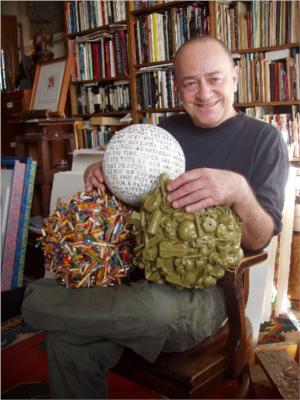
Born in Hackensack, New Jersey on 16 November 1942[1], Benes was the son of Bohemian immigrants; his middle name Lidice referred to the Czech village destroyed by the Nazis that same year. He studied at Pratt Institute in Brooklyn and the Ecole des Beaux-Arts in Avignon, and as a teenager had made the US Olympic speed skating team. His first exhibition in 1969[1] was characteristically confrontational: in "Leather and Lace" he appeared strapped naked to a padded leather table.
He worked in the tradition of Joseph Cornell, building shadow box assemblages from found objects, documents, and personal fragments. After his partner Howard Meyer died from Kaposi's Sarcoma in the late 1980s, grief and mortality became the explicit subjects of his work. A three-metre hourglass combined the ashes of two deceased friends, binding them together permanently. Books nailed shut protested censorship; correspondence from his aunt was transformed into small bound volumes.
Benes served on the board of Visual AIDS from 2003[1] to 2009. His New York apartment, which contained a collection valued at over a million dollars, was reconstructed as "Barton's Place" at the North Dakota Museum of Art after his death in New York City on 30 May 2012[1].
Timeline
- 1942Born in Hackensack, New Jersey, on 16 November. His parents were Bohemian immigrants, and his middle name referred to Lidice, the Czech village destroyed by the Nazis that year.
- 1969Held his first exhibition, "Leather and Lace", in which he appeared strapped naked to a padded leather table.
- 1986Was diagnosed with AIDS.
- 1990Exhibited his "Lethal Weapons" series in Lund, Sweden. The shadow boxes contained weapons mixed with his HIV-positive blood.
- 2003Served on the board of Visual AIDS until 2009.
- 2012Died in New York City on 30 May, aged 69.
- 2012His New York apartment, containing a collection valued at over a million dollars, was reconstructed as "Barton's Place" at the North Dakota Museum of Art after his death.
Notable Works
Tap to view larger.
Next stop
Browse the movements →
Every movement in the collection, from the Renaissance to Pop art.
Related Artists
_%E2%80%93_LOC.jpg)



Frequently Asked Questions
What is Barton Lidice Benes known for?
Barton Lidice Benes is known for his shadow box assemblages created from found objects, documents, and personal fragments. After his partner died in the late 1980s, his art explicitly addressed grief and mortality. One of his works combined the ashes of two deceased friends in a three-metre hourglass.What is Barton Lidice Benes's most famous work?
Barton Lidice Benes is best known for his altered books and artworks incorporating unusual materials, but determining a single 'most famous work' is difficult. His art often blends personal history, humour, and critique. Benes's work frequently incorporates found objects, altered books, and ephemera. In contrast, Pablo Picasso's 1937 painting *Guernica* is widely recognised. Picasso created it in response to the bombing of Guernica, a Basque town in Spain, during the Spanish Civil War. The Spanish Republican government commissioned Picasso to produce a mural for the Paris Exhibition that summer. After reading a newspaper account of the bombing, he abandoned his original concept. He painted *Guernica* in black, white, and grey, reflecting the newsprint through which he learned of the event. The painting became a powerful political statement. It was exhibited internationally, drawing attention to the Spanish Civil War.What should I know about Barton Lidice Benes's prints?
Barton Lidice Benes (1942[1]-2012[1]) produced prints as part of his wider artistic practice. When considering Benes's prints, it is useful to understand some basic printmaking terminology. An "original print" is conceived as a print and executed solely as a print, often in a numbered edition, and signed by the artist. Each impression in the edition is an original, printed from a plate, stone, screen, or block created for that purpose. The artist inks and pulls each print individually; it is a multi-original medium. The artist decides the number of prints in the edition. Numbering accounts for the number of prints in the edition; each has a specific number (for example, 12/25 means the edition is 25, and the print is number 12). A reproduction is a copy of a work of art conceived in another medium (painting or watercolour). It is usually made by photo-mechanical means. Numbering and signing a reproduction does not change its essence; it is still a reproduction, not an original print. The edition size is the choice of the artist, rather than a technical limitation of the medium. There is no inherent need to make limited editions, although most printmakers do limit their editions.What style or movement did Barton Lidice Benes belong to?
It is difficult to assign Barton Lidice Benes (1942[1]-2012[1]) to a single movement. His work often incorporated found objects and altered books, which aligns with aspects of assemblage art and appropriation art. These approaches gained prominence in the mid-20th century and continue to be relevant in contemporary art. Benes's practice of collecting and recontextualising materials also shares similarities with the broader tradition of collecting as an art form. This can be traced back centuries, with examples such as Wunderkammern (cabinets of curiosities) assembled by European royalty and scholars. These collections often blurred the lines between art, science, and history, a characteristic that resonates with Benes's eclectic and often humorous creations.What techniques or materials did Barton Lidice Benes use?
Barton Lidice Benes (1942[1]-2012[1]) was an American[1] artist known for his mixed-media constructions and collages. He frequently incorporated found objects into his work, transforming everyday items into art. Benes often employed collage techniques, combining diverse materials like postage stamps, maps, and playing cards. His works frequently included elements of wordplay and visual puns. The artist's practice involved assemblage, where three-dimensional objects were combined to create sculptures or wall-mounted pieces. Benes's materials ranged from the commonplace to the unusual. He used items such as antique bottles, buttons, and bones. These were arranged in unexpected juxtapositions. His art frequently had a satirical or humorous edge, commenting on themes of consumerism, history, and personal identity. He worked across various scales, from small, intimate works to larger, more ambitious installations.What was Barton Lidice Benes known for?
Thomas Hart Benton (1889-1975[1]) was an American[1] painter and muralist associated with the Regionalist art movement. Regionalism, which became prominent in the 1930s, focused on depictions of rural American life. Benton's early work synthesised modern art, film, and republicanism. During the Depression era, his art often critiqued what he saw as the dehumanising aspects of American life. He aimed to revive a worker-determined economy, believing corporate leadership had failed. Benton did not idealise a pre-industrial America; instead, he supported social progress through technology, tempered by American democratic values. His major murals from the 1930s include *America Today* (1930-31), *The Arts of Life in America* (1932), *A Social History of the State of Indiana* (1933), and *A Social History of the State of Missouri* (1936). These works transferred his political views into public art. In 1937, *Life* magazine commissioned Benton to create a picture of the film industry in Hollywood. He sketched scenes of movie production, from casting to set design. His painting, *Hollywood*, depicted the industry as a workplace, with American workers engaged in production. However, *Life* rejected the picture.When did Barton Lidice Benes live and work?
Barton Lidice Benes (1942[1]-2012[1]) was an American[1] artist known for his mixed-media assemblages and collages. He incorporated found objects, ephemera, and personal memorabilia into his works. These pieces often explored themes of memory, identity, and the passage of time. Benes was born in Glen Ridge, New Jersey. He studied at the Pratt Institute in New York City. After graduating, he remained in New York, establishing himself as a working artist. He became part of the city's artistic community. His work frequently incorporated elements of humour and irony. He often used unconventional materials, such as postage stamps, buttons, and fragments of antique textiles. These materials gave his art a distinctive, tactile quality. Benes's art was exhibited in galleries and museums throughout the United States. His work is held in several public collections.Where can I see Barton Lidice Benes's work?
Barton Lidice Benes's artwork can be viewed in several museums. These include institutions in the United States, Canada, and the United Kingdom. In the United States, you can find his work at the Metropolitan Museum of Art (New York), the Museum of Modern Art (New York), the Los Angeles County Museum of Art, the Minneapolis Institute of Arts, the Virginia Museum of Fine Arts (Richmond), the Charles Hosmer Morse Museum of American[1] Art (Winter Park, Florida), and the Wolfsonian at Florida International University (Miami Beach). In Canada, his work is at the Royal Ontario Museum (Toronto). In the United Kingdom, his work is held by the Victoria & Albert Museum (London), the Brighton Museum & Art Gallery, the Geffrye Museum (London), the Manchester Art Gallery, and the National Museums of Scotland Royal Museum (Edinburgh).Where was Barton Lidice Benes from?
Barton Lidice Benes (1942[1]-2012[1]) was an American[1] artist, born in Trenton, New Jersey. His family background was Czech; his father, Bohumil Benes, emigrated to the United States in 1930. Benes studied at Auburn University in Alabama, and later at the Pennsylvania Academy of the Fine Arts. His work often incorporated found objects and collage techniques. He is particularly known for creating altered books and boxes containing collections of ephemera. These constructions frequently engaged with themes of memory, personal history, and mortality. Although born in New Jersey, Benes spent a significant portion of his life in New York City. He was a fixture of the downtown art scene. His work has been exhibited in various institutions, including the Museum of Modern Art and the Whitney Museum of American Art. Benes's art reflects his personal experiences and observations, often with a distinctive sense of humour and irony.Who did Barton Lidice Benes influence?
Barton Lidice Benes (1942[1]-2012[1]) was an American[1] artist known for his mixed-media assemblages and altered books. His work often incorporated found objects, ephemera, and personal mementoes. While Benes did not have a formal teaching position, his unique artistic vision and approach to art-making have resonated with many contemporary artists. Benes's influence can be seen in artists who embrace collage, assemblage, and appropriation as methods of artistic expression. His use of everyday objects and his ability to transform them into works of art have inspired others to look at the world around them with a fresh perspective. The personal and often autobiographical nature of his art has encouraged artists to explore their own identities and experiences in their work. Although it is difficult to name specific individuals who were directly influenced by Benes, his impact can be observed in the broader art world. Many artists working today share his interest in repurposing materials, combining different media, and creating art that is both visually stimulating and conceptually engaging. His art is a demonstration of the power of imagination and the ability to find beauty in the unexpected.Who influenced Barton Lidice Benes?
Barton Lidice Benes (1942[1]-2012[1]) was an American[1] artist known for his collages and assemblages. His work often incorporated found objects, ephemera, and personal mementos. Although sources do not directly state Benes's influences, we can infer them from his artistic style and the cultural context in which he worked. His use of collage and assemblage aligns him with 20th-century movements such as Dada and Surrealism. Artists like Kurt Schwitters, with his Merz collages made from urban detritus, and Joseph Cornell, known for his shadow boxes filled with evocative objects, seem relevant to Benes's practice. Benes's interest in collecting and arranging objects also connects him to the tradition of the cabinet of curiosities, a precursor to the modern museum. These cabinets displayed diverse collections of natural and artificial objects, reflecting a desire to understand and categorise the world. The personal and often autobiographical nature of Benes's art suggests influence from artists who explored identity and memory in their work.Who was Barton Lidice Benes?
William Baziotes, born in Pittsburgh in 1912 to Greek parents, was an American[1] artist associated with Abstract Expressionism and Surrealism. He grew up in Reading, Pennsylvania, and worked at a glass company from 1931 to 1933. During this time, he took evening drawing classes and befriended poet Byron Vazakas, who introduced him to Baudelaire and Symbolist poets. Baziotes saw the Matisse exhibition at The Museum of Modern Art, New York, in 1931 and moved there in 1933 to study painting at the National Academy of Design until 1936. Baziotes exhibited in his first group show at the Municipal Art Gallery, New York, in 1936. He worked for the WPA Federal Art Project as an art teacher at the Queens Museum. By 1940, he met artists like Matta, Jimmy Ernst, and Gordon Onslow-Ford, and began experimenting with Surrealist automatism. In 1941, Matta introduced Baziotes to Robert Motherwell, with whom he formed a close friendship. Baziotes died in New York in June 1963[1]. The Solomon R. Guggenheim Museum presented a memorial exhibition of his work in 1965.
Sources
Editorial draws on the following primary and tertiary references for Barton Lidice Benes.
- [1] wikipedia Wikipedia: Barton Lidice Benes Used for: biography, birth dates, death dates, identifiers, movement attribution, nationality.
- [2] book Art, the ape of nature : studies in honor of H. W. Janson Used for: biography, stylistic analysis.
- [3] book Doss, Erika, 1956-, Benton, Pollock, and the politics of modernism : from regionalism to abstract expressionism Used for: biography, stylistic analysis.
- [4] book Doss, Erika, 1956-, Benton, Pollock, and the politics of modernism : from regionalism to abstract expressionism Used for: biography, stylistic analysis.
Editorial overseen by Solis Prints. Sources verified 2026-08-30. Click a source for details, or hover over [N] in the page above to preview.
Editorial standardsMethodologyCorrectionsAI disclosureAbout the editorial team