


![[Unkown] by Basilio Santa Cruz Pumacallao](https://cdn.shopify.com/s/files/1/0833/9292/1935/files/artwork-basilio-santa-cruz-pumacallao-unkown.jpg?width=480)
![[Unkown] by Basilio Santa Cruz Pumacallao](https://cdn.shopify.com/s/files/1/0833/9292/1935/files/artwork-basilio-santa-cruz-pumacallao-unkown_c71db5b1-12ef-43a2-bba6-90d5f3c7f1fe.jpg?width=480)
Basilio Santa Cruz Pumacallao
Among the painters of the colonial Cuzco School, Basilio Santa Cruz Pumacallao is distinguished by two things: documentary proof of his indigenous identity and a compositional energy that set him apart from his contemporaries. Born in Cusco in 1635[1] of Quechua and Ladino heritage, his origins were confirmed in the 20th century by the historian Jorge Cornejo Bouroncle, who found contracts naming him as Basilio de Santa Cruz Pumacallao with a distinctly Quechua surname. That confirmation mattered: most Cuzco School artists were presumed mestizo at best.
Biography
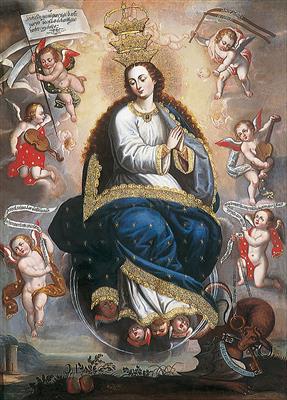
His patron was Bishop Manuel de Mollinedo, who also brought artworks from Madrid to Cusco that Santa Cruz studied directly. Access to Spanish paintings, rather than the European prints that most colonial painters worked from, distinguishes his style from that of Diego Quispe Tito, his most significant contemporary. The result was a more dynamic compositional approach, large in scale and lavish in decorative detail.
He is credited with developing the arcabuceros: angels in military dress wielding muzzle-loaded firearms, a figure unique to the Cuzco School and absent from European art of the period. The image fused Catholic iconography with the visual language of colonial military power, producing an iconographic invention with no clear European precedent.
His works are held in the Cathedral of Cusco, the Convento de San Francisco, and the Iglesia de la Merced. The Series of the Life of Saint Francis, a major studio commission, has its final painting dated 1667[1]. Santa Cruz died in 1710[1], aged approximately 74.
Timeline
- 1635Born in Cusco, of Quechua and Ladino heritage.
- 1667Completed the final painting in the Series of the Life of Saint Francis, a major studio commission.
- 1667Developed the arcabuceros, angels in military dress wielding firearms, a figure unique to the Cuzco School.
- 1710Died at approximately 74 years old.
Notable Works
Tap to view larger.
Next stop
Browse the movements →
Every movement in the collection, from the Renaissance to Pop art.
Frequently Asked Questions
What is Basilio Santa Cruz Pumacallao known for?
Basilio Santa Cruz Pumacallao is credited with developing the arcabuceros, a figure unique to the Cuzco School. These angels in military dress wield muzzle-loaded firearms, fusing Catholic iconography with the visual language of colonial military power. This iconographic invention has no clear European precedent.Who was Basilio Santa Cruz Pumacallao?
Basilio Santa Cruz Pumacallao was a painter of the colonial Cuzco School, notable for documentary proof of his indigenous identity. Born in Cusco in 1635[1], his Quechua heritage was confirmed in the 20th century. His origins set him apart, as most Cuzco School artists were only presumed to be mestizo.What was Basilio Santa Cruz Pumacallao's art style?
Basilio Santa Cruz Pumacallao's style is distinguished by a dynamic compositional approach, large in scale and lavish in decorative detail. This was due to his access to Spanish paintings, provided by his patron Bishop Manuel de Mollinedo, rather than the European prints that most colonial painters worked from. This access distinguished his style from that of his contemporary, Diego Quispe Tito.How did Basilio Santa Cruz Pumacallao die?
Basilio Santa Cruz Pumacallao died in 1710[1] at the age of 75.
Sources
Editorial draws on the following primary and tertiary references for Basilio Santa Cruz Pumacallao.
- [1] wikipedia Wikipedia: Basilio Santa Cruz Pumacallao Used for: biography, birth dates, death dates, identifiers, movement attribution, nationality.
- [2] book Elizabeth Gilmore Holt; Project Muse, A Documentary History of Art, Volume 2 _ Michelangelo and the Mannerists, The Baroque and the Eighteenth Century Used for: biography.
- [3] book Elizabeth Gilmore Holt; Project Muse, A Documentary History of Art, Volume 2 _ Michelangelo and the Mannerists, The Baroque and the Eighteenth Century Used for: biography.
- [4] book Elizabeth Gilmore Holt; Project Muse, A Documentary History of Art, Volume 2 _ Michelangelo and the Mannerists, The Baroque and the Eighteenth Century Used for: biography.
Editorial overseen by Solis Prints. Sources verified 2026-10-07. Click a source for details, or hover over [N] in the page above to preview.
Editorial standardsMethodologyCorrectionsAI disclosureAbout the editorial team