



Benvenuto Cellini
In the winter of 1543[1], Benvenuto Cellini presented Francis I of France with a salt cellar in gold and enamel, just 26 centimetres high. The king, by Cellini's own account, declared it 'a hundred times more divine than anything I might have imagined.' The object survives in Vienna's Kunsthistorisches Museum: Neptune and Tellus recline with legs intertwined, their bodies elongated in the Mannerist fashion, flanked by allegories of the winds and times of day derived from Michelangelo's Medici Chapel. It is the only major surviving work in precious metal securely attributed to him. The rest were melted down.
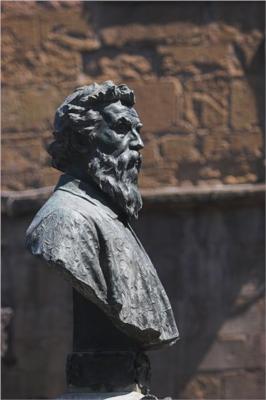
Biography
Cellini was born in Florence in 1500[1] and trained initially as a goldsmith. From 1529[1] he served Pope Clement VII in Rome as goldsmith and seal cutter, using those years to study Michelangelo, Raphael, and antique sculpture. He left Rome under violent circumstances in 1540 and went to Paris, where he entered the service of Francis I and produced his first sustained work as a sculptor rather than a craftsman. Intrigues by the Italian painter Primaticcio cost him royal favour in 1545, and he returned to Florence, where Cosimo I de' Medici commissioned the bronze Perseus with the Head of Medusa (completed 1554) that now stands in the Piazza della Signoria.
Perseus took nine years and established his reputation as a sculptor. The autobiography he wrote between 1558[1] and 1566 established his reputation as an egotist of spectacular range. Unpublished until 1728, it is perhaps the most vivid personal document to survive from the Italian Renaissance: Cellini murders, escapes prison, defeats sorcery, casts bronze at the edge of physical collapse, and presents himself throughout as a man of honour, military courage, and superhuman technical skill. The scholar Virginia Cox noted that his 'impulsiveness, violence, and explosive creativity' allowed him, quite literally, to get away with murder.
He participated in the paragone debate of 1546[1], when the critic Benedetto Varchi canvassed leading artists on the comparative excellence of painting and sculpture, and responded with characteristic forcefulness. He died in Florence in 1571[1], leaving the Salt Cellar, the Perseus, a bronze portrait bust of Cosimo I, and a literary monument that has overshadowed almost everything else.
Timeline
- 1500Born in Florence.
- 1529Served Pope Clement VII in Rome as goldsmith and seal cutter.
- 1540Left Rome and went to Paris, entering the service of Francis I.
- 1543Presented Francis I of France with a gold and enamel salt cellar.
- 1545Lost royal favour due to intrigues and returned to Florence.
- 1546Participated in the paragone debate.
- 1554Completed the bronze "Perseus with the Head of Medusa", commissioned by Cosimo I de' Medici, in Florence.
- 1558Began writing his autobiography.
- 1566Finished writing his autobiography.
- 1571Died in Florence at 71.
Notable Works
Tap to view larger.
Next stop
Mannerism →
Explore the artists and ideas of Mannerism.
Related Artists


%20(14578560789).jpg)


Frequently Asked Questions
What is Benvenuto Cellini known for?
Benvenuto Cellini is known for his autobiography and his work as a goldsmith and sculptor. His bronze Perseus with the Head of Medusa, completed in 1554[1], established his reputation as a sculptor.What is Benvenuto Cellini's most famous work?
While Benvenuto Cellini produced many sculptures and metalworks, he is perhaps best known for his bronze sculpture *Perseus with the Head of Medusa*. Created between 1545[1] and 1554, it is located in the Loggia dei Lanzi in Florence, Italy. Commissioned by Duke Cosimo I de' Medici, the sculpture depicts the Greek mythological hero Perseus standing triumphantly over the slain Medusa, a Gorgon whose gaze could turn men to stone. The sculpture is praised for its dramatic pose and technical virtuosity, especially the difficulty of casting such a large bronze figure. Cellini himself detailed the challenging casting process in his autobiography, recounting the near-disasters and innovative solutions required to complete the work. *Perseus with the Head of Medusa* is considered a masterpiece of the Italian Renaissance, a high point of Cellini's career.What should I know about Benvenuto Cellini's prints?
Benvenuto Cellini (1500[1]-1571[1]) was a Florentine goldsmith, sculptor, and writer, best known for his autobiography. He began his career as a goldsmith and seal cutter, working for Clement VII in Rome from 1529[1] to 1535. During this period, he studied the works of Michelangelo and Raphael, as well as antique sculpture. Forced to leave Rome in 1540 after an act of violence, Cellini went to Paris. There, he worked for Francis I as a sculptor. The bronze relief Nymph of Fontainebleau is the only remaining example of his French[1] work. After losing favour with Francis I in 1545, Cellini returned to Florence. Cosimo I commissioned him to create a bronze portrait bust and Perseus with the Head of Medusa. He worked on the Perseus for nine years, from 1545 to 1554; it established his reputation as a sculptor. Besides his autobiography, Cellini wrote a treatise on goldsmithing and sculpture, which contains information on his working methods. In 1546, he contributed to a debate on the comparative excellence of the arts, organised by Benedetto Varchi of the Florentine Academy.What style or movement did Benvenuto Cellini belong to?
Benvenuto Cellini (1500[1]-1571[1]) was a Florentine goldsmith and sculptor associated with the Mannerist style. Mannerism[1] extended beyond painting into sculpture and architecture. Cellini's autobiography helped to secure his place in art history. Cellini worked for emperors, kings, popes and princes. Francis I of France employed Cellini, paying him an annual salary and fees. One of Cellini’s most famous pieces is a gold salt cellar made for Francis I between 1540[1] and 1543. The price paid for the salt cellar was almost 50 percent greater than Cellini’s salary for the year. The salt cellar features two figures: Neptune, who represents Water (the source of salt), and Ceres (Tellus), who represents Earth. The figures recline on an ebony base decorated with Dawn, Day, Twilight, Night, and the four winds. The boat next to Neptune held the salt, and the triumphal arch next to Tellus held the pepper. The elongated proportions of the figures, especially Tellus, show Cellini’s Mannerist approach. Mannerist artists aimed to appeal to the emotions through aesthetic effect.What was Benvenuto Cellini known for?
Benvenuto Cellini (1500[1]-1571[1]) was a Florentine artist of the Italian Renaissance. He excelled as a goldsmith, sculptor, draughtsman, and soldier. Cellini is also known for his autobiography, which presents a vivid picture of his life and times. Cellini's early career was spent in Florence and Rome, where he produced medals and jewellery. One of his patrons was Pope Clement VII. After Clement's death, Cellini travelled to France, where he worked for Francis I. He created the gold salt cellar, now in the Kunsthistorisches Museum, Vienna, during this period. Cellini returned to Florence in 1545[1]. There, he created the bronze sculpture Perseus with the Head of Medusa, which is in the Loggia dei Lanzi. He also produced marble sculptures, including a statue of Christ in the Bargello Museum. Cellini's work combines technical skill with Mannerist aesthetics. His autobiography offers insights into his artistic processes and his relationships with patrons and other artists. He died in Florence in 1571.When did Benvenuto Cellini live and work?
Benvenuto Cellini (1500[1]-1571[1]) was a Florentine artist of the Renaissance. He is best known as a sculptor and goldsmith; he also worked as a draughtsman, soldier, and musician. His career took him to several Italian cities, and he spent time in France. Cellini was born in Florence. He trained as a goldsmith there, and he was later employed in Rome. He made medals for Pope Clement VII and Pope Paul III. Around 1540[1], he entered the service of King Francis I of France. He executed sculptures for the royal Château de Fontainebleau. In 1545, Cellini returned to Florence, where he remained for the rest of his life. He was patronised by Cosimo I de' Medici, Duke of Florence. His most famous sculpture is Perseus with the Head of Medusa (1545-1554[1]); this bronze statue is in the Loggia dei Lanzi in Florence. Cellini also wrote an autobiography; this provides insight into his life and artistic practices. He died in Florence in 1571.Where can I see Benvenuto Cellini's work?
Benvenuto Cellini (1500[1]-1571[1]) was a Florentine artist best known for sculpture and metalwork. Several museums hold examples of his art. The Bargello Museum, in Florence, Italy, possesses Cellini's bronze sculpture *Narcissus* (circa 1548[1]). The Bargello also has Cellini's marble bust of Cosimo I de' Medici (1545-1548[1]). This portrait shows the Florentine Duke in armour. Cellini's most famous sculpture, *Perseus with the Head of Medusa* (1545-1554), is on display in the Loggia dei Lanzi, Piazza della Signoria, Florence. The sculpture shows the Greek hero Perseus standing over Medusa's corpse. The Louvre Museum, in Paris, holds what is probably Cellini's most celebrated piece of metalwork: the *Salt Cellar of Francis I* (1540-1543). This gold and enamel table ornament was produced for the French[1] king Francis I. The Kunsthistorisches Museum, in Vienna, has a similar, though smaller, piece attributed to Cellini.Where was Benvenuto Cellini from?
Benvenuto Cellini was from Florence; he was born there in 1500[1] and died there in 1571[1]. His autobiography describes his eventful life. He began his artistic career as a goldsmith. From 1529[1] to 1535, Cellini was employed as a goldsmith and seal cutter by Clement VII in Rome. While there, he had the opportunity to study the works of Michelangelo and Raphael, as well as antique sculpture. Due to an act of violence, Cellini left Rome in 1540. He went to Paris and worked for Francis I as a sculptor. The bronze relief, Nymph of Fontainebleau, is the only remaining example of his work created in France. After losing favour with Francis I in 1545, Cellini returned to Florence. He received a commission from Cosima I for a bronze portrait bust and Perseus with the Head of Medusa. Cellini worked on Perseus, which secured his fame as a sculptor, for nine years (1545-1554[1]).Who did Benvenuto Cellini influence?
Benvenuto Cellini (1500[1]-1571[1]) was a significant figure of the Italian Renaissance, and his impact can be seen in the work of later artists, particularly those working in sculpture and metalwork. Cellini's autobiography, while often exaggerated, provided insights into workshop practices and the life of an artist during the period. This text influenced later generations' understanding of the Renaissance artistic world. His technical manuals on metalworking and sculpture also circulated widely, impacting the methods of subsequent artisans. Giambologna (1529[1]-1608[1]), a Flemish sculptor working in Florence, is often cited as being directly influenced by Cellini's style, particularly in his bronze figures. Giambologna adopted Cellini's emphasis on dynamic poses and surface finish. Cellini's influence also extended to goldsmithing. His elaborate designs and technical virtuosity set a standard for goldsmiths throughout Europe. While direct attribution of influence is difficult, the high level of craftsmanship and artistic ambition seen in later Renaissance and Baroque metalwork owes a debt to Cellini's example. He remains a figure of interest for those studying the intersection of art, craft, and self-promotion in the 16th century.Who influenced Benvenuto Cellini?
Benvenuto Cellini (1500[1]-1571[1]) was a Florentine goldsmith and sculptor. His autobiography gives an account of his life and work. From 1529[1] to 1535, Cellini was employed as a goldsmith and seal cutter by Clement VII in Rome. This position gave him the opportunity to study the works of Michelangelo and Raphael, as well as examples of antique sculpture. Cellini's career reflects a shift in how some artists viewed themselves in relation to society. He saw himself as more than a craftsman. His belief in his own virtuosity set him apart. He moved within society and was admired by princes and popes. He wrote treatises on sculpture and goldsmithing, in addition to his autobiography.Who was Benvenuto Cellini?
Benvenuto Cellini (1500[1]-1571[1]) was a Florentine goldsmith and sculptor. His autobiography describes his eventful life. He began his career as a goldsmith. From 1529[1] to 1535, Cellini worked as a goldsmith and seal cutter for Clement VII in Rome. During this period, he studied works by Michelangelo and Raphael, in addition to antique sculpture. Forced to leave Rome because of an act of violence, he went to Paris in 1540. There, he worked for Francis I, his first employment as a sculptor. The bronze relief Nymph of Fontainebleau is the only remaining example of his French[1] work. In 1545, Cellini returned to Florence after losing favour with Francis I. Cosima I commissioned a bronze portrait bust and Perseus with the Head of Medusa. Cellini worked on Perseus between 1545 and 1554; this sculpture established his reputation. Although he produced many works as a goldsmith, the Salt Cellar of Francis I, now in Vienna, is the only piece that is definitely attributed to him. Made between 1540 and 1543, it features figures of Neptune and Ceres, representing Water and Earth. Cellini also wrote a Treatise on the Goldsmith's Art and Sculpture, which contains information on his working methods.Why are Benvenuto Cellini's works important today?
Benvenuto Cellini (1500[1]-1571[1]) was a Florentine artist working as a goldsmith and sculptor. His autobiography, along with Giorgio Vasari's *Lives*, helped establish the idea of individual artistic genius during the Renaissance. Cellini's autobiography presents him as an accomplished artist, statesman, soldier, and lover. Cellini worked for Clement VII in Rome from 1529[1] to 1535, where he studied the works of Michelangelo and Raphael. Later, he worked for Francis I in Paris, where he created sculptures; the bronze relief *Nymph of Fontainebleau* is the only remaining example. After losing favour with Francis I, he returned to Florence and received a commission from Cosimo I for a bronze portrait bust and *Perseus with the Head of Medusa*. He worked on *Perseus* from 1545 to 1554. Although Cellini executed many works as a goldsmith, the *Salt Cellar of Francis I* in Vienna is the only piece that can definitively be ascribed to him. The gold-and-enamel piece features Neptune and Tellus reclining atop an ebony base decorated with relief figures of Dawn, Day, Twilight, Night, and the four winds. The elongated proportions of the figures reveal Cellini’s Mannerist approach to form. He also wrote *Treatise on the Goldsmith's Art and Sculpture*, which contains information on his working methods.
Sources
Editorial draws on the following primary and tertiary references for Benvenuto Cellini.
- [1] wikipedia Wikipedia: Benvenuto Cellini Used for: biography, birth dates, death dates, identifiers, movement attribution, nationality.
- [2] book Elizabeth Gilmore Holt; Project Muse, A Documentary History of Art, Volume 2 _ Michelangelo and the Mannerists, The Baroque and the Eighteenth Century Used for: biography, stylistic analysis.
- [3] book Elizabeth Gilmore Holt; Project Muse, A Documentary History of Art, Volume 2 _ Michelangelo and the Mannerists, The Baroque and the Eighteenth Century Used for: biography, stylistic analysis.
- [4] book Elizabeth Gilmore Holt; Project Muse, A Documentary History of Art, Volume 2 _ Michelangelo and the Mannerists, The Baroque and the Eighteenth Century Used for: biography, stylistic analysis.
- [5] book Peter Robb, M: The Man Who Became Caravaggio Used for: biography.
Editorial overseen by Solis Prints. Sources verified 2026-09-22. Click a source for details, or hover over [N] in the page above to preview.
Editorial standardsMethodologyCorrectionsAI disclosureAbout the editorial team