

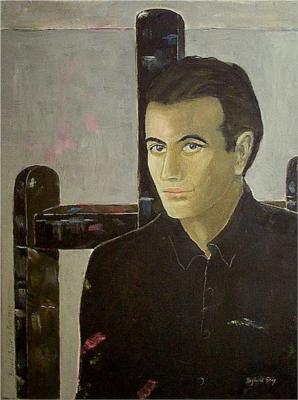
Bernard Buffet
Bernard Buffet was barely twenty when critics were already comparing him to Picasso. He had won the Prix de la Critique in 1948[1], sharing it with Bernard Lorjou, and his spare, angular canvases (outlined in heavy black lines against near-empty grounds) seemed to speak directly to a France still hollowed out by occupation and rationing. Elongated figures, bare rooms, still lifes stripped to their bones: Buffet's early work had the quality of grief made visible.
Biography
The reversal came quickly. By the late 1950s, a Provençal castle, a Rolls-Royce, and a celebrated marriage to writer Annabel Schwob had replaced the austerity of his early work in the public imagination. Critics who had championed him turned hostile; Picasso, whose comparison had helped make Buffet's reputation, now dismissed him publicly. Cultural minister André Malraux became an outspoken antagonist. The prolific output did not help: Buffet claimed to produce a painting a day across four decades, eventually totalling over 8,000 works.
What those critics often missed was the quality of his best figurative series. His clown paintings, carnival subjects rendered with the same structural rigour applied to his post-war still lifes, form a coherent body of work across several decades. "Les Clowns Musiciens, le Saxophoniste" (1991[1]) sold for £1,022,500 at Christie's London, the auction record for his work. His retrospective at the Galerie Charpentier in 1958 opened when he was just thirty; he had been painted on the cover of Time magazine that same year for a portrait of Charles de Gaulle.
Buffet died by suicide at Tourtour on 4 October 1999[1], having been diagnosed with Parkinson's disease. A retrospective at the Musée d'Art Moderne de Paris in 2016 confirmed a reappraisal that had been gathering momentum since his death.
Timeline
- 1928Born in 1928.
- 1948Won the Prix de la Critique, sharing it with Bernard Lorjou.
- 1958Aged 30, his retrospective opened at the Galerie Charpentier.
- 1958His portrait of Charles de Gaulle appeared on the cover of Time magazine.
- 1991Painted "Les Clowns Musiciens, le Saxophoniste".
- 1991"Les Clowns Musiciens, le Saxophoniste" later sold for £1,022,500 at Christie's London.
- 1999Died by suicide at Tourtour on 4 October, after being diagnosed with Parkinson's disease.
Notable Works
Tap to view larger.
Next stop
Expressionism →
Explore the artists and ideas of Expressionism.
Related Artists



Frequently Asked Questions
What is Bernard Buffet known for?
Bernard Buffet is known for his spare, angular canvases, often featuring elongated figures, bare rooms, and still lifes. Later in his career, he produced figurative series, including clown paintings and carnival subjects.What is Bernard Buffet's most famous work?
Bernard Buffet is best known for his paintings of clowns and religious subjects, as well as still lifes and portraits. However, pinpointing a single "most famous" work is difficult, as his popularity has fluctuated and varies by region. One contender for his most recognised painting is "Clown Violinist" (1955[1]), which typifies his angular style and recurring clown motif. The subject's gaunt features and melancholic expression are characteristic of Buffet's post-war aesthetic. This piece is part of a series of clown paintings that cemented his popular appeal. Another potential candidate is "The Christ" (1951), reflecting Buffet's engagement with religious themes. This stark, linear depiction of Christ departs from traditional representations, aligning with the existential mood of the era. Ultimately, the "most famous" work is subjective and dependent on individual interpretation and exposure. Both "Clown Violinist" and "The Christ", among others, remain significant examples of his contribution to 20th-century art.What should I know about Bernard Buffet's prints?
Bernard Buffet (1928[1]-1999[1]) was a French[1] painter and printmaker associated with anti-abstract art. Buffet gained early recognition; by his late twenties, he already had a significant reputation. Buffet's prints often share stylistic and thematic connections with his paintings. He favoured drypoint, lithography, and etching. These prints allowed for wider distribution of his artistic vision. Common subjects include clowns, religious scenes, and still lifes. His style is characterised by angularity and starkness; he used black lines to define forms. The overall effect can be emotionally intense. Collectors should be aware of the wide range in print quality and edition sizes. Some Buffet prints were produced in very large numbers, while others are relatively scarce. Authentication can be a concern, so provenance is important. Buffet's printmaking output is substantial, offering options for both new and experienced collectors. His work provides insight into post-war French figurative art.What style or movement did Bernard Buffet belong to?
Bernard Buffet (1928[1]-1999[1]) was a French[1] painter associated with anti-abstract art movements after the Second World War. Buffet gained recognition in the late 1940s as part of the "misérabilisme" tendency; this style expressed post-war anxieties through bleak figurative works. His paintings often feature elongated figures, angular forms, and a restricted colour palette, creating a sense of melancholy. Buffet's subjects included portraits, still lifes, and religious scenes. Although he achieved early success, his popularity declined as abstract art became more dominant. Despite this, Buffet continued to develop his distinctive style. He remained committed to representational painting throughout his career. Later in life, his work experienced renewed interest. Buffet's artistic output offers a view into the anxieties of his time. His work provides an alternative to the dominant trends in post-war art.What techniques or materials did Bernard Buffet use?
Bernard Buffet's practice involved diverse materials and techniques. He often combined oil paint with other substances to create unusual textures. In his earlier work, he incorporated materials such as cement, tar, gravel, sand, dust, and even butterfly wings. He thickened paint with sand and glue, creating a gritty paste. Dubuffet also used unconventional tools and supports, believing that this stimulated creativity. For his portraits, Dubuffet would lay the canvas flat and cover it with a thick layer of light-coloured oil paint, applied with a spatula. He then sprinkled ashes, sand, and coal dust over the surface. Colour was added as a thin wash. The image was created by incising lines into this surface with a palette knife, revealing the canvas texture. A thin mixture of paint and turpentine was brushed over the face, staining the lines. Later, in the Hourloupe cycle, he restricted his palette to red, white, blue, and black. He moved away from natural materials, using colour to project abstract ideas.What was Bernard Buffet known for?
Bernard Buffet (1928[1]-1999[1]) was a French[1] painter and printmaker associated with post-war Expressionism[1]. Buffet gained recognition for his distinctive figurative style. His works often feature elongated, angular figures rendered with dark, heavy outlines, and a muted palette. Buffet's subjects included portraits, still lifes, religious scenes, and cityscapes. During the 1950s, Buffet achieved considerable commercial success and critical attention. However, his popularity declined in later decades, as his style was viewed by some as repetitive. Despite shifts in critical opinion, Buffet remained a prolific artist, producing a substantial body of work throughout his career. He is known for his contributions to the Figurative movement, and his art provides a view into post-war anxieties and alienation.When did Bernard Buffet live and work?
Bernard Buffet was born on 31 July 1901 in Le Havre; his father was a wine merchant. Buffet studied at the Académie Julian in Paris but left after six months to work independently. During this time, he met artists such as Valadon, Dufy, and Max Jacob. He also developed friendships with Charles Albert Cingria and, later, Léger. Between 1920 and 1921, he studied linguistics, philosophy, literature, and music, showing an interest in Dada and psychopathic art. In 1924, he stopped painting until 1933[1], when he began painting part-time while also making marionettes and masks. He resumed painting full-time in 1934. In 1942, for the third time, he decided to dedicate himself to art. Buffet had his first solo exhibition at Galerie René Drouin in Paris in 1944. He began collecting Art Brut in France and Switzerland around 1945. Buffet died in 1985.Where can I see Bernard Buffet's work?
Bernard Buffet's paintings and prints are held in many public collections. These include museums in France, other parts of Europe, and North America. In France, the Musée d'Art Moderne in Paris holds several paintings. The Musée Bernard Buffet in Surugadaira, Japan, is dedicated to his work; it holds a large collection of paintings, watercolours, prints, and documents relating to his life and career. Other museums with works by Buffet include The Museum of Modern Art in New York, which has prints in its collection. The Tate Gallery in London also holds a lithograph. These and other institutions occasionally display Buffet's work as part of temporary exhibitions or within their permanent collection displays. Prospective viewers should check museum websites for current information about which works are on view. Major auction houses, such as Sotheby's and Christie's, also handle Buffet's work regularly.Where was Bernard Buffet from?
Bernard Buffet was a French[1] painter, born 10 July 1928[1]. Buffet's early life was spent in Paris, where he also studied at the École Nationale Supérieure des Beaux-Arts. He gained recognition early in his career; his work was exhibited at the Galerie Drouant-David in Paris, and he won the Prix de la Critique in 1948[1]. Buffet's paintings often featured a distinctive style with angular figures and dark outlines. He explored various subjects, including portraits, still lifes, and religious scenes. Although he achieved considerable commercial success, Buffet's work was not always critically admired, and opinions on his artistic merit varied during his career. Later in life, Buffet struggled with illness and died by suicide in 1999[1] in France.Who did Bernard Buffet influence?
Bernard Buffet's artistic influence is not well documented. However, Henri Matisse influenced a number of artists. Several critics, art historians, and artists responded to the Matisse retrospective exhibition at the Museum of Modern Art. Ellsworth Kelly, Francis M. Naumann, Jeff Perrone, Richard Hennessey, and Robert Kushner responded positively. Nancy Spero, Jo Anna Isaak, and Kenneth Silver were politically critical. Jennifer Bartlett, Lynne Tillman, and Gary Indiana offered impressionistic responses, while Robert Rosenblum, Peter Schjeldahl, and Charles Stuckey gave sober art-historical analyses. Matisse's impact extended to American artists from the 1940s through the 1970s, including Hans Hofmann and Sean Scully. His use of the window motif is comparable to that of Robert Motherwell, especially in *Open Window, Collioure*. Hard-edged painters such as Youngerman, Kelly, and Zox, certain colourists (Frankenthaler, Motherwell, Stella), and figurative artists (Avery, Wesselman) also felt his influence. Roy Lichtenstein created pastiches of Matisse and Diebenkorn. Serge Fauchier, a member of the “Support/surface” group, was influenced by Matisse and American colour-field painters.Who was Bernard Buffet?
Jean Dubuffet (1901-1985[1]) was a French[1] artist who rejected academic artistic traditions. He sought inspiration outside established aesthetic norms, admiring the creativity found in children's drawings, the art of the mentally ill, and that of self-taught artists. Dubuffet termed this raw, spontaneous expression 'art brut'. His work often featured mundane subjects: figures, objects, and environments. He rarely painted from life, instead using mental images akin to those of untrained artists. Dubuffet aimed to challenge viewers' aesthetic expectations by presenting crude or banal imagery. He felt that looking at such art could refresh one's perception of the everyday world, revealing grand, moving, and even tragic aspects of ordinary things. His subjects included the human figure, stones, tables, cows, and coffee pots. Dubuffet's approach deliberately ignored conventional aesthetics, denying centuries of pictorial technique. He was interested in the ugly and chaotic, viewing them as integral parts of the world. Dubuffet sought a spiritual realm disconnected from established culture.Why are Bernard Buffet's works important today?
Bernard Buffet was a prolific French[1] painter, draughtsman, and printmaker. He is associated with anti-abstract expressionism, which rejected non-figurative painting. Buffet aimed to create art accessible to a wide audience, and his work gained considerable commercial success. Buffet's paintings often feature angular figures and stark compositions. His subjects include portraits, still lifes, and religious scenes. He developed a distinctive style characterised by thin, black lines and muted colours. Although art critics were often dismissive, the public embraced Buffet's accessible style. His popularity peaked in the 1950s. Later in his career, Buffet continued to produce a large number of works, although tastes had shifted away from his aesthetic. Today, there is renewed interest in his art, particularly his graphic work. His prints offer a more affordable way to collect his art. They allow a wider audience to engage with his artistic vision.
Sources
Editorial draws on the following primary and tertiary references for Bernard Buffet.
- [1] wikipedia Wikipedia: Bernard Buffet Used for: biography, birth dates, death dates, identifiers, movement attribution, nationality.
- [2] book guggenheim-guhe00solo Used for: stylistic analysis.
- [3] book guggenheim-jeandubuffetretr00dubu Used for: biography.
- [4] book guggenheim-jeandubuffetretr00newy Used for: biography.
- [5] book guggenheim-onehundredpainti00thom Used for: biography.
- [6] book guggenheim-picassow00nash Used for: biography.
- [7] book Masterpieces of western art : a history of art in 900 individual studies from the Gothic to the present day Used for: biography, stylistic analysis.
- [8] book Robert Hughes, The Shock of the New, 1980 Used for: stylistic analysis.
Editorial overseen by Solis Prints. Sources verified 2026-09-22. Click a source for details, or hover over [N] in the page above to preview.
Editorial standardsMethodologyCorrectionsAI disclosureAbout the editorial team