



Bernardo Strozzi
Bernardo Strozzi entered the Capuchin monastery in Genoa at the age of seventeen, training as a friar alongside his vows. When his father died in 1608[9] he was permitted to leave temporarily to care for his mother. After her death the monastery recalled him; he refused, fled to Venice around 1630, and spent the remaining fourteen years of his life painting for doges, patriarchs, and the Grimani family. The church's loss became Venetian Baroque painting's gain.
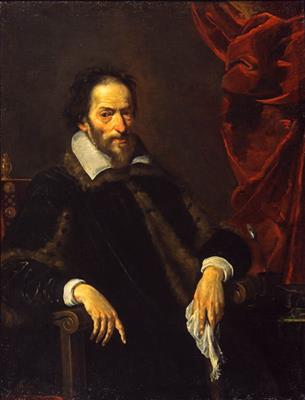
Biography
Born in Genoa in 1581[9], Strozzi had trained under the Sienese painter Pietro Sorri before taking monastic orders. Genoa in the early seventeenth century was an unusually cosmopolitan city for an artist: Orazio Gentileschi worked there, Rubens visited, and van Dyck followed. Strozzi absorbed Caravaggio's dramatic lighting and figure types, Flemish looseness of brushwork, and Rubensian physicality with equal appetite. His The Cook (c.1625[9], Palazzo Rosso, Genoa) shows the synthesis at its most confident: a kitchen-genre composition with trompe-l'oeil surfaces, vigorous paint handling, and figure arrangement drawn from Caravaggio's spatial logic.
His Calling of St. Matthew (c.1620[9], Worcester Art Museum) demonstrates how closely he studied Caravaggio's Contarelli Chapel version, preserving the diagonal light shaft and the startled gesture of the called apostle while adding his own warmer palette. Personification of Fame (1635-36, National Gallery, London) and David with the Head of Goliath (c.1635, Cincinnati Art Museum) show the Venetian period at its most assured: theatrical costume, a lighter background, Caravaggio's confrontational energy dressed in Rubens's clothes.
He is credited as one of the founders of the Venetian Baroque, an assessment that rests less on pure invention than on transmission. Strozzi carried the lessons of Caravaggism, Flemish colorism, and Lombard naturalism into Venice at the moment the city's own painting tradition most needed renewing. His two nicknames, Il Cappuccino and Il Prete Genovese, followed him from Genoa to the lagoon as reminders of an earlier life he had definitively refused.
Timeline
- 1581Born in Genoa.
- 1608Left the Capuchin monastery temporarily to care for his mother after his father's death.
- 1620Painted "Calling of St. Matthew".
- 1625Painted "The Cook" around this time.
- 1630Fled to Venice after refusing to return to the monastery.
- 1635Painted "David with the Head of Goliath" around this time.
- 1635Painted "Personification of Fame" from 1635-36.
- 1644Died in Venice at 63.
Notable Works
Tap to view larger.
Where to See Bernardo Strozzi
4 museums worldwide.
-
 1 works
Art Gallery of South Australia
Adelaide, Australia
10:00–17:00 daily, closed Christmas Day · Free
-
 1 works
Musée Granet
Aix-en-Provence, France
Tue–Sun 10:00–18:00 (until Nov 1, 2026), Tue–Sun 12:00–18:00 (from Nov 3, 2026), closed Mondays · 14 € adults
-
 1 works
National Gallery of Armenia
Yerevan, Armenia
-
 1 works
Philbrook Museum of Art
Tulsa, United States
Wed–Sun 9:00–17:00, Fri 9:00–21:00, closed Mon–Tue · $22 adults
Next stop
Browse the movements →
Every movement in the collection, from the Renaissance to Pop art.
Bernardo Strozzi prints
Hand-finished archival prints from Bernardo Strozzi's body of work.
 The Madonna of Justice - Bernardo Strozzi
From £28.00
The Madonna of Justice - Bernardo Strozzi
From £28.00
 Saint Antony of Padua holding Baby Jesus - Bernardo Strozzi
From £37.00
Saint Antony of Padua holding Baby Jesus - Bernardo Strozzi
From £37.00
 The Release of St. Peter - Bernardo Strozzi
From £37.00
The Release of St. Peter - Bernardo Strozzi
From £37.00
 St. John the Baptist Preaching - Bernardo Strozzi
From £37.00
St. John the Baptist Preaching - Bernardo Strozzi
From £37.00
 Doge Francesco Erizzo - Bernardo Strozzi
From £28.00
Doge Francesco Erizzo - Bernardo Strozzi
From £28.00
 A Personification of Fame - Bernardo Strozzi
From £28.00
A Personification of Fame - Bernardo Strozzi
From £28.00
Related Artists


Take Bernardo Strozzi home.
See all Bernardo Strozzi prints →Frequently Asked Questions
What is Bernardo Strozzi known for?
Bernardo Strozzi is credited as one of the founders of the Venetian Baroque style. This assessment rests less on pure invention than on transmission, as he carried the lessons of Caravaggism, Flemish colorism, and Lombard naturalism into Venice.What is Bernardo Strozzi's most famous work?
Bernardo Strozzi (1581[9]-1644[9]) was an Italian[9] painter, and one of the founders of the Venetian Baroque style. Born in Genoa, he trained with Pietro Sorri. Strozzi joined the Capuchin Monastery of St. Barnabas at age 17, painting devotional works. He left in 1608[9] to care for his family, but was later ordered to return. Instead, he moved to Venice and established a workshop, achieving considerable recognition. It is difficult to name one single "most famous" work. However, several paintings are frequently cited. The Cook (c. 1625; Galleria di Palazzo Rosso, Genoa) is often mentioned; it bridges Italian and Flemish art. Strozzi combines close observation of objects, reminiscent of northern European painting, with a focus on the figure of the cook herself. Other notable works include the Calling of St. Matthew (c. 1620; Worcester Art Museum), which draws inspiration from Caravaggio's version of the same scene. Also of note is the Adoration of the Shepherds (c. 1616-1618[9]; Walters Art Gallery, Baltimore), in which Strozzi combines Baroque trends with solid naturalism.What should I know about Bernardo Strozzi's prints?
Bernardo Strozzi (1581[9]-1644[9]) was an Italian[9] painter of the Baroque period. Strozzi's prints are not as well known as his paintings; information about them is scarce. Prints are generally divided into original prints, reproductions, and more recent types such as giclée prints and canvas transfers. Original prints, such as woodcuts, engravings, or etchings, are produced by hand by the artist, directly on the plate or block. The number of prints in an edition is limited by the wear of the plate; some publishers also impose limits to increase the value of the print. The price of a print depends on the artist's reputation, the image's popularity, and the quality of materials. In the 1880s, there was a market for fine art etchings; some publishers issued magazines dedicated to the etching. Continental printmakers were often employed because they were cheaper than British ones. Some prints were considered fine works of art because of the collaboration between engraver and painter; plates were destroyed after small editions had been taken.What style or movement did Bernardo Strozzi belong to?
Bernardo Strozzi (1581[9]-1644[9]) is considered one of the founders of the Venetian Baroque style. Born in Genoa, he trained with Pietro Sorri, and later entered the Capuchin Monastery of St Barnabas, painting devotional works. Genoa in the early 17th century was artistically active, shaped by strong links with Antwerp. Peter Paul Rubens and Anthony van Dyck, both influenced by Venetian colour, worked there. The city also saw Caravaggesque realism, particularly through Orazio Gentileschi, and the influence of Lombard painters. Strozzi synthesised these elements into his own style. His *Calling of St Matthew* (circa 1620[9]) draws from Caravaggio's work of the same name. Both paintings feature Christ pointing to St Matthew, who gestures in response. Light enters diagonally, and other figures are unaware of the interaction. Strozzi's Genoese period and later Venetian phase included paintings and frescoes for aristocratic clients, plus religious works, particularly altarpieces for the Capuchin Order.What techniques or materials did Bernardo Strozzi use?
Bernardo Strozzi, a 17th-century Italian[9] painter, worked primarily with oil on canvas. Venetian painters favoured canvas over plaster or wood panels because the lagoon climate was not suited to fresco, and canvas was more practical for large works, or for export. Venice was a centre for weaving linen, hemp, and jute; these were the fabrics Venetian artists used, sometimes blending them. For larger pieces, painters selected thicker twill and herringbone canvases for their strength, applying thin gesso grounds to maintain flexibility for transport. The combination of canvas and ground created a textured surface that influenced paint application. Oil paint was applied in thin layers. Strozzi, like other Baroque masters, employed impasto, a technique using thick applications of paint (usually white) to create highlights. This allowed for a freer style and larger formats. Dark areas were achieved with thin, transparent washes, often revealing a preliminary wash or imprimatura. The highlights, in contrast, appear thick and raised. This approach allowed the image to evolve during the painting process, resulting in dramatic chiaroscuro.What was Bernardo Strozzi known for?
Bernardo Strozzi (1581[9]-1644[9]) is considered a founder of the Venetian Baroque style. Born in Genoa, he trained with Pietro Sorri. At 17, he entered a Capuchin monastery, painting devotional works. He left in 1608[9] to care for his family, but was later ordered to return. Instead, he moved to Venice around 1630, opening a studio and finding fame. His patrons included Doge Francesco Erizzo and members of the Grimani family. Strozzi's style combined several influences. He drew from Caravaggio, as seen in his *Calling of St. Matthew* (circa 1620), which echoes Caravaggio's version of the same subject. He also incorporated the colour and painterly style of Peter Paul Rubens and Anthony van Dyck, who had both spent time in Genoa. His output included paintings and frescoes for aristocratic clients, and religious pieces, especially altarpieces, for the Capuchin Order. He often included architectural elements or realistically depicted objects in his compositions. Although he rarely devoted himself to still lifes, he was an excellent painter of them.When did Bernardo Strozzi live and work?
Bernardo Strozzi was born in Genoa in 1581[9] or 1582[9]. He became a Capuchin friar, a religious order within the Catholic Church, around the age of seventeen. He was nicknamed 'il Prete Genovese' (the Genoese Priest) because of this. However, he later received dispensation to leave the order. This was to care for his mother, or, according to some accounts, after her death. He then supported himself as an artist. He died in Rome in 1644[9]. Strozzi's artistic career unfolded primarily in Genoa and Venice. In Genoa, he produced numerous altarpieces and portraits for local churches and patrician families. His notable works include *Saint Francis Adoring the Cross* and *The Liberation of Saint Peter*. Around 1630, Strozzi moved to Venice, where he continued to paint prolifically. He received commissions from Venetian churches and private patrons. In Venice, he is known for works such as *The Plague in Venice*.Where can I see Bernardo Strozzi's work?
Bernardo Strozzi's paintings can be viewed in numerous museums. In Italy, his works are held at the Galleria degli Uffizi (Florence), the Pinacoteca di Brera (Milan), the Galleria e Museo Estense (Modena), the Palazzo Barberini (Rome), the Pinacoteca Nazionale di Siena, the Galleria dell’ Accademia (Venice), and the Museo Correr (Venice). Outside Italy, Strozzi's art has travelled to collections such as the Nationalmuseum (Stockholm). Other European museums that hold his paintings include the Kunsthistorisches Museum (Vienna). In the Netherlands, you can find his works in the Rijksmuseum (Amsterdam) and the Mauritshuis (The Hague). In the United Kingdom, Strozzi's paintings are in the collections of the National Gallery (London), the National Portrait Gallery (London), and the Victoria and Albert Museum (London). In the United States, his works can be viewed at the Metropolitan Museum of Art (New York) and the National Gallery of Art (Washington).Where was Bernardo Strozzi from?
Bernardo Strozzi was born in Genoa in 1581[9]. He is considered one of the founders of the Venetian Baroque style, although he did not move to Venice until later in his career. Strozzi's early training was with the Sienese painter Pietro Sorri. At the age of 17, he entered the Capuchin Monastery of St Barnabas. He was permitted to leave the monastery temporarily in 1608[9], following his father's death, to care for his mother and sister. After his mother died, he refused an order to return to the monastery in 1630. Instead, he escaped to Venice. Genoa in the early 17th century had a stimulating artistic environment. Peter Paul Rubens and Anthony van Dyck, both influenced by Venetian art, worked there. Orazio Gentileschi brought Caravaggism to the city. Strozzi's artistic style combines these influences. He created paintings and frescoes for aristocratic patrons, plus religious works for the Capuchin Order. Strozzi died in Venice in 1644[9].Who did Bernardo Strozzi influence?
Bernardo Strozzi's artistic impact is registered in the work of numerous artists. Venetian Renaissance painters provided a base for Baroque artists in Rome. The achievements of artists such as Titian and Tintoretto inspired not only the Carracci family and Caravaggio, but also artists outside Italy. Rubens, Van Dyck, Rembrandt, and Velázquez all studied Venetian paintings, and their pictorial style and subject interpretation show this influence. Appreciation for Venetian art continued into the eighteenth century. French painters like Boucher, Watteau, and Fragonard reflected Venetian influence in their mythological scenes and portraits. Many European artists travelled to Italy to study Venetian works, often knowing them through copies and engravings. Caravaggio's style was absorbed into Western art. Painters such as Rubens, Velázquez, and Pietro da Cortona echoed his compositions. French artists, including Valentin de Boulogne and Georges de La Tour, also show Caravaggio's impact. Interest in Caravaggio resurged during the Neoclassical and Romantic periods; Jacques-Louis David and Théodore Géricault were among those who drew inspiration from his work.Who influenced Bernardo Strozzi?
Bernardo Strozzi, a prominent figure in the early Baroque period, absorbed a range of influences that shaped his distinctive style. Venetian Renaissance painters, such as Titian and Tintoretto, provided a foundation for Strozzi's artistic development, particularly in his use of colour and dynamic composition. Strozzi was also responsive to the work of Paolo Veronese, whose art was rooted in the Italian[9] High Renaissance. Veronese's love of worldly splendour and his subordination of content to form had an impact. A visit to Rome exposed Strozzi to the work of Michelangelo, especially the figures in the Sistine Chapel. Northern European artists who studied Venetian art also had an impact. Rubens and Van Dyck, both admirers of Titian, transmitted elements of the Venetian style through Europe. Strozzi synthesised these influences, creating a style that blended Venetian colourism with Baroque dynamism.
Sources
Editorial draws on the following primary and tertiary references for Bernardo Strozzi.
- [1] museum Musée Granet Used for: museum holdings.
- [2] museum Philbrook Museum of Art Used for: museum holdings.
- [3] museum Art Gallery of South Australia Used for: museum holdings.
- [4] museum Musei di Strada Nuova Used for: museum holdings.
- [5] museum Samuel H. Kress Collection Used for: museum holdings.
- [6] museum National Gallery of Armenia Used for: museum holdings.
- [7] academic The Editors of Encyclopaedia Britannica, Bernardo Strozzi | Italian painter Used for: biography.
- [8] academic Chiara Krawietz, Strozzi, Bernardo Used for: biography.
- [9] wikipedia Wikipedia: Bernardo Strozzi Used for: biography, birth dates, death dates, identifiers, movement attribution, nationality.
- [10] book Victoria Charles, Baroque Art Used for: biography.
- [11] book Zuffi, Stefano, 1961-, Baroque painting : two centuries of masterpieces from the era preceding the dawn modern art Used for: biography.
- [12] book Lilian H. Zirpolo, Historical Dictionary of Baroque Art and Architecture Used for: biography.
- [13] book Masterpieces of western art : a history of art in 900 individual studies from the Gothic to the present day Used for: biography.
- [14] book Irving Lavin;, Visible Spirit Used for: stylistic analysis.
- [15] museum Bernardo Strozzi (1581 - 1644) Used for: biography.
Editorial overseen by Solis Prints. Sources verified 2026-09-16. Click a source for details, or hover over [N] in the page above to preview.
Editorial standardsMethodologyCorrectionsAI disclosureAbout the editorial team