



Bernd and Hilla Becher
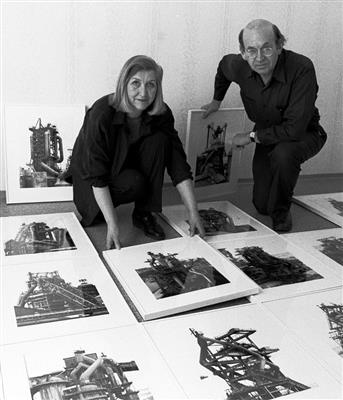
At the 1991[2] Venice Biennale, the jury awarded the Golden Lion for sculpture to two photographers who had spent three decades documenting industrial ruins. Bernd Becher (1931-2007[2]) and Hilla Becher (1934-2015) photographed blast furnaces, water towers, cooling towers, and gasometers across Europe and North America using large-format Plaubel Peco cameras, always under overcast skies to eliminate directional shadows, always without human figures.
Biography
Their method was as systematic as an engineer's survey. Each photograph was made at a consistent height with the structure centred and filling the frame. Individual images were assembled into grids of structurally similar buildings, treating industrial architecture the way a biologist arranges specimen trays. They described the resulting structures as "anonymous sculptures," whose forms were shaped by function rather than artistic intent.
The archive began from documentary urgency: as the European Economic Community was founded in the late 1950s, the coal and steel industries of the Ruhr Valley began to collapse and demolitions followed. What started as a record became, across fifty years, one of the defining bodies of photographic art of the twentieth century. A nine-print Water Towers (1980[2]), measuring 155.6 x 125.1 cm, sold at Sotheby's Paris in November 2015 for $441,940.
The institutional consequences extended well beyond their own practice. Bernd was appointed professor of photography at the Kunstakademie Düsseldorf in 1976[2], holding the post until 1996. His students formed the core of what is now called the Düsseldorf School: Andreas Gursky, Thomas Ruff, Thomas Struth, and Candida Höfer all studied under him, each developing the large-format, deadpan aesthetic that has dominated art photography since the 1990s.
Timeline
- 1959The Bechers began documenting industrial structures as the coal and steel industries of the Ruhr Valley declined.
- 1976Bernd Becher was appointed professor of photography at the Kunstakademie Düsseldorf.
- 1980The Bechers created "Water Towers", a series of nine prints.
- 1991The Bechers were awarded the Golden Lion for sculpture at the Venice Biennale.
- 1996Bernd Becher retired from his professorship at the Kunstakademie Düsseldorf.
- 2007Bernd Becher died, aged 48.
Notable Works
Tap to view larger.
Next stop
Browse the movements →
Every movement in the collection, from the Renaissance to Pop art.
Frequently Asked Questions
What is Bernd and Hilla Becher known for?
Bernd and Hilla Becher are known for their photography. Although photography was their exclusive medium, they received the prize at the Venice Biennale for sculpture.What is Bernd and Hilla Becher's most famous work?
Bernd and Hilla Becher are best known for their photographic series of industrial structures. Beginning in 1957, the pair photographed buildings such as water towers, blast furnaces, and coal silos across Europe and North America. These black-and-white images were arranged in grids, categorised by function. The Bechers aimed to create a visual grammar that allowed viewers to compare different structures. They referred to the buildings they photographed as "anonymous sculptures", forms dictated by their function. Their objective approach has been compared to Minimalist art. The Bechers' work gained recognition in the 1970s, with Bernd Becher teaching at Düsseldorf Art Academy from 1976[2]. Although they collaborated on all aspects of their work, Hilla often handled the darkroom tasks. In 1990, they received an award at the Venice Biennale in the sculpture category, despite working exclusively in photography. One example of their work is *Water Towers*, a 3x3 grid of nine gelatin silver prints from 1980.What should I know about Bernd and Hilla Becher's prints?
Bernd and Hilla Becher, a husband-and-wife team, began photographing industrial structures in Europe and North America around 1957. They focused on structures such as water towers, blast furnaces, and coal silos. Their work aimed to provide a grammar for understanding and comparing different structures. The Bechers arranged their black-and-white photographs into series based on functional typologies, often displayed in grids. This method revealed structural and material variations within specific types of buildings. The photographs were usually taken from the same angle, with evenly distributed light, and printed in identical sizes. The structures, they said, were "anonymous sculptures". Their work has been linked to obsolescence, as they began documenting structures in the Ruhrgebiet that were being demolished due to the decline of mining. The absence of people in their photographs gives even functioning plants an outmoded appearance. Both Bechers were involved in all aspects of their work, from scouting locations to printing. However, Hilla often handled the laboratory tasks. Bernd taught at the Düsseldorf Art Academy, becoming the first professor of fine art photography at a West German art institution in 1976[2].What style or movement did Bernd and Hilla Becher belong to?
Bernd and Hilla Becher are best known for their photographic work documenting industrial structures. They systematically photographed water towers, blast furnaces, and other examples of what they termed "anonymous sculptures" throughout Europe and North America, beginning in the late 1950s. Although photography was their medium, the Bechers received an award for sculpture at the Venice Biennale in 1990[2]. Their objective approach, serial repetition, and focus on industrialisation have drawn comparisons to Minimalism. The Bechers themselves avoided such categorisation. Minimalist sculptor Carl Andre appreciated their work, finding common ground between their photography and Minimalist art. Their work stood apart from the subjective style popular among German photographers in the 1950s and 1960s. Instead of exploring the "inner psyche", they focused on the external world. The Bechers' methodical approach and typological studies influenced a younger generation of photographers, including Andreas Gursky and Thomas Struth.What techniques or materials did Bernd and Hilla Becher use?
Bernd and Hilla Becher worked almost exclusively in black and white photography. They travelled throughout Europe and North America from 1957 onwards, photographing industrial structures such as water towers, coal silos, and blast furnaces. They used a large bellows camera, a Plaubel Peco, with exposure times between ten seconds and one minute. The Bechers were systematic in their approach; they precisely selected viewpoints, often aiming the lens directly at a corner or the exact centre of a wall. They might shoot one, three, four, six, or eight views of each structure. In some cases, they made thorough documentation of all the structures in a sprawling plant, taking up to six hundred pictures. Both were involved in all aspects of producing the work, including scouting locations, negotiating with owners, setting up cameras, and printing. Hilla handled most of the later laboratory tasks. Their consistent approach to subject matter, viewpoint, and printing gives their work a unified, objective quality.What was Bernd and Hilla Becher known for?
Bernd (1931-2007[2]) and Hilla (1934-2015) Becher were German conceptual artists and photographers known for their black-and-white photographs of industrial structures. Working as a couple from the late 1950s, they photographed buildings such as water towers, blast furnaces, and coal silos throughout Europe and North America. The Bechers organised their images into grids, categorising structures by function. This method revealed both the structural similarities and the subtle design variations between buildings of the same type. Their work has been compared to Minimalist art, because of its themes of repetition and standardisation. Initially, the work was credited only to Bernd. Hilla’s technical skills were essential to their practice, but she was often excluded from recognition, until 1967[2]. Both were involved in all aspects of their work, from site scouting to printing, using similar angles and even lighting in their photography. Bernd taught photography at the Düsseldorf Art Academy from 1976, while Hilla managed much of the darkroom work. In 1990, they received an award for sculpture at the Venice Biennale, although their medium was photography.When did Bernd and Hilla Becher live and work?
Bernd Becher was born in Siegen, Germany, in 1931. Hilla Becher was born in Berlin in 1934. They met in 1957 while working at an advertising agency. They began their collaborative project in 1959[2], marrying in 1961[2]. Their first joint exhibition was in 1967. Bernd taught at the Düsseldorf Art Academy from 1976, becoming the first professor of fine-art photography at a West German art institution. The pair received an award at the Venice Biennale in 1990. Bernd Becher died in 2007[2]. The Bechers are known for their black-and-white photographs of industrial structures. These included water towers, coal silos, and blast furnaces. They travelled throughout Europe and North America to photograph these structures. The Bechers organised their photographs into series based on functional typologies, arranging them into grids. They aimed to provide a grammar for understanding different structures. Their consistent aim was to evacuate their own subjectivity from the work.Where can I see Bernd and Hilla Becher's work?
Bernd and Hilla Becher had several solo and group exhibitions during their careers. These included solo shows at Galerie Ruth Nohl, Siegen (1963[2]); Staatliche Kunstakademie, Dusseldorf (1966); Staatliches Museum fur Angewandte Kunst, Munich (1967); Stedelijkvon Abbe-Museum, Eindhoven, and Stadtisches Museum, Monchengladbach (1968); Stadtische Kunsthalle, Dusseldorf (1969); Galerie Konrad Fischer, Dusseldorf, and Moderna Museet, Stockholm (1970); Neue Galerie, Aachen (1971); and Sonnabend Gallery, New York (1972). Group exhibitions featuring their work included Prospect 69, Stadtische Kunsthalle, Dusseldorf (1969); Konzeplion-Conception, Stadtisches Museum, Schloss Morsbroich, Leverkusen (1970); Edinburgh International Festival, Strategy: Get Arts, Demarco Gallery, Edinburgh, and Information, Museum of Modern Art, New York (1970); Prospect 71, Stadtische Kunsthalle, Dusseldorf (1971); 13 Artists Chosen for Documenta, Sonnabend Gallery, New York, and Documenta V, Kassel (1972).Where was Bernd and Hilla Becher from?
Bernd Becher was born in 1931 in Siegen, Germany. Hilla Becher was born in Berlin in 1934. They are known for their black and white photographs of industrial structures. Bernd studied at the Kunstakademie in Stuttgart, and later at the Kunstakademie in Düsseldorf. Hilla also attended the Kunstakademie in Düsseldorf. They began working together in 1959[2], and married in 1961[2]. In March 1963, they had their first joint exhibition at the Ruth Nohl gallery in Siegen; however, it was titled 'Bernhard Becher: Fotos'. By 1965, the exhibition title shifted to the subject, 'Anonymous Architecture', at Pro Gallery in Bad Godesberg. By 1967, both artists' names were mentioned in the Neue Sammlung exhibition in Munich. Bernd taught at Düsseldorf Art Academy beginning in 1976, becoming the first professor of fine art photography at a West German art institution.Who did Bernd and Hilla Becher influence?
Bernd and Hilla Becher's objective, serial approach to photography influenced a younger generation of photographers, including Andreas Gursky and Thomas Struth. Their work also found common ground with minimalist artists like Carl Andre and Richard Long, who recognised the artistic merit in their seemingly unartistic style. The Bechers' approach, characterised by uniformity and an aspiration to completeness, can be viewed as an antihumanist successor to August Sander's portraits of the German population. Like Sander, they employed black-and-white images, precise focus, and a consistent presentation. Their focus on industrial structures, presented in grids, revealed shared structural elements and subtle design variations across different periods and locations. This objective and scientific method, combined with themes of repetition and standardisation, paralleled the interests of Minimalist artists and impacted conceptual art. The Bechers were included in many early exhibitions of conceptual art.Who influenced Bernd and Hilla Becher?
Bernd and Hilla Becher cited August Sander as a major influence. Sander, little known in the 1960s, created a project mapping types among the German population. The Bechers owned Sander's 1929 book, *Antlitz der Zeit* (*Face of Our Time*). Similarities exist between the two bodies of work: both comprise uniform black-and-white images, often vertically oriented, cleanly centred, and with even lighting. Other art historians have named Eugène Atget, Karl Blossfeldt, Walker Evans, and Albert Renger-Patzsch as precursors, in addition to lesser-known industrial photographers. Hilla's mother studied photography in Berlin in the 1920s and gave Hilla a camera at age twelve. Hilla gained darkroom equipment from her uncle and interned for architectural photographer Walter Eichgrün, whose studio held an archive of historical photographs. Bernd trained as a decorative painter and studied painting and drawing. He used a camera to collect source material for paintings, documenting industrial structures in graphic illustrations.Who was Bernd and Hilla Becher?
Bernd and Hilla Becher were German conceptual artists and photographers known for their typological studies of industrial structures. Bernd was born in the Siegen district of Germany in 1931 and died in Rostock in 2007[2]. Hilla was born in Potsdam in 1934. They began their collaborative project in 1959[2], marrying in 1961[2]. Initially, their work was recognised only under Bernd's name; Hilla's contribution was often excluded, reflecting the patriarchal values of the time. They travelled throughout Europe and North America from 1957 onwards, photographing industrial architecture such as water towers, blast furnaces, and coal silos. The Bechers organised their photographs into series based on functional typologies, arranged in grids or rows. Their approach emphasised the sculptural qualities of these "anonymous sculptures", revealing structural variations within specific building types. They aimed to provide a "grammar" for understanding and comparing different structures. Their objective, scientific style influenced later photographers and paralleled interests of Minimalist artists. Bernd taught at the Düsseldorf Art Academy from 1976, becoming the first professor of fine-art photography at a West German art institution.
Sources
Editorial draws on the following primary and tertiary references for Bernd and Hilla Becher.
- [1] museum Victoria and Albert Museum Used for: museum holdings.
- [2] wikipedia Wikipedia: Bernd and Hilla Becher Used for: biography, birth dates, death dates, identifiers, movement attribution, nationality.
- [3] book Beard, Lee, 1973- author, Butler, Adam, author; Van Cleave, Claire, author; Fortenberry, Diane, author; Stirling, Susan, author, Beard, Lee, 1973- author, Butler, Adam, author; Van Cleave, Claire, author; Fortenberry, Diane, author; Stirling, Susan, author - The Art Book_ New Edition, Mini Format Used for: biography, stylistic analysis.
- [4] book guggenheim-amsterdamparisdu00solo Used for: biography.
- [5] book guggenheim-museum00solo Used for: biography, stylistic analysis.
- [6] book Palmer, Daniel; , Photography and Collaboration Used for: biography, stylistic analysis.
Editorial overseen by Solis Prints. Sources verified 2026-09-22. Click a source for details, or hover over [N] in the page above to preview.
Editorial standardsMethodologyCorrectionsAI disclosureAbout the editorial team