

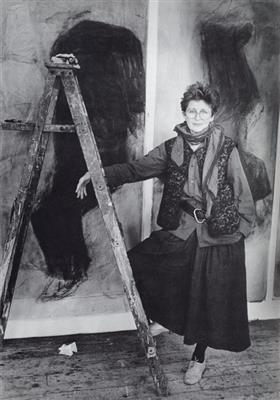
Betty Goodwin
Her artistic practice transformed grief into material. Betty Goodwin's first significant body of work began in 1968[1], when she enrolled in an etching class at Sir George Williams University in Montreal and started running pieces of clothing through a printing press. Her father had been a tailor: Abraham Roodish opened Rochester Vest Manufacturing Company in Montreal in 1928, and died of a heart attack when Goodwin was nine. The vest series that followed, pressing and distorting garments into paper and copper, carried an unmistakable weight of absence.
Biography
Born in Montreal in 1923[1] to Romanian immigrant parents, Goodwin came to formal art training late, studying design at Valentine's Commercial School of Art before years outside institutional art circles. The 1968[1] etching class redirected everything. The Vest series brought swift recognition, including a solo exhibition at the Musée d'art contemporain de Montréal in 1976.
Her later work extended these preoccupations across medium and scale. The Swimmers series (1982[1]-88) placed fragile human figures in dark, pressured spaces. Carbon (1986) worked directly with the material in dense, layered drawings on brown paper. La mémoire du corps (1990-95) and Nerves (1993-95) continued her inquiry into embodied memory and the body's capacity to register what the mind cannot hold. In 1988 she received a Guggenheim Foundation Fellowship; in 2003, both the Governor General's Award in Visual and Media Arts and the Order of Canada.
Her son Paul died of a drug overdose at the age of thirty. Loss remained, throughout her career, both subject and method. She died in Montreal in December 2008[1].
Timeline
- 1923Born in Montreal to Romanian immigrant parents.
- 1928Her father opened Rochester Vest Manufacturing Company in Montreal.
- 1932Her father died of a heart attack when she was nine years old.
- 1968Enrolled in an etching class at Sir George Williams University in Montreal, marking a shift in her artistic direction.
- 1976Held a solo exhibition of her Vest series at the Musée d'art contemporain de Montréal.
- 1982Began her Swimmers series, which she worked on until 1988.
- 1986Created "Carbon", dense, layered drawings on brown paper.
- 1988Received a Guggenheim Foundation Fellowship.
- 2003Received both the Governor General's Award in Visual and Media Arts and the Order of Canada.
- 2008Died in Montreal in December.
Notable Works
Tap to view larger.
Next stop
Browse the movements →
Every movement in the collection, from the Renaissance to Pop art.
Related Artists


Frequently Asked Questions
What is Betty Goodwin known for?
Betty Goodwin is known for her work with clothing, which she ran through a printing press, and for her later work exploring embodied memory. Her vest series, which involved pressing and distorting garments into paper and copper, brought her swift recognition.What is Betty Goodwin's most famous work?
It is difficult to identify Betty Goodwin's single 'most famous' work, as her notability rests on her diverse output. She is well known for her drawings, prints, sculptures, and mixed-media installations. Goodwin gained recognition for emotionally charged works that often explore themes of human vulnerability, memory, and loss. Goodwin's practice included series of works such as 'Swimmers' and 'Vest'. These explore the human form and its relationship to the world. Her prints and drawings frequently incorporate found objects and layered imagery; this adds depth and complexity. Her installations create immersive environments that invite contemplation. While she does not have one single piece that overshadows her other creations, the cumulative effect of her art has secured her reputation.What should I know about Betty Goodwin's prints?
Betty Goodwin (1923[1]-2008[1]) was a Canadian[1] artist known for drawings, prints, sculptures, and mixed-media installations. Goodwin's prints often incorporate etching, aquatint, and drypoint techniques. She frequently worked on a large scale, creating series of works that explore themes of memory, loss, and the human condition. Goodwin began printmaking in the 1960s. Early works include the "Swift" series (1969[1]-1972[1]), based on Jonathan Swift's satirical essay "A Modest Proposal". These prints combine etching and aquatint to create images of distorted figures and unsettling scenes. Later, she produced the "Metal Notebooks" series, which feature abstract forms and textures achieved through layering and manipulation of the printing plate. Goodwin's approach to printmaking was experimental; she often combined different techniques and materials to achieve a unique visual effect. She manipulated the surfaces of her prints, adding collage elements or hand-drawn marks. Goodwin represented Canada at the Venice Biennale in 1995. Her work is held in the collections of the National Gallery of Canada, the Musée d'art contemporain de Montréal, and other major museums.What style or movement did Betty Goodwin belong to?
It is difficult to assign Betty Goodwin to a single movement or style. Her practice resists easy categorisation. Goodwin's work often incorporates elements of drawing, printmaking, and sculpture; this multidisciplinary approach makes it challenging to place her within a specific artistic movement. Some have associated Goodwin with aspects of abstract expressionism, given the emotionally charged nature of her work and the gestural qualities of her drawings. Others see connections to conceptual art, because of her focus on ideas and processes. Her art often explores themes of memory, loss, and the human condition; this places her work in conversation with various contemporary art movements that engage with social and political issues. Ultimately, Goodwin's individual style makes her a unique figure.When did Betty Goodwin live and work?
Betty Goodwin was a Canadian[1] artist who lived from 1923[1] to 2008[1]. Born in Montreal, Quebec, on 19 March, Goodwin studied at the École des Beaux-Arts, Montreal, from 1948[1] to 1950. Although primarily known as a printmaker for much of her career, Goodwin also produced drawings, sculptures, and installations. Her work often explored themes of the human condition, memory, and loss. Goodwin represented Canada at the Venice Biennale in 1995. She was the first living Canadian woman to be given a solo exhibition at the Musée d’art contemporain de Montréal in 1998. Goodwin's art has been exhibited widely in Canada and internationally. She died in Montreal on 24 January 2008.Where was Betty Goodwin from?
Betty Goodwin was born in Montreal, Quebec, in 1923[1]. Goodwin was a Canadian[1] artist known for prints, drawings, sculptures, and mixed-media installations. She studied at the Montreal Museum of Fine Arts School, from 1948[1] to 1952. Her early work consisted of paintings and sculptures, but she turned to printmaking in the late 1960s. Goodwin used a variety of printmaking techniques, including etching, lithography, and silkscreen. Goodwin's work often explored themes of memory, identity, and the human condition. She frequently incorporated found objects and personal photographs into her art. Goodwin represented Canada at the Venice Biennale in 1995. She received the Governor General's Award in Visual and Media Arts in 1998. Betty Goodwin died in Montreal in 2008[1].Who did Betty Goodwin influence?
It is difficult to identify specific artists who were directly influenced by Betty Goodwin. However, some general connections can be drawn between Goodwin's approach and the work of later artists. The feminist art movement, for example, saw artists such as Nancy Spero create a pictographic language of body gestures. Spero depicted the diversity of representations of women from prehistory to the present. Similarly, Kiki Smith developed an iconography of body parts, particularly those that reveal the interior functions of the female. Smith's Body Art has political significance in the metaphor of the body and the "body politic", with the hidden body systems as signs of hidden social issues. Goodwin's focus on the human form, and the expression of interior states, could be seen as a precursor to this type of work. William T. Williams, an African American artist, developed a sophisticated technique comparable to jazz improvisation. He interweaves colour and brushwork within a clear two-part structure that permits endless variations on the central theme. Goodwin's experimental approach to materials and form may have resonances with Williams's work.Who influenced Betty Goodwin?
Betty Goodwin's artistic development involved several influences. In the 1940s, she studied Matisse, appreciating his work. However, she felt more affected by Analytic Cubist drawing. By the early 1950s, Goodwin considered Pollock, de Kooning, and Rothko, of the New York School, her mentors. She saw Gorky's 1947[1] Agony and The Liver Is the Cock's Comb (1944) at his 1951 Whitney exhibition, which impressed her. Goodwin found that Gorky's transition from Kandinsky made sense to her. She also viewed many of Pollock's 1940s works, including his later webbed enamel paintings. Exposure to the works of Still, Rothko, and Newman at Betty Parsons's gallery also impacted the scale of her art. Goodwin knew some of these artists and visited their studios. The circle included Gottlieb, Stamos, and Baziotes. In the late 1950s and early 1960s, she found Louis's Veils and Unfurleds and Noland's targets and chevrons moving and intriguing.Why are Betty Goodwin's works important today?
Betty Goodwin (born in Montreal, Quebec, in 1923[1]; died there in 2008[1]) was a Canadian[1] artist known for her drawings, prints, sculptures, and installations. Her works often explore themes of memory, loss, and the human condition. Goodwin's art is important because it provides a visual language for complex emotional states. Her use of layering, erasure, and fragmented imagery mirrors the way memories fade and transform over time. This approach resonates with contemporary audiences interested in the psychological aspects of art. Additionally, Goodwin's exploration of the body, often through clothing or fragmented forms, connects with current discussions about identity, gender, and the human form. Her pieces invite viewers to contemplate their own experiences of vulnerability, resilience, and the search for meaning in a complex world. Goodwin's art offers a space for reflection on what it means to be human in the face of adversity.How did Betty Goodwin die?
Betty Goodwin died in 2008[1] at the age of 85.
Sources
Editorial draws on the following primary and tertiary references for Betty Goodwin.
- [1] wikipedia Wikipedia: Betty Goodwin Used for: biography, birth dates, death dates, identifiers, movement attribution, nationality.
- [2] book Beard, Lee, 1973- author, Butler, Adam, author; Van Cleave, Claire, author; Fortenberry, Diane, author; Stirling, Susan, author, Beard, Lee, 1973- author, Butler, Adam, author; Van Cleave, Claire, author; Fortenberry, Diane, author; Stirling, Susan, author - The Art Book_ New Edition, Mini Format Used for: biography.
- [3] book guggenheim-annialbers00webe Used for: biography, stylistic analysis.
- [4] book guggenheim-guhe00solo Used for: biography.
- [5] book guggenheim-onehundredpainti00thom Used for: biography, stylistic analysis.
- [6] book Massey, Anne,Seago, Alex, Pop Art and Design Used for: biography.
- [7] book F, Davidson, Bernice, Raphael's Bible: a study of the Vatican Logge Used for: biography.
Editorial overseen by Solis Prints. Sources verified 2026-09-30. Click a source for details, or hover over [N] in the page above to preview.
Editorial standardsMethodologyCorrectionsAI disclosureAbout the editorial team