



Boyukagha Mirzazade
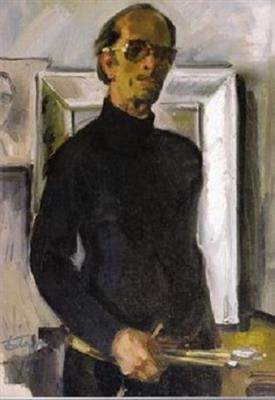
Boyukagha Mirzazade spent his long career at the intersection of painting and theatre design, producing work that documented Azerbaijani life across some of the most turbulent decades of the Soviet century. Born in Baku on 21 February 1921[1], he studied at the city's Technical School of the Arts under Azim Azimzade, the caricaturist and illustrator widely regarded as the founder of modern Azerbaijani art. The lineage mattered: Azimzade had trained in Tiflis and St Petersburg before returning to document Azerbaijani society in a distinctively local vernacular, and his students inherited that orientation toward place and identity.
Biography
Mirzazade briefly enrolled at the Moscow Institute of Fine Arts in 1940[1] but left when the Soviet Union entered the Second World War. He returned to Baku and built a career that combined painting with stage design, eventually contributing sets and costumes for roughly twenty theatrical productions. The institutional recognition came steadily: he was named People's Artist of the Azerbaijan SSR in 1967 and later received both the State Prize of Azerbaijan and the Order of the Red Banner of Labour.
His canvases entered the permanent collections of the Azerbaijan State Museum of Art, the Nizami Ganjavi National Museum of Azerbaijani Literature, and the Baku Museum of Modern Art. Alongside his studio practice, he taught for decades at the Azerbaijan State Academy of Fine Arts and the Azerbaijan State University of Culture and Arts, serving as department head and professor.
Mirzazade died in Baku on 3 November 2007[1], aged 86, after more than six decades as a working artist and educator. The Shohrat Order, awarded by the independent Republic of Azerbaijan after the Soviet collapse, suggested that his standing survived the political transition intact.
Timeline
- 1921Born in Baku on 21 February. He became a painter and theatre designer.
- 1940Enrolled at the Moscow Institute of Fine Arts, but left due to the Second World War.
- 1967Named People's Artist of the Azerbaijan SSR.
- 2007Died in Baku on 3 November, aged 86. He had been an artist and educator for over six decades.
Notable Works
Tap to view larger.
Next stop
Browse the movements →
Every movement in the collection, from the Renaissance to Pop art.
Related Artists



Frequently Asked Questions
What is Boyukagha Mirzazade known for?
Boyukagha Mirzazade is known for his paintings and stage designs, contributing sets and costumes for around twenty theatrical productions. He was named People's Artist of the Azerbaijan SSR in 1967[1] and received the State Prize of Azerbaijan and the Order of the Red Banner of Labour.What is Boyukagha Mirzazade's most famous work?
It is difficult to name Boyukagha Mirzazade's single most famous work. He was a prolific artist who worked across a range of media, including graphic art, painting, and decorative panels. Mirzazade is known for his illustrations of literary works dealing with the Caucasus region. These include Leo Tolstoy’s stories *Hadji-Murat* (illustrated in multiple editions between 1912 and 1941[1]) and *The Cossacks* (1917-37), as well as Lermontov’s fairy tales *Ashik-Kerib* (1914-15) and his poem *The Demon* (1914-16). He also produced many graphic works and paintings of Saint Petersburg during the 1900s and early 1910s. Examples include *The Old St. Nicholas Market in Saint Petersburg* (1901), *Peter the Great’s Boat* (1906), and *The Kazan Cathedral* (1903). Later, from the late 1910s to the first half of the 1930s, he created works devoted to the Caucasus, showing views, architectural monuments and local people. Other significant projects include his decorative paintings for the Large Moscow Hotel (1906) and other locations. Between 1935 and the early 1940s, he designed decorative panels for the Moscow metro, the Moscow Hotel, the Lenin Library, and the Bolshoi Theatre.What style or movement did Boyukagha Mirzazade belong to?
It is difficult to assign Boyukagha Mirzazade to a single style or movement. Styles are manners or devices by which works are created; each work possesses a style specific to itself, irrespective of period. However, analysis of art from the early 20th century indicates some trends that may be relevant. Movements advocating the coloured surface gained traction, leading to theories of displaced coloured surfaces and surface movement. Rondism, constructing according to the curve of a circle, also emerged. Cubism sought to expose the third dimension through form, often employing chiaroscuro. Futurism, originating in Italy, promoted dynamism, addressing movement because painting is essentially static. Cubism manifested in classical, academic, romantic, and realist forms, even abstract ones. Futurism influenced some cubists, resulting in a transitory cubism with futurist characteristics.Where can I see Boyukagha Mirzazade's work?
Boyukagha Mirzazade's work can be viewed in various public and private collections. These include the Los Angeles County Museum of Art (LACMA), the Metropolitan Museum of Art, the Royal Ontario Museum, and the National Museums of Scotland. Other locations are the Victoria and Albert Museum in London, the Freer Gallery of Art, and the Arthur M. Sackler Gallery in Washington, DC. Additional museums holding relevant collections are the Staatliche Museen Preussischer Kulturbesitz in Berlin, the Brooklyn Museum in Brooklyn, the British Museum in London, the Calouste Gulbenkian Museum in Lisbon, and the State Hermitage Museum in St Petersburg, Russia. The Musée du Louvre and the Musée des Arts Décoratifs, both in Paris, also hold relevant works. These museums house significant collections of Islamic art, which may include works similar to Mirzazade's.Who did Boyukagha Mirzazade influence?
It is difficult to say precisely who Boyukagha Mirzazade influenced. However, the broader context of Islamic and Middle Eastern art history may provide some insight. Mughal painting adopted subjects similar to those in Safavid history books, such as legendary stories, local events, portraits, and genre scenes. A new style of execution emerged around 1567, exemplified by the manuscript *Dastan-e Amir Hamzeh* (Stories of Amir Hamzeh). Traditional Iranian themes like battles and feasts gained monumentality through the size of the images and the depiction of objects and figures in terms of mass rather than line. While some colourfulness was lost, the images acquired greater expressive power. Mughal portraiture also conveyed a stronger sense of individuality compared to Safavid portraits. European art began to affect Islamic art, with Ottoman architecture being influenced from the beginning. In Mughal India, European ideas about space influenced painting in the 18th century, and Persian painting has shown constant Western influence since the 17th century.Who influenced Boyukagha Mirzazade?
It is difficult to summarise the influences on Boyukagha Mirzazade, as sources do not directly address this topic. However, we can infer some influences based on the artistic climate of his time and place. Figures such as Mikhail Vrubel were important for many early avant-garde artists. His deconstructive approach to form and emphasis on underlying structure had a significant effect on artists like Gabo, Rodchenko, and Tatlin. Vrubel's method involved dividing compositions into geometric patterns and consciously using texture, which produced a constructive effect. Additionally, the Russian[1] avant-garde was influenced by Tolstoy's philosophy of art. Tolstoy prioritised creative intuition over professional skill, and his ideas about art as a means of expressing emotion resonated with artists searching for new ideologies. Figures such as Elena Guro engaged with Tolstoy's ideas, critiquing and building upon them in their own work. The avant-garde also drew inspiration from folk art, children's drawings, and non-Western traditions, challenging established aesthetic norms.Who was Boyukagha Mirzazade?
Boyukagha Mirzazade (dates unknown) was an artist who worked in graphic design and painting. He is known for his book covers and illustrations, as well as his paintings of Saint Petersburg and the Caucasus. He designed covers for books such as Muther’s *History of Painting in the Nineteenth Century* (1902), *Portraits of Russian[1] Writers* (1903), and Alexander Benois’ *Russian School of Painting* (1904). Mirzazade also illustrated literary works dealing with the Caucasus, including Leo Tolstoy’s stories *Hadji-Murat* (1912-16, 1931[1], 1936-37, 1941) and *The Cossacks* (1917-37), as well as Lermontov’s fairy tales *Ashik-Kerib* (1914-15) and his poem *The Demon* (1914-16). His paintings from the 1900s to the mid-1910s often depicted Saint Petersburg, while his works from the late 1910s to the mid-1930s focused on the Caucasus. Mirzazade also produced sketches for decorative paintings in various locations, including the Large Moscow Hotel (1906) and the Palace of Railroad Workers in Kharkov (1931).How did Boyukagha Mirzazade die?
Boyukagha Mirzazade died in 2007[1] at the age of 86.
Sources
Editorial draws on the following primary and tertiary references for Boyukagha Mirzazade.
- [1] wikipedia Wikipedia: Boyukagha Mirzazade Used for: biography, birth dates, death dates, identifiers, movement attribution, nationality.
- [2] book MARCUS. MILWRIGHT, A Story of Islamic Art Used for: biography.
- [3] book Roxburgh, David J., Envisioning Islamic Art and Architecture: Essays in Honor of Renata Holod Used for: biography, stylistic analysis.
- [4] book guggenheim-twopri00weis Used for: biography.
- [5] book Milwright, Marcus, Islamic Arts and Crafts: An Anthology Used for: stylistic analysis.
- [6] book Masterpieces of western art : a history of art in 900 individual studies from the Gothic to the present day Used for: biography.
Editorial overseen by Solis Prints. Sources verified 2026-09-30. Click a source for details, or hover over [N] in the page above to preview.
Editorial standardsMethodologyCorrectionsAI disclosureAbout the editorial team