

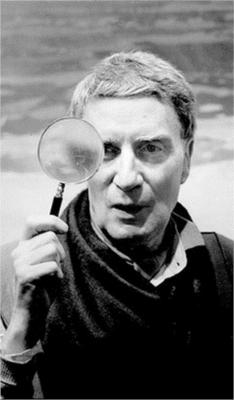
Brion Gysin
- Beat Generation
Brion Gysin told William Burroughs that 'writing is fifty years behind painting,' and then handed him the tool to close the gap: the cut-up technique, which Gysin had stumbled upon while slicing newsprint with a Stanley knife. Burroughs credited him with introducing 'the writer to collage, which has been used by painters for fifty years.' The exchange, at Paris's Beat Hotel in 1958[1], reshaped avant-garde literature.
Biography
Born in Taplow, England in 1916[1] and raised in Canada, Gysin arrived in Paris in 1934[1] to study at the Sorbonne, where his social circle quickly included Max Ernst, Meret Oppenheim, Salvador Dalí, and Picasso. In New York by 1940, he shared a studio with Roberto Matta and met Jackson Pollock and Arshile Gorky. It was a formation that made him as much painter as writer: Burroughs later described Gysin's canvases as 'the psychic landscape of my own work.'
Gysin's calligraphy-based paintings drew on his years in Morocco running a restaurant in Tangier, and on his study of Sufi ceremonial traditions. His other major invention, the Dreamachine (1959[1], co-developed with Ian Sommerville), was a slotted cylinder rotating around a light bulb at a frequency designed to induce closed-eye hallucinations by synchronising with the brain's alpha waves.
Despite his influence, institutional recognition came slowly. Burroughs held Gysin's first major solo exhibition only after Gysin's death in Paris in 1986[1]. The cut-up technique has since become standard vocabulary for experimental writing, music, and visual art.
Timeline
- 1916Born in Taplow, England.
- 1934Arrived in Paris at 18 to study at the Sorbonne.
- 1940Shared a studio with Roberto Matta in New York, and met Jackson Pollock and Arshile Gorky.
- 1958Introduced William Burroughs to the cut-up technique at the Beat Hotel in Paris.
- 1959Co-developed the Dreamachine with Ian Sommerville.
- 1986Died in Paris. His first major solo exhibition was held posthumously by William Burroughs.
Notable Works
Tap to view larger.
Next stop
Browse the movements →
Every movement in the collection, from the Renaissance to Pop art.
Related Artists
_%E2%80%93_LOC.jpg)


Frequently Asked Questions
What is Brion Gysin known for?
Brion Gysin is known for his avant-garde writing techniques and his paintings. He is also known for co-developing the Dreamachine with Ian Sommerville, a device that used light and frequency to induce closed-eye hallucinations.What is Brion Gysin's most famous work?
Brion Gysin is perhaps best known for his role in experimental art and literature, particularly his explorations of cut-up techniques and permuted poems. While he produced a diverse body of work, encompassing painting, drawing, and performance, there isn't one single piece that overshadows all others as his 'most famous'. His artistic practice often involved collaboration and innovation. He worked with William S. Burroughs on cut-up writing methods, which involved dissecting and rearranging texts to create new meanings. Gysin also invented the 'Dreamachine', a stroboscopic device intended to produce visual stimuli when viewed with closed eyes. Although not a conventional artwork, the Dreamachine is a well-known example of Gysin's interest in altering perception and exploring the subconscious. His theories and experiments had an impact on avant-garde art and literature.What should I know about Brion Gysin's prints?
Brion Gysin (1916[1]-1986[1]) was a painter, writer, sound poet, and performance artist, associated with the Beat Generation[1] and known for his experimental techniques. While specific details about Gysin's printmaking are scarce, it is helpful to consider some general aspects of printmaking and related practices by his contemporaries. Printmaking allows for the production of multiple original artworks, often involving collaboration with skilled technicians, due to the complex processes and equipment. Artists may create prints as versions of existing works or as natural corollaries, exploring different aesthetic or technical aspects. Some artists, like Richard Hamilton, incorporated photography and commercial printing methods into their practice. Hamilton's work with prints involved retouching, dye transfer, and offset lithography. He combined mass-produced objects with hand-painted marks, blurring the lines between the original artwork and promotional material. Such approaches resonate with Gysin's experimental ethos and his interest in exploring the boundaries between art and other forms of expression.What style or movement did Brion Gysin belong to?
Brion Gysin was associated with several artistic movements during his career. These include Lettrism, the Situationist International, and the Beat Generation[1]. He is also known for his association with the cut-up technique, a method of writing and art-making popularised by William S. Burroughs. Lettrism, founded in the 1940s by Isidore Isou, focused on letters and typography as primary elements of artistic expression. The Situationist International, active from the late 1950s to the early 1970s, advocated for revolutionary social change through art and urbanism. The Beat Generation, emerging in the 1950s, was a literary movement that explored themes of counterculture and nonconformity. Gysin's work often combined elements of these movements, reflecting an interest in experimental techniques and unconventional ideas.What techniques or materials did Brion Gysin use?
Brion Gysin was an experimental artist who worked across different media. He is associated with techniques such as the cut-up, the permutation poem, and the Dreamachine. The cut-up technique, which Gysin developed with William S. Burroughs in the late 1950s, involved cutting up written texts or other media and reassembling them in random or semi-random ways. This method aimed to disrupt conventional meanings and create new associations. Gysin applied the cut-up method to painting, creating works with fragmented and layered imagery. Gysin also experimented with permutation poems, where lines of text are rearranged to generate different combinations and meanings. This technique, like the cut-up, explored the possibilities of chance and altered perspectives. Another of Gysin's notable inventions was the Dreamachine, a stroboscopic device designed to produce visual hallucinations when viewed with closed eyes. The Dreamachine, created with Ian Sommerville in 1961[1], comprised a rotating cylinder with cut-out patterns and a light bulb. Gysin believed the Dreamachine could expand consciousness and offer new creative experiences.What was Brion Gysin known for?
Brion Gysin (1916[1]-1986[1]) was a painter, writer, sound poet, and performance artist. He is best known as an innovator of experimental techniques, often in collaboration with his friend William S. Burroughs. Gysin's artistic career began in Paris in the 1930s. He was associated with the Surrealist group, but later rejected their aesthetic. His early paintings often featured Arabic calligraphy, reflecting his interest in Moroccan culture. He lived for extended periods in Tangier, where he ran a restaurant called The 1001 Nights. In the late 1950s, Gysin invented the "cut-up" technique for writing, which involved cutting up and rearranging existing texts to create new meanings. Burroughs adopted and popularised this method. Gysin also experimented with sound poetry, creating compositions using electronically manipulated voices. Another important invention was the "Dreamachine", a stroboscopic device designed to produce visual hallucinations when viewed with closed eyes. Gysin believed the Dreamachine could unlock the creative potential of the mind. He continued to explore these interests in his paintings, writings, and performances until his death in 1986[1].When did Brion Gysin live and work?
Brion Gysin was born in London on 24 February 1922[1]. After spending much of his life in Europe and North Africa, he died in Paris on 13 July 1986[1]. He began evening art classes in Pimlico in 1934, then studied at Westminster Technical College and Saint Martin's School of Art from 1936. In 1938, he studied painting at the Royal Academy Schools until 1940. After military service and further study at the Slade School of Art, Gysin had his first one-man exhibition in 1950. Gysin taught design to silversmithing, typography, and industrial design students at the Central School of Arts and Crafts from 1952 to 1953. He was also a member of the Independent Group, formed at the Institute of Contemporary Arts. From 1953 to 1966, he lectured at King's College, University of Durham (later the University of Newcastle-upon-Tyne), teaching a Basic Design Course. He also taught Interior Design at the Royal College of Art from 1957 to 1961.Where can I see Brion Gysin's work?
Brion Gysin's artwork can be found in several public collections. These include museums in Europe, North America, and elsewhere. The Tate Gallery in London holds a number of Gysin's works. The British Museum also owns some of his pieces, particularly those related to his calligraphic experiments. In Paris, the Centre Pompidou has examples of his paintings and permutational poems. Across the Atlantic, the Museum of Modern Art (MoMA) in New York City includes Gysin's work in its collection. Further afield, institutions such as the Sharjah Art Foundation in the United Arab Emirates sometimes exhibit his pieces. Smaller galleries and private collections also contain Gysin's output. However, access to these works may be limited. Major museums offer the most reliable opportunity to view his creations. Always check museum websites for current exhibitions.Where was Brion Gysin from?
Brion Gysin was born in Taplow, Buckinghamshire, on 19 January 1916[1]. His parents were American[1], but Gysin spent much of his life outside the United States. He was educated at Downside School, near Bath, and later studied at the Sorbonne in Paris. During the Second World War, Gysin was based in Canada, working as a codebreaker. After the war, he travelled extensively, spending time in Tangier, Morocco, where he ran a restaurant called The 1001 Nights. Gysin's artistic practice was varied. He experimented with painting, writing, sound poetry, and performance. He is perhaps best known for his involvement with the cut-up technique, a method of rearranging text to create new meanings, which he developed with William S. Burroughs. He died in Paris in 1986[1].Who did Brion Gysin influence?
Brion Gysin's artistic explorations had an impact on a range of figures, particularly in literature and music. William S. Burroughs was a close collaborator. They worked together on experimental techniques, such as the cut-up method, which involved fragmenting and rearranging text to create new meanings. Burroughs adopted this method in his novels. Gysin's interest in sound and technology also influenced musicians. He experimented with tape loops and other audio techniques, prefiguring some developments in electronic music. The composer and musician David Bowie was aware of Gysin's work. Some sources claim Gysin's theories about sound influenced Bowie's creative process, although the precise nature and extent of this influence remains open to interpretation. Beyond these figures, Gysin's ideas about art, technology, and consciousness have resonated with various countercultural movements and experimental artists. His interdisciplinary approach and interest in exploring the boundaries of perception continue to be a source of interest for those working in diverse creative fields.Who influenced Brion Gysin?
Brion Gysin's artistic development involved several influences, particularly in literature and painting. Early exposure to Surrealism shaped his initial artistic direction. He admired the work of Surrealist artists such as René Magritte and Salvador Dalí. Their impact is visible in Gysin's early paintings, which often explored dreamlike imagery and unconventional juxtapositions. Gysin's time in Paris during the 1930s exposed him to the ideas of the Surrealist movement, which promoted the irrational and the liberation of the imagination. Later, his association with the Beat Generation[1], especially William S. Burroughs, significantly altered his creative path. Gysin and Burroughs collaborated on experimental literary techniques, such as the cut-up method. This technique involved cutting up and rearranging existing texts to create new meanings. Gysin also drew inspiration from non-Western art forms. His travels in North Africa, particularly his time in Morocco, exposed him to different aesthetic traditions. He incorporated elements of calligraphy and geometric patterns into his visual work. These diverse influences contributed to Gysin's unique and experimental artistic style, which spanned painting, writing, and multimedia installations.Who was Brion Gysin?
Brion Gysin (1916[1]-1986[1]) was a painter, writer, sound poet, and performance artist, most associated with the Beat Generation[1]. Born in Taplow, Buckinghamshire, he was raised in Canada. He returned to Europe to study at the Sorbonne in Paris. He became involved with Surrealism in the 1930s; however, by 1936[1], he was refused participation in the International Surrealist Exhibition in London. After war service, Gysin settled in Tangier, Morocco, where he ran a restaurant. He experimented with calligraphy and painting, often inspired by North African motifs. In the late 1950s, he invented the "cut-up" technique with William S. Burroughs, a method of rearranging text to create new meanings. He applied this technique to sound, creating sound poetry. Gysin also invented the "Dreamachine", a stroboscopic device intended to produce visual hallucinations. He collaborated with musicians, writers, and artists throughout his career, exploring the boundaries of consciousness and perception.
Sources
Editorial draws on the following primary and tertiary references for Brion Gysin.
- [1] wikipedia Wikipedia: Brion Gysin Used for: biography, birth dates, death dates, identifiers, movement attribution, nationality.
- [2] book guggenheim-futurismmodernfo00solo Used for: biography.
- [3] book guggenheim-masterp00solo Used for: biography.
- [4] book guggenheim-rroseisr00bles Used for: biography, stylistic analysis.
- [5] book guggenheim-twopri00weis Used for: biography, stylistic analysis.
- [6] book Hammond, Paul, The shadow and its shadow : surrealist writings on the cinema Used for: stylistic analysis.
Editorial overseen by Solis Prints. Sources verified 2026-10-16. Click a source for details, or hover over [N] in the page above to preview.
Editorial standardsMethodologyCorrectionsAI disclosureAbout the editorial team