



Burhan Dogancay
In 1964[3], Thomas M. Messer, the director of the Guggenheim Museum, told Burhan Dogancay he should quit his day job. Dogancay had arrived in New York two years earlier on diplomatic service for the Turkish[3] government; Messer had seen his paintings. He quit the diplomatic service and spent the next fifty years photographing walls.
Biography
Born in Istanbul in 1929[3] to a painter father, Adil Dogancay, Burhan trained in law at the University of Ankara and took a doctorate in economics from the University of Paris, where he also attended the Académie de la Grande Chaumière. From the mid-1970s onward, his Walls of the World project consumed the rest: more than 30,000 photographs of urban walls across 100 countries on five continents, documenting the sedimentary layers of posters, graffiti, peeling paint, and official notices that accumulate on vertical surfaces in cities.
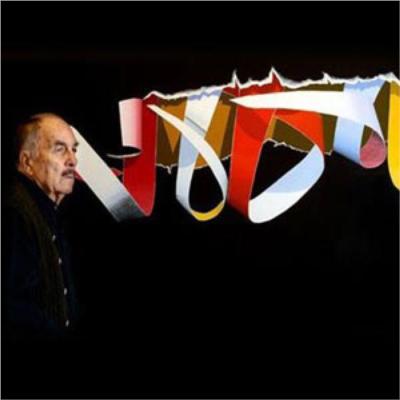
His Ribbon series, developed in the 1970s and 1980s, translates the wall-observation into painting and sculpture. Strips of paper, photographed or rendered in oil and acrylic, generate shadows with the precision of calligraphy. The series later moved into aluminium composite sculptures and Aubusson tapestries.
In 2004[3], Dogancay established his own museum in Istanbul, the first contemporary art museum in Turkey dedicated to a single artist's work. Symphony in Blue (1987), a major Ribbon canvas, sold at auction for 1.7 million dollars in 2009. His work is held at MoMA, the Metropolitan Museum, and the Guggenheim. He died in January 2013[3].
Timeline
- 1929Born in Istanbul to painter Adil Dogancay.
- 1962Moved to New York while in diplomatic service for the Turkish government.
- 1964Burhan Dogancay was encouraged by Thomas M. Messer, director of the Guggenheim Museum, to quit his diplomatic service job and focus on art.
- 1970Started his Walls of the World project, photographing urban walls across 100 countries.
- 1970Developed his Ribbon series, translating wall observations into paintings and sculptures.
- 1987Created "Symphony in Blue", a major Ribbon canvas.
- 2004Established his own museum in Istanbul, the first contemporary art museum in Turkey dedicated to a single artist's work.
- 2009His canvas "Symphony in Blue" sold at auction for 1.7 million dollars.
- 2013Died in January, aged 83.
Notable Works
Tap to view larger.
Next stop
Browse the movements →
Every movement in the collection, from the Renaissance to Pop art.
Related Artists


Frequently Asked Questions
What is Burhan Dogancay known for?
Burhan Dogancay is known for his Walls of the World project, which involved over 30,000 photographs of urban walls across 100 countries. He is also known for his Ribbon series, which translated his wall observations into paintings and sculptures using strips of paper, oil, and acrylic.What is Burhan Dogancay's most famous work?
It is difficult to name one single work as Burhan Dogancay's 'most famous', but his series of 'Walls' is certainly among his best-known and critically appreciated work. These pieces, begun in the 1960s, depict urban walls from cities around the world. Dogancay photographed walls in various states of repair, covered in graffiti, posters, and other markings, and then recreated these images in his paintings and collages. Dogancay was interested in the way that walls reflect the passage of time and the history of a place. He saw them as a kind of urban archaeology, revealing layers of human activity and expression. His 'Walls' series has been exhibited in museums and galleries around the world, and his work is held in the collections of major museums, including the Museum of Modern Art in New York, the Centre Pompidou in Paris, and the British Museum in London.What should I know about Burhan Dogancay's prints?
When considering Burhan Dogancay's prints, it is useful to understand some basic principles of printmaking. An original print is conceived as a print and executed solely as a print. Each print is made from a plate, stone, screen, or block created for that purpose. There is no single original from which copies are made; instead, each print is individually inked and pulled. The artist decides the number of prints in the edition. Reproductions, on the other hand, are copies of artworks originally created in another medium, such as painting or watercolour, and are usually made by photomechanical means. Numbering and signing a reproduction does not transform it into an original print. The market plays a significant role in determining the worth of art. The context of a print, including its purpose and the social group it targets, influences its production. The decision to limit an edition is the artist's choice, not a technical requirement. Editions are often marked with a print number and an edition number, along with the title and signature, typically in pencil.What style or movement did Burhan Dogancay belong to?
It is difficult to place Burhan Dogancay within a single style or movement. Some sources connect tendencies in art with other aspects of life, such as architecture and clothing. They suggest looking at the variegated surfaces and polychromy in decoration of churches and monuments. This approach may reveal connections between Dogancay's art and broader cultural trends. Other sources mention Persian and Mughal miniatures or nineteenth-century orientalist painters. These are inspirations for designers, with patterns and colours from tiles, carpets and antique textiles. However, these elements are transposed with interpretation. The sources become obscured in cultural fusion. Without more information, it is not possible to align Dogancay with a specific artistic movement.What techniques or materials did Burhan Dogancay use?
Burhan Dogancay was known for his use of urban walls as both subject matter and inspiration. He photographed walls in cities around the world, then reinterpreted these images in his art. Dogancay employed a variety of media. These included collage, photography, painting, drawing, and printmaking. He often combined techniques in a single work. His paintings frequently incorporated elements of collage, using torn paper, posters, and other found materials to build up textured surfaces. He was interested in the layering and decomposition of walls, and his techniques mirrored this process. Dogancay also developed unique methods. One such method was "folding-crushing," where he folded and crushed paper before applying paint. This created irregular surfaces and unpredictable effects. His work often included calligraphic elements, reflecting his Turkish[3] heritage and interest in script as a visual form. He experimented with different types of paint, from acrylics to watercolours, adapting his approach to suit the specific qualities of each material.When did Burhan Dogancay live and work?
Burhan Dogancay was born in Istanbul in 1929[3]. He had his first one-man art show while pursuing his law degree at Ankara University. He then earned a PhD in economics at the University of Paris. Although he worked in the field of economics, art remained central to his life. In 1964[3], Dogancay relocated to New York City and fully dedicated himself to art. His works have been displayed in numerous solo exhibitions, and are part of collections in museums around the world. Dogancay is best known for his series focusing on urban walls. He photographed walls in cities across the globe, later using them as inspiration for paintings, sculptures, and collages. He died in Istanbul in 2013[3].Where can I see Burhan Dogancay's work?
Many museums hold works by Burhan Dogancay. These include institutions in the United States, such as the Metropolitan Museum of Art (New York), the Museum of Modern Art (New York), the Los Angeles County Museum of Art, the Minneapolis Institute of Arts, the Virginia Museum of Fine Arts (Richmond), the Wolfsonian at Florida International University (Miami Beach), and the Charles Hosmer Morse Museum of American Art (Winter Park, Florida). In Canada, Dogancay's work can be seen at the Royal Ontario Museum (Toronto). European venues include the Victoria & Albert Museum (London), the National Museums of Scotland (Edinburgh), the Manchester Art Gallery, the Brighton Museum & Art Gallery, the Geffrye Museum (London), and the Bakelite Museum (Williton, UK). Other European museums that hold his work are the Museu Calouste Gulbenkian (Lisbon), the Museu d’Art Modern (Barcelona), and the Museo Art Nouveau y Art Deco (Salamanca, Spain).Where was Burhan Dogancay from?
Burhan Dogancay was born in Istanbul, Turkey, in 1929[3]. His early life involved a mix of artistic pursuits and academic studies. He began painting at a young age, encouraged by his father, Adil Dogancay, who was also an artist. Dogancay's initial career path led him to economics. He received a law degree from Ankara University in 1950[3] and later earned a doctorate in economics from the University of Paris in 1953. While in Paris, he continued to develop his artistic skills at the Académie de la Grande Chaumière. In 1964, Dogancay made the decision to move to New York City, where he fully dedicated himself to art. This move marked a significant point in his career, allowing him to immerse himself in the city's artistic environment. He is best known for his focus on urban walls, which he saw as reflections of society. Dogancay travelled extensively, documenting walls in various cities around the world. He died in Istanbul in 2013[3].Who did Burhan Dogancay influence?
It is difficult to identify specific artists who were directly influenced by Burhan Dogancay. However, consideration of artistic influence requires analysis of Dogancay's historical context, as well as the artistic movements and traditions that shaped his work. For instance, the modernisation of Ottoman art education in the late 19th century involved a fusion of Western techniques with local traditions. This environment produced artists such as Şeker Ahmed Paşa and Hüseyin Zekâî, who blended documentary styles with fine-art painting. Similarly, the fusion of Turkmen and Timurid styles in 15th-century Persian painting demonstrates how artistic movements can combine different traditions, influencing subsequent generations. George Chinnery's teaching in India also illustrates the transmission of artistic idioms, as seen in the work of his pupils Charles D'Oyly and William Prinsep. These examples show how influence occurs through a complex interplay of artistic traditions, education, and individual vision.Who was Burhan Dogancay?
Without reference material about Burhan Dogancay, I cannot provide a specific answer to your question. However, I can offer a general response based on the assumption that you are seeking biographical information about an artist. To find information about an artist, one might consult art historical resources; these include academic books, journal articles, and museum or gallery publications. Catalogues raisonnés offer comprehensive listings of an artist's work, while exhibition catalogues and scholarly essays analyse their practice within broader artistic movements or historical contexts. In addition, biographical dictionaries and encyclopaedias of artists can provide summaries of their life and career. Primary source material, such as the artist's writings or interviews, can also give valuable insight. Examination of these resources should provide a detailed understanding of the artist's background, artistic development, and place within art history.Why are Burhan Dogancay's works important today?
Burhan Dogancay's art remains important because of its focus on urban walls as a reflection of society. His work captured the energy of city life. Dogancay's images of walls, with their layers of graffiti and posters, provide a record of social change. Born in Istanbul in 1929[3], Dogancay pursued degrees in law and economics before dedicating himself to art. He moved to Paris in the 1960s, and then to New York. His travels influenced his artistic vision. Dogancay's work moved beyond simple documentation. He transformed the mundane into art. His images of walls became abstract compositions. These works invite viewers to consider the stories behind the surfaces. They prompt reflection on urban existence. His paintings, drawings, and collages offer a unique perspective on the world. Dogancay died in 2013[3]. His art continues to resonate with audiences.
Sources
Editorial draws on the following primary and tertiary references for Burhan Dogancay.
- [1] museum Harvard Art Museums Used for: museum holdings.
- [2] museum Victoria and Albert Museum Used for: museum holdings.
- [3] wikipedia Wikipedia: Burhan Dogancay Used for: biography, birth dates, death dates, identifiers, movement attribution, nationality.
- [4] book guggenheim-carlandre00wald Used for: biography, stylistic analysis.
- [5] book guggenheim-guggenheimintern1964allo Used for: biography.
- [6] book guggenheim-handboo00pegg Used for: biography, stylistic analysis.
- [7] book guggenheim-refigur00kren Used for: biography.
- [8] book guggenheim-robertm00morr Used for: biography, stylistic analysis.
- [9] book Masterpieces of western art : a history of art in 900 individual studies from the Gothic to the present day Used for: biography.
Editorial overseen by Solis Prints. Sources verified 2026-09-30. Click a source for details, or hover over [N] in the page above to preview.
Editorial standardsMethodologyCorrectionsAI disclosureAbout the editorial team