



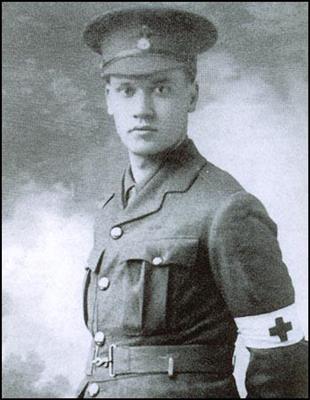
Timeline
- 1889Born as Christopher Richard Wynne Nevinson.
- 1912Studied at the Académie Julian in Paris, where he encountered Marinetti and the Italian Futurists.
- 1914Co-signed the Vital English Art manifesto with Marinetti.
- 1915Painted "La Mitrailleuse", depicting French machine-gunners; Walter Sickert praised it as a definitive statement on the war.
- 1916His exhibition at the Leicester Galleries sold out.
- 1917Appointed official war artist in April and visited the Western Front in July.
- 1917His painting "Paths of Glory", depicting dead British soldiers, was censored by the War Office.
- 1940Served as a stretcher-bearer during the Blitz.
- 1946Died in 1946, weeks after his final Royal Academy exhibition.
Notable Works
Tap to view larger.
Next stop
Futurism →
Explore the artists and ideas of Futurism.
Related Artists


Frequently Asked Questions
What is C. R. W. Nevinson known for?
C. R. W. Nevinson is known for his paintings of mechanised carnage during the First World War. His 1916[1] exhibition at the Leicester Galleries sold out, and Walter Sickert called his painting La Mitrailleuse (1915) the most authoritative statement on the war in the history of painting.What should I know about C. R. W. Nevinson's prints?
C. R. W. Nevinson produced prints using various methods, including woodblock. The number of prints from a woodblock is not limited by the block itself, provided it is cared for. A wood engraving of Newcastle by Thomas Bewick was printed 900,000 times. The artist usually makes the decision to limit an edition, not technical issues. Most printmakers limit their editions. An edition is a number of identical prints that are produced from the same block, and these come in two forms: an ‘open’ edition or a ‘limited’ edition. Cleaning a slab or roller requires removing as much old ink as possible with a scraper or by rolling it onto newspaper. Washing-up liquid softens what remains. A squeegee gathers the resulting liquid, which can be scooped up into newspaper. The slab can be finished off with cotton rag and water; white spirit is an alternative if using oil-based ink. Roll off as much ink as possible from the roller onto newspaper, then soften all the ink using washing-up liquid only, before washing the roller with warm water and washing-up liquid.What style or movement did C. R. W. Nevinson belong to?
C. R. W. Nevinson was associated with multiple early twentieth-century art movements, most notably Futurism[1]. This Italian movement, launched in 1909[1] by Filippo Tommaso Marinetti, promoted revolution in both art and society. Futurists aimed to usher in a more enlightened era by embracing war and modern technology. They sought to destroy cultural institutions such as museums and libraries, while celebrating the dynamism of machinery. Nevinson's association with Futurism is evident in his focus on motion, speed, and the energy of modern life. Umberto Boccioni, a key figure in Futurism, used Cubist techniques to express these concepts, influencing Nevinson's work. Although Futurism declined after World War I, its ideas were adopted in France, America, and Russia, where it evolved into Cubo-Futurism. This offshoot differed from Italian Futurism by rarely glorifying machines, especially as instruments of war.What techniques or materials did C. R. W. Nevinson use?
C. R. W. Nevinson's techniques involved a range of materials and methods, reflecting the artistic currents of his time. Like many artists, he experimented with different approaches to achieve his desired effects. Examination of paintings by his contemporaries, such as Whistler, reveals insights into the period's practices. Whistler often employed dark grey grounds, carefully prepared palettes, and a limited range of colours. He was known to scrape down unsuccessful areas and was interested in texture. Whistler mixed his oil paint with turpentine and mastic varnish, creating a "sauce" that allowed for free brushwork, and controlled colour and tone through the thickness of application. Similarly, Turner, another British[1] artist, initially worked as a watercolourist before transitioning to oils. This background influenced his oil painting techniques, including the use of transparent washes and optical mixing of colours. Turner also favoured absorbent primings, which provided a rapid indication of the final colour.What was C. R. W. Nevinson known for?
C. R. W. Nevinson was known for his association with Futurism[1], an early 20th-century artistic and social movement that originated in Italy. Futurism, founded in 1909[1] by Filippo Tommaso Marinetti, celebrated modernity, technology, speed, and dynamism. It sought to break away from the past and embrace the future. Nevinson, along with other British[1] artists, briefly aligned himself with Futurism around 1913. These artists, including Wyndham Lewis, exhibited under the banner of both Cubism and Futurism. Nevinson's work during this period reflected Futurist themes, such as the energy of modern life and the experience of movement. However, the association was short-lived. By 1914, disagreements arose between the British artists and Marinetti, leading to a split. Despite his brief involvement, Nevinson's Futurist-influenced works remain an important aspect of his artistic output.When did C. R. W. Nevinson live and work?
Christopher Richard Wynne Nevinson was born on 13 August 1889[1] in London. He died there on 7 October 1946[1]. Nevinson was the son of the writer and war correspondent Henry Woodd Nevinson and the suffragist and writer Margaret Wynne Nevinson. Nevinson studied at the Slade School of Art. There, he met Mark Gertler, Stanley Spencer, and Dora Carrington. He befriended the Italian Futurist Marinetti, and was influenced by his ideas. Nevinson’s early work aligned with Futurism[1], and he was a founder member of the short-lived Rebel Art Centre. During the First World War, he served as an ambulance driver. The conflict had a marked effect on his art, and he became known for his paintings of wartime subjects, often with a focus on the mechanisation and dehumanisation of modern warfare. After the war, Nevinson moved away from Futurism. He explored urban themes, and painted cityscapes of London, Paris, and New York.Where can I see C. R. W. Nevinson's work?
C. R. W. Nevinson's art can be seen in numerous galleries and museums. In London, his work is held at the British[1] Museum, the Courtauld Institute of Art Gallery, the Imperial War Museum, the National Gallery, the National Portrait Gallery, the Saatchi Gallery, Tate Modern, and the Victoria and Albert Museum. Outside of London, Nevinson's pieces can be viewed at the Towneley Hall Art Gallery (Burnley), the Fitzwilliam Museum (Cambridge), the National Museum of Wales (Cardiff), the National Gallery of Scotland and the Scottish National Gallery of Modern Art (Edinburgh), the Burrell Collection (Glasgow), the Jersey Museum and Art Gallery (St Helier), and the Leeds City Art Gallery. Other locations include the Aberdeen Art Gallery and Museum, the Ulster Museum (Belfast), the Barber Institute of Fine Arts (Birmingham), the Bristol Art Gallery, and the Walker Art Gallery (Liverpool).Who influenced C. R. W. Nevinson?
C. R. W. Nevinson was exposed to diverse artistic influences during his education. From 1903[1] to 1907, he studied at the St John's Wood School of Art. He then studied at the Slade School of Art between 1908 and 1912; there, he encountered the teachings of Henry Tonks, a figure known for his traditional approach. A more radical shift occurred in Nevinson's artistic development when he moved to Paris in 1911. There, he attended the Académie Julian and came into contact with the literary figure Gertrude Stein, as well as artists working in avant-garde styles. He met both Gino Severini and Ardengo Soffici; they persuaded him to join the Futurist movement. Nevinson's time in Italy further solidified his engagement with Futurism[1]; he signed the Futurist Painting Technical Manifesto in 1914. Futurism, with its emphasis on dynamism and the depiction of movement, became a defining element in Nevinson's early work. However, his style later evolved to include other influences, particularly after his experiences during the First World War.How did C. R. W. Nevinson die?
C. R. W. Nevinson died in 1946[1] at the age of 57.
Sources
Editorial draws on the following primary and tertiary references for C. R. W. Nevinson.
- [1] wikipedia Wikipedia: C. R. W. Nevinson Used for: biography, birth dates, death dates, identifiers, movement attribution, nationality.
- [2] book Post-impressionism : cross-currents in European painting Used for: biography, stylistic analysis.
- [3] book Post-impressionism : cross-currents in European painting Used for: biography, stylistic analysis.
- [4] book Sickert, Walter, 1860-1942, Sickert, paintings Used for: biography, stylistic analysis.
Editorial overseen by Solis Prints. Sources verified 2026-10-15. Click a source for details, or hover over [N] in the page above to preview.
Editorial standardsMethodologyCorrectionsAI disclosureAbout the editorial team