

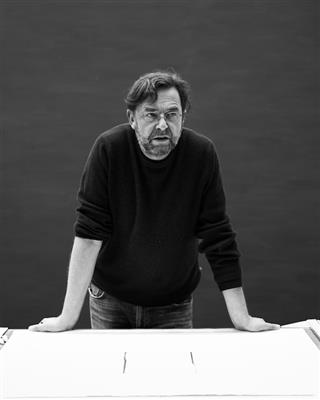
Callum Innes
- contemporary art
Callum Innes arrived at his signature practice through a process of deliberate reduction. Working in Edinburgh since completing his studies at Edinburgh College of Art in 1985, he developed a technique for his 'Exposed' paintings in which previously applied oil paint is partially dissolved and removed with turpentine, leaving ghost traces and exposed canvas alongside residues of colour. The result is a surface that records both action and erasure, closer in spirit to photography than to traditional mark-making.
Biography
He was nominated for the Turner Prize in 1995, the year Damien Hirst won it, and took the NatWest Art Prize in 1998 and the Jerwood Painting Prize in 2002. The nominations and prizes came as his international reputation was building: solo shows at the Ikon Gallery in Birmingham and the Kunsthalle Bern in 1999 established him firmly within European abstraction. He has been represented by Frith Street Gallery in London since 1990 and by Sean Kelly Gallery in New York.
His works are held at Tate, the Guggenheim, the Centre Pompidou, and the Scottish National Gallery of Modern Art. A retrospective was held at De Pont Museum in the Netherlands in 2016. Innes also makes watercolours, in which the same logic of selective disclosure and concealment applies, though the medium's speed and translucency introduce a different quality of mark.
He was born in Edinburgh in 1962[1] and continues to live and work there.
Timeline
- 1962Born in Edinburgh.
- 1985Completed studies at Edinburgh College of Art.
- 1990Began representation by Frith Street Gallery in London.
- 1995Nominated for the Turner Prize.
- 1998Won the NatWest Art Prize.
- 1999Had solo shows at the Ikon Gallery in Birmingham and the Kunsthalle Bern.
- 2002Won the Jerwood Painting Prize.
- 2016A retrospective of his work was held at De Pont Museum in the Netherlands.
Notable Works
Tap to view larger.
Next stop
Browse the movements →
Every movement in the collection, from the Renaissance to Pop art.
Related Artists



Frequently Asked Questions
What is Callum Innes known for?
Callum Innes is known for his 'Exposed' paintings, in which he partially dissolves previously applied oil paint with turpentine. This technique leaves ghost traces and exposed canvas alongside residues of colour, creating a surface that records both action and erasure. He also makes watercolours using a similar logic of selective disclosure and concealment.What is Callum Innes's most famous work?
Callum Innes is a Scottish artist known for his unique approach to abstract painting. His signature "Removed Paintings" series involves applying thin layers of paint to canvas, then removing portions with turpentine before the paint dries. This process results in subtle, dissolving forms and translucent surfaces, exploring themes of absence and presence. While it's difficult to pinpoint one single "most famous" work, several pieces have received considerable attention. *Exposed Painting: Ultramarine* (1992) is an early example of his removal technique. *Agua Azul* (2007), a large watercolour on canvas, is another well-regarded work. His works are held in collections including the Scottish National Gallery of Modern Art, Edinburgh; Tate Gallery, London; and the Guggenheim, New York.What should I know about Callum Innes's prints?
Callum Innes is a contemporary artist known for his abstract paintings and watercolours, and he also produces prints. When considering Innes's prints, there are a few aspects to bear in mind. Printmaking is an unregulated activity, but conventions exist. Most printmakers limit their editions, and this decision is the artist's choice, not a technical constraint. Each print in a limited edition is considered an original, created from a plate, stone, screen, or block made for that purpose. The artist individually inks and pulls each print. The edition number is written on the bottom left margin of the print, the title in the centre, and the signature on the right. These markings are usually in pencil. The edition claim is written as a pair of numbers: the print number and the edition number. For example, 12/25 indicates that the print is number 12 from an edition of 25.What style or movement did Callum Innes belong to?
Callum Innes's work resists easy categorisation within a single art movement. Minimalism, which emerged in the United States during the 1960s and 1970s, shares some common ground with Innes's approach. Minimalism is characterised by its reduction to essentials: pure abstraction, objectivity, and anonymity. Decoration or expressive gestures are absent. Minimalist painting often employs monochromatic palettes and mathematically derived grids. Op Art, another abstract movement that developed in the 1960s, also presents points of comparison. Op Art explores the fallibility of the human eye, creating optical illusions of movement through the strategic use of forms and colours. While Innes's work is not explicitly illusionistic, it engages with perception and the ways in which colour can activate a surface. Ultimately, Innes's practice might be best understood as occupying a space between these movements, drawing on their emphasis on abstraction and perceptual effects while forging its own distinct path.What techniques or materials did Callum Innes use?
Callum Innes is known for a distinctive approach to painting, often involving the controlled removal, or "unpainting", of layers of colour. While specific details of his process are not widely published, we can discuss the general materials and techniques employed by painters. Artists typically begin with a support, such as cotton canvas, which may be primed with gesso. The priming creates a suitable surface for the application of paint. Oil paint is a common medium, offering a wide range of colours and blending possibilities. Artists' quality paints are favoured for their colour saturation, permanence, and stability. Brushes are used to apply the paint to the prepared surface. Solvents, such as turpentine, can be mixed with the paint to modify its viscosity and drying time. The artist's technical skill, combined with the qualities of the medium, informs the aesthetic decisions made during the painting process. Understanding these techniques is essential to appreciating the artwork.What was Callum Innes known for?
Callum Innes is known for paintings that explore colour, light, and the act of painting itself. His works often involve the removal, or 'unpainting', of layers of paint using turpentine or other solvents. This technique creates subtle gradations and translucent effects. The process reveals the canvas beneath and allows light to interact with the remaining pigment. Innes's practice aligns with all-over painting, where the treatment of the canvas is relatively uniform. This approach challenges traditional notions of composition, such as a top, bottom, or centre. His work prompts viewers to contemplate the physical properties of paint and the interplay between presence and absence. Innes's art resides in the tradition of Agnes Martin, whose work similarly invites quiet contemplation.Where can I see Callum Innes's work?
Callum Innes's art can be viewed in several prominent museums. Within the United Kingdom, these include the National Museum of Scotland in Edinburgh, Manchester Art Gallery, Brighton Museum & Art Gallery, and the Victoria & Albert Museum in London. Other British[1] galleries that hold his work are the Scottish National Gallery of Modern Art (Edinburgh), Leeds City Art Gallery, the British Museum (London), the National Gallery (London), the National Portrait Gallery (London), the Saatchi Gallery (London), and Tate Modern (London). In the United States, museums include the Metropolitan Museum of Art (New York), the Museum of Modern Art (New York), the Los Angeles County Museum of Art, the Minneapolis Institute of Arts, the Virginia Museum of Fine Arts (Richmond), the Wolfsonian at Florida International University (Miami Beach), and the Charles Hosmer Morse Museum of American Art (Winter Park, FL). Other museums that hold his work are the Royal Ontario Museum (Toronto).Who did Callum Innes influence?
Callum Innes's work relates to the practice of artists such as Liz Calame, who incorporates chance and spillage in her compositions. Calame's method has been compared to Jackson Pollock's, as both artists work on horizontal supports. Also, both rely on the indexical mark for their effect. However, Calame's paintings resist a psychological reading because she 'traces traces', creating critical distance. Innes's art can also be understood in relation to painters who use digital technology to generate imagery, such as Shahzia Sikander. Sikander sees the digital process as another way to explore formal and subjective issues. This contrasts with artists who engage in a dialectic with digital media, testing its claims and exploring its limitations.Who influenced Callum Innes?
Callum Innes's work aligns with abstract expressionism and minimalism, though he developed his own distinct style. Brice Marden, another abstract painter, cited Mark Rothko as a major influence, particularly Rothko's ambition and willingness to explore emotional experiences through painting. Marden noted Rothko's use of colour and touch to evoke empathy. He also observed that Rothko's late work, with its hard edges and atmospheric qualities, had not been widely followed up on. Rothko, in turn, was influenced by a range of artists. He admired Delacroix and Courbet, seeing them as grand painters who dealt with large ideas. Rothko's process involved laying on a ground colour and then adding other colours intuitively, feeling out the plane as he worked. He sought to create environments where the viewer's spirit becomes isolated, forcing them to confront themselves.Who was Callum Innes?
James Dickson Innes (born in Llanelli in 1887; died 1914) was a painter who attended Carmarthen Art School from 1904 to 1905, and the Slade from 1906 to 1908. In 1907, Innes met Augustus John, moved to Fitzroy Street, and regularly visited 19 Fitzroy Street. In 1908, he travelled around France with John Fothergill. By 1910, he was living in Paris, where he was close to Matthew Smith. He visited Leo Stein’s collection and Vollard’s gallery. Innes painted in North Wales with Augustus John, as well as in Spain, at Collioure, and elsewhere in the south of France. He exhibited at the New English Art Club (NEAC), the Allied Artists' Association (AAA), and with the Camden Town Group. He was a member of the NEAC (1911) and the Camden Town Group (1911). The Chenil Gallery hosted one-man shows for him in 1911 and 1913. Innes first went to Collioure in 1908 with John Fothergill; he was not aware of its connections with the Fauves. The intense light of the south encouraged him to lighten his palette. He made his colours bolder and brighter after seeing Matisse’s paintings at Leo Stein’s in Paris in 1910, and Augustus John’s Provençal studies at the Chenil Gallery in 1911.Why are Callum Innes's works important today?
Callum Innes, born in Edinburgh in 1962[1], is known for his distinctive "Removed Paintings". These works involve a reductive process. Innes applies layers of paint, often oil on canvas, and then selectively removes areas with turpentine. This process reveals previous layers and creates subtle tonal variations. His approach questions traditional painting methods. By taking away material, he explores ideas of absence and presence. The controlled removal of paint creates a sense of depth and luminosity. This method distinguishes his work from purely additive painting techniques. Innes's pieces often feature large, monochromatic fields of colour. These fields are interrupted by the erased areas. These reveal the under layers and the canvas beneath. The effect is both minimal and expressive. His work has been exhibited internationally. It can be found in collections such as the Scottish National Gallery of Modern Art and the Guggenheim in New York. His approach to colour and process continues to influence contemporary abstract painting.What was Callum Innes's art style?
Callum Innes's art style can be described as abstraction. His 'Exposed' paintings involve the partial removal of paint to reveal underlying layers, while his watercolours employ selective disclosure and concealment.
Sources
Editorial draws on the following primary and tertiary references for Callum Innes.
- [1] wikipedia Wikipedia: Callum Innes Used for: biography, birth dates, death dates, identifiers, movement attribution, nationality.
- [2] book Scobie, Stephen, Earthquakes and Explorations _ Language and Painting From Cubism to Concrete Poetry Used for: stylistic analysis.
- [3] book guggenheim-britishartnowame00wald Used for: biography.
- [4] book guggenheim-hugob00gugg Used for: biography.
- [5] book guggenheim-newhorizonsiname00denn Used for: biography.
- [6] book Post-impressionism : cross-currents in European painting Used for: biography, stylistic analysis.
- [7] book Post-impressionism : cross-currents in European painting Used for: biography, stylistic analysis.
Editorial overseen by Solis Prints. Sources verified 2026-09-30. Click a source for details, or hover over [N] in the page above to preview.
Editorial standardsMethodologyCorrectionsAI disclosureAbout the editorial team