



Camille Claudel
At twelve, Claudel was already modelling in clay dug from the ground near her home in the Oise, producing work serious enough to catch the attention of professional sculptor Alfred Boucher. That recognition set in motion a career of exceptional creative power and, ultimately, devastating loss.
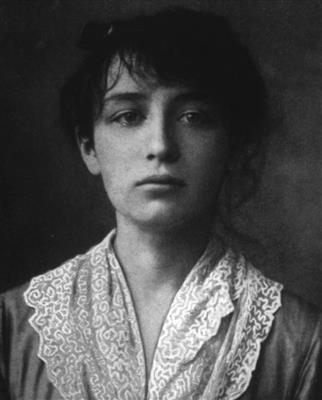
Biography
She enrolled at the Académie Colarossi in Paris, one of the few institutions of the period that admitted women, and in 1882[1] shared a workshop with the sculptor Jessie Lipscomb and two other young women. When Boucher relocated to Florence after winning the Grand Prix du Salon, he asked Auguste Rodin to take over instruction of the group. Claudel was nineteen when she began working with Rodin; he was forty-three. She quickly became indispensable, excelling at modelling hands and feet for his monumental commissions. Rodin acknowledged her gifts plainly: "I have shown her where to find gold, but the gold she has found is really her own."
The professional relationship became an affair lasting the better part of fifteen years, complicated by Rodin's refusal to leave his long-term companion, Rose Beuret. Claudel ended the intimate relationship in 1892[1] and broke from Rodin entirely in 1898. She pursued an independent career, producing works that included a study of Clotho, one of the three Fates, depicted as an aged woman burdened with human destiny.
As Rodin's reputation expanded and her own stalled, Claudel grew increasingly isolated. In 1913[1], her brother, the writer Paul Claudel, had her committed to a psychiatric institution. She spent the last thirty years of her life institutionalised, dying there in 1943[1]. Her sculptures were largely rediscovered in the decades after her death.
Timeline
- 1864Born in France.
- 1876At twelve, Claudel was modelling in clay, attracting the attention of sculptor Alfred Boucher.
- 1882Shared a workshop in Paris with Jessie Lipscomb and two other young women; enrolled at the Académie Colarossi.
- 1883Began working with Auguste Rodin, aged 19; he was 43. She excelled at modelling hands and feet for his commissions.
- 1892Ended her intimate relationship with Rodin.
- 1898Broke from Rodin entirely and pursued an independent career.
- 1913Committed to a psychiatric institution by her brother, Paul Claudel.
- 1943Died in a psychiatric institution, aged 78.
Notable Works
Tap to view larger.
Next stop
Art Nouveau →
Explore the artists and ideas of Art Nouveau.
Related Artists


Frequently Asked Questions
What is Camille Claudel known for?
Camille Claudel is known for her sculpture. She began creating work good enough to catch the eye of a professional sculptor when she was only twelve years old.What is Camille Claudel's most famous work?
Camille Claudel's most celebrated sculpture is generally considered to be *The Waltz*. She produced several versions of this work, charting its development from conception to completion. The initial model, created around 1889[1], was in plaster. It depicted a nude couple dancing, their bodies closely entwined. Claudel then created a second plaster version in 1892, modifying the composition to address concerns about its perceived indecency. This revised version added drapery that partially veiled the figures. Despite these alterations, officials still refused to commission a marble version for a public space. The French[1] Ministry of Fine Arts rejected it, deeming it unsuitable. Eugène Blot, a supporter of Claudel, eventually commissioned a bronze cast. This bronze version helped to increase Claudel's recognition. She also produced a marble version of *The Waltz* later in her career. The different versions demonstrate Claudel's artistic process and the challenges she faced in gaining acceptance for her work.What should I know about Camille Claudel's prints?
Camille Claudel is best known as a sculptor; information about her printmaking is scarce. While Claudel did produce drawings, pastels, and photographs, these are not usually considered fine art prints in the traditional sense. Most sources concentrate on Claudel's sculptures, such as "The Waltz" (1889[1]-1905[1]) and "The Age of Maturity" (1894-1902). These works explore themes of love, loss, and the passage of time, often with a personal dimension related to her relationship with Auguste Rodin. Claudel's sculptures are characterised by their emotional intensity and naturalistic style. If you are interested in works on paper related to Claudel, you might look for catalogues of her drawings or photographs of her sculptures. These can provide insight into her creative process and the development of her sculptural ideas. However, it is important to verify the authenticity and provenance of any work attributed to Claudel, as her market value is high and forgeries exist.What style or movement did Camille Claudel belong to?
Camille Claudel (1864[1]-1943[1]) was a French[1] sculptor working at the end of the 19th century. Her mature works are usually associated with the Art Nouveau[1] style, though she also produced pieces that show the influence of academic and realist sculpture. Claudel's early training was traditional. She studied at the Académie Colarossi in Paris, and from 1884[1] she worked in the studio of Auguste Rodin. Her early works, such as "The Old Woman" (1882), are realist studies. Later, she assisted Rodin on major commissions, including "The Burghers of Calais" and "The Gates of Hell". Around 1893, Claudel began to develop her distinctive style. Works such as "The Waltz" (1892-1905[1]) and "Clotho" (1893) display the flowing lines and sensuous surfaces associated with Art Nouveau. These sculptures also show Claudel's interest in psychological states and emotional intensity. "The Wave" (1897) combines bronze figures with an onyx base, typical of Art Nouveau's use of mixed materials. Claudel's later work became more stylised and expressive, reflecting her increasing mental distress.What techniques or materials did Camille Claudel use?
Camille Claudel was a sculptor who worked primarily in bronze, marble, and plaster. She also produced some works in terracotta and wood. Claudel's process typically began with a clay model. These models allowed her to explore form and composition before moving to more permanent materials. For bronze casting, she employed the lost-wax method, a process that allows for highly detailed results. This involved creating a wax version of the sculpture from the clay model, coating it in a ceramic shell, melting out the wax, and then pouring molten bronze into the resulting mould. After cooling, the ceramic shell was broken away, and the bronze was refined through chasing and patination. When working in marble, Claudel used traditional carving techniques, employing chisels and rasps to remove material and gradually reveal the final form. Marble carving is an exacting process that demands precision and control. Plaster was often used for preparatory models or as a final material for exhibition pieces, sometimes tinted to resemble terracotta.What was Camille Claudel known for?
Camille Claudel (1864[1]-1943[1]) was a French[1] sculptor and graphic artist. She is best known for her bronze and marble figures, which often explore themes of emotional intensity and psychological tension. Claudel began her studies in Paris in the 1880s. She soon met Auguste Rodin and became his student, assistant, and lover. This relationship had a significant impact on her artistic development. Some of her early works, such as "The Waltz" (1889[1]-1905[1]), show Rodin's influence, but she quickly developed her own distinct style. Claudel's sculptures are characterised by their expressive poses and attention to detail. Her figures often convey a sense of movement and emotion, capturing fleeting moments in time. "The Age of Maturity" (1894-1902) is one of her most famous works, depicting a woman being led away by an older woman, while a younger woman kneels in despair. The piece has been interpreted as an allegory of Claudel's own life and her relationship with Rodin. Despite her talent, Claudel faced challenges in a male-dominated art world. Her work was often overshadowed by Rodin's, and she struggled to gain recognition in her own right. In 1913, she was committed to a psychiatric hospital, where she remained until her death.When did Camille Claudel live and work?
Camille Claudel was a French[1] sculptor born in 1864[1]. She started working with clay at the age of twelve. Some of her early pieces drew the attention of the sculptor Alfred Boucher, who encouraged her father to support her artistic career. Claudel studied at the Académie Colarossi, one of the few institutions at the time that accepted female students. Boucher became her mentor. In 1882[1], he produced a sculpture of her entitled *Camille Claudel Lisant*. At eighteen, Claudel rented a workshop with other young female sculptors. Around 1884, after Boucher moved to Florence, Auguste Rodin took over the instruction of his students. Claudel then began working with Rodin as his assistant. She became Rodin’s muse and lover. However, Rodin refused to end his relationship with Rose Beuret. Claudel ended the intimate aspect of her relationship with Rodin in 1892; however, they continued to see each other until 1898. Claudel exhibited at the Salon d’Automne in 1903. She died in 1943[1].Where can I see Camille Claudel's work?
Many museums hold works by the French[1] sculptor Camille Claudel (1864[1]-1943[1]). The Musée Camille Claudel in Nogent-sur-Seine, France, opened in 2017 and contains the most comprehensive collection of her sculptures. Other museums with holdings include the Musée Rodin in Paris, which possesses several of her pieces due to her association with Auguste Rodin. The Musée d’Orsay, also in Paris, displays some of her key sculptures as well. Outside France, institutions such as the National Museum of Women in the Arts in Washington, D.C., and the Ny Carlsberg Glyptotek in Copenhagen feature examples of her art. These collections provide opportunities to view her marble, bronze, and plaster sculptures, offering insight into her artistic development and unique style.Where was Camille Claudel from?
Camille Claudel was a French[1] sculptor, born in 1864[1]. At the age of twelve, she was already working with clay, and her early efforts drew the attention of the sculptor Alfred Boucher. He encouraged her father to support her artistic ambitions. Claudel later joined the Académie Colarossi; it was one of the few institutions at the time that accepted female students. Boucher became her mentor. She created a bust of him, and he produced a sculpture of her titled *Camille Claudel Lisant* (1882[1]). At eighteen, Claudel shared a workshop with other young female sculptors, including Jessie Lipscomb, Amy Singer, and Emily Fawcett. Boucher advised them; however, after winning the Grand Prix du Salon in 1881, he moved to Florence. He asked Auguste Rodin to take over instruction of his students. Around 1884, Claudel began working with Rodin as his assistant, and they began an affair. Claudel became Rodin’s muse and lover.Who did Camille Claudel influence?
While it is difficult to identify specific artists directly influenced by Camille Claudel, some sources offer insight into artistic influence more broadly. The question of influence is a recurring theme in art history. For example, Paul Cézanne directly quoted compositions by Gustave Courbet. More broadly, artists may absorb influence through technique, such as Courbet's use of the palette knife. Looking at Henri Matisse, Gertrude Stein noted the rivalry between "Picassoites and Matisseites". Some artists bypassed abstract expressionism by using Matisse's surface-oriented figurative work. Matisse influenced the American artists Milton Avery and Stuart Davis, and the Canadian artist Audrey Skaling. Grace Hartigan was influenced by Matisse's *Bather by a River* and *Variation on a Still Life by de Heem*. André Lhote incorporated Matisse's colour-usage in flat planes into his version of synthetic cubism. Raymond Duchamp-Villon's work was seen to accord with a long line of French[1] artists, bearing within them a feeling for art transmitted from the past, and giving it new forms.Who was Camille Claudel?
Camille Claudel (1864[1]-1943[1]) was a French[1] sculptor and graphic artist. She is known for her bronze and marble figures, which often possess a psychological intensity. Claudel began studying sculpture in Paris in the 1880s. Alfred Boucher taught her in his workshop. When Boucher moved to Florence, Auguste Rodin took over as her instructor. Claudel soon became Rodin's assistant and collaborator, contributing to works such as "The Burghers of Calais" and "Gates of Hell". Their professional association developed into a passionate, but ultimately destructive, personal relationship. Claudel's independent works include "The Waltz" (1889[1]-1905[1]), "The Age of Maturity" (1894-1902), and "Clotho" (1893). These sculptures display a move away from Rodin's influence. They explore themes of emotional turmoil and the human condition. Despite critical recognition, Claudel struggled to gain the same level of fame as Rodin. In 1913, she was confined to a psychiatric hospital, where she remained until her death. Her work has experienced a posthumous rise in appreciation. She is now recognised as an important figure in late 19th- and early 20th-century sculpture.Why are Camille Claudel's works important today?
Camille Claudel's sculptures are important for several reasons. Interest in her work has grown since the late twentieth century, partly due to renewed attention to women artists. Claudel (1864[1]-1943[1]) was a gifted sculptor who worked in bronze, marble, plaster, and terracotta. She is known for works such as "The Waltz" (1889[1]-1905[1]), "The Age of Maturity" (1894-1902), and "Clotho" (1893). Her sculptures often display emotional intensity and a close observation of the human form. Her association with Auguste Rodin also contributes to her notability. She was his student, assistant, and lover. The complicated nature of their relationship, and the way it affected her career, has drawn considerable attention. Some view her as a muse unfairly overshadowed by a more famous man. Others recognise her independent talent and vision. The tragic circumstances of her life further contribute to the interest in Claudel's art. In 1913, she was confined to a psychiatric hospital by her family, where she remained until her death. The loss of her artistic career, and the reasons for her confinement, continue to be subjects of discussion and debate.
Sources
Editorial draws on the following primary and tertiary references for Camille Claudel.
- [1] wikipedia Wikipedia: Camille Claudel Used for: biography, birth dates, death dates, identifiers, movement attribution, nationality.
- [2] book Susie Hodge, Artistic Circles Used for: biography, stylistic analysis.
- [3] book Dorling Kindersley, Artists: Inspiring Stories of the World's Most Creative Minds Used for: biography, stylistic analysis.
- [4] book Carol Strickland and John Boswell, The Annotated Mona Lisa Used for: biography.
Editorial overseen by Solis Prints. Sources verified 2026-09-17. Click a source for details, or hover over [N] in the page above to preview.
Editorial standardsMethodologyCorrectionsAI disclosureAbout the editorial team