



Carlos Almaraz
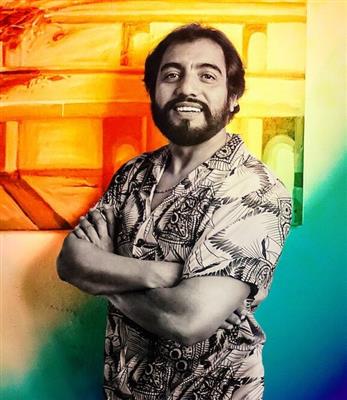
Carlos Almaraz was born in Mexico City in 1941[1] and grew up in East Los Angeles after his family moved first to Chicago, then to California when he was nine. The city, its freeways, its light, its violence and colour, became the material of almost everything he made.
Biography
After completing his MFA at Otis College of Art and Design in 1974[1], he spent the early 1970s working directly for Cesar Chavez and the United Farm Workers, creating activist murals at a moment when Chicano art was forming its own political and aesthetic identity. In 1973 he co-founded Los Four, the first Chicano artist collective to receive a major museum exhibition, and in 1977 helped establish the Centro de Arte Publico in Highland Park. These were institutional acts as much as artistic ones: the goal was to force mainstream American[1] galleries and museums to reckon with a body of work they had systematically ignored.
Almaraz's mature painting drew on Expressionism, California light, and the compositional drama of Van Gogh and Monet, though his subjects were emphatically local: Echo Park, Sunset Boulevard, car crashes on the freeway at night. The crash paintings, with their explosive colour and smeared motion, became his most recognised motif. "Europe and the Jaguar" (1982[1]) and "Sunset Crash" (1982) are among the best-known. Six of his works entered the Smithsonian American[1] Art Museum's collection; others are held at the Whitney and the Cheech Marin Center for Chicano Art.
He died of AIDS-related illness in Los Angeles in December 1989[1], aged 48, at the point when his reputation had finally crossed into the American[1] mainstream.
Timeline
- 1941Born in Mexico City.
- 1950Moved to California with his family, growing up in East Los Angeles, at 9.
- 1973Co-founded Los Four, the first Chicano artist collective to receive a major museum exhibition.
- 1974Completed his MFA at Otis College of Art and Design.
- 1977Helped establish the Centro de Arte Publico in Highland Park.
- 1982Painted "Europe and the Jaguar".
- 1982Painted "Sunset Crash".
- 1989Died of AIDS-related illness in Los Angeles in December, aged 48.
Notable Works
Tap to view larger.
Next stop
Browse the movements →
Every movement in the collection, from the Renaissance to Pop art.
Related Artists
_%E2%80%93_LOC.jpg)



Frequently Asked Questions
What is Carlos Almaraz known for?
Carlos Almaraz is known for his paintings of Los Angeles, including Echo Park, Sunset Boulevard, and car crashes on the freeway at night. His crash paintings, with their explosive colour and smeared motion, became his most recognised motif. "Europe and the Jaguar" (1982[1]) and "Sunset Crash" (1982) are among his best-known works.What is Carlos Almaraz's most famous work?
Carlos Almaraz, a member of the Los Four art collective, gained recognition for his canvas paintings near the end of his life. He died from an AIDS-related illness in 1989[1]. Among his most noted works are his car crash paintings. These paintings depict explosive disasters on freeways; one catastrophe after another. They are rendered in abstract eruptions of fire, motion, and colour. One such painting is *Crash in Phthalo Green* (1984[1]). Almaraz's studio was located on the southern edge of Echo Park Lake, north of the 101 Freeway. He drew inspiration from the contrast between the lake and the nearby Hollywood Freeway. He stated that he would often wake up to the sound of metal crashing.What should I know about Carlos Almaraz's prints?
Carlos Almaraz (1941[1]-1989[1]) was a Mexican-American[1] artist associated with the Chicano art movement in Los Angeles. He is known for his paintings and prints that explore themes of urban life, cultural identity, and personal experiences. Almaraz's printmaking often involved lithography and screen printing. These techniques allowed him to create bold, colourful images that reflected the energy of the city. His prints frequently feature scenes of East Los Angeles, with its distinctive architecture, street life, and cultural events. Common subjects included cityscapes at night, car crashes, and portraits. His work often blends realism with dreamlike or surreal elements. This combination creates a sense of heightened emotion and symbolic meaning. Almaraz's prints are not merely documentary; they convey a sense of longing, passion, and social commentary. Prints such as "Echo Park Lake, Nocturne" (1982[1]) show his interest in capturing the atmosphere of Los Angeles at night. Others, like the "Boycott Gallo" series, reflect his political activism and support for the United Farm Workers. His prints offer insight into the Chicano experience and the complexities of urban life in late 20th-century America.What style or movement did Carlos Almaraz belong to?
Carlos Almaraz is associated with the Chicano art movement, which gained momentum in the United States during the 1960s and 1970s. He was a member of the Los Four art collective, which played a role in bringing Chicano art to the attention of major institutions; they had the first Chicano art exhibition at the Los Angeles County Museum of Art in 1974[1]. After Los Four disbanded in 1983, Almaraz focused on his painting. His work often depicted scenes of East Los Angeles and explored themes related to Chicano identity and culture. Some of his most well-known paintings depict car crashes on freeways, rendered in an abstract style with bright colours. These paintings reflected Almaraz's experience of living near the Hollywood Freeway and waking up to the sounds of car crashes.What was Carlos Almaraz known for?
Carlos Almaraz (born in Los Angeles, 1941[1]) was known for his colourful figurative paintings. He was raised in the Boyle Heights district of East Los Angeles. From 1956[1] to 1958, he studied at the Otis Art Institute, and at California State College, Los Angeles. Almaraz formed an art collective called "Los Four" with Gilbert Lujan, and Alberto de la Rocha. After the disbanding of Los Four in 1983, Almaraz focused on dominant features of the East LA area. He gained acclaim for his paintings on canvas toward the end of his time with Los Four, especially after his death in 1989[1], which was related to AIDS. Among his last, most famous works were his car crash paintings. These paintings, such as *Crash in Phthalo Green* (1984), convey explosive disasters on freeways. Almaraz's studio was located on the southern edge of Echo Park Lake, just north of the 101 Freeway. He found inspiration there, living between a "very serene lake" and "the Hollywood Freeway, which literally has crashes going on every few hours... I used to wake up to the sound of metal crunching".When did Carlos Almaraz live and work?
Carlos Almaraz was born in Los Angeles in 1941[1]. He died in Tijuana, Mexico, in 1989[1]. He received a B.A. in 1962[1] and an M.A. in 1964 from the University of California, Los Angeles (UCLA). At UCLA, he studied with Stanton Macdonald-Wright and William Brice. He also studied privately with Antonio Valles and Daniel Zenteno. In 1966, Almaraz travelled to Spain, then moved to La Paz, Mexico, where he founded El Centro de Arte Regional. He taught at the University of California Extension, San Diego, from 1964 to 1966; at El Centro de Arte from 1966 to 1969; at California State, Northridge, from 1969 to 1970; at California State, Sacramento, from 1970 to 1972; and at the University of California, Santa Cruz, from 1972 to 1997. During the 1980s, he travelled frequently to Baja California. Almaraz was known for his self-portraits, still lifes, and public murals.Where can I see Carlos Almaraz's work?
To view works by Carlos Almaraz, consider visiting the Los Angeles County Museum of Art (LACMA), located at 5905 Wilshire Boulevard, Los Angeles. Additionally, the Metropolitan Museum of Art in New York City, situated at 1000 Fifth Avenue, also holds relevant collections. Other options include the Minneapolis Institute of Arts, found at 2400 Third Avenue South, Minneapolis, and the Museum of Modern Art, located at 11 West 53rd Street, New York. Further afield, the Royal Ontario Museum in Toronto, Canada, at 100 Queens Park, may also be of interest. In Europe, the Museu d’Art Modern (MNAC) in Barcelona, Spain, located in the Parc de la Ciutadella, offers another opportunity to view related artworks. These museums provide a range of options for those interested in experiencing Almaraz's artistic contributions.Where was Carlos Almaraz from?
Carlos Almaraz was born in Los Angeles, California, in 1941[1]. He was raised in the Boyle Heights district of East Los Angeles. This area has a rich cultural history, particularly for Mexican Americans, and this heritage informed much of Almaraz's work. Almaraz studied at the Otis Art Institute and California State College, both located in Los Angeles, from 1956[1] to 1958. He later formed an art collective known as “Los Four” with fellow artists Gilbert Lujan and Alberto de la Rocha. Almaraz lived in New York for a year in 1968-69, and he first visited Mexico in 1969. He worked as a designer for the Charles Eames Studio, AGM Records, and the Los Angeles Community Redevelopment Agency. Since 1974, he was commissioned for numerous murals and public art projects.Who did Carlos Almaraz influence?
Carlos Almaraz's work, particularly his paintings of car crashes and Los Angeles freeways, influenced other Chicano artists who also depicted the urban environment. After the dissolution of the art collective Los Four in 1983[1], Almaraz, along with Frank Romero, concentrated on capturing East Los Angeles' dominant features. Romero, like Almaraz, integrated freeways into his art, reflecting their impact on the community. Almaraz's paintings, such as *Crash in Phthalo Green* (1984), portrayed explosive freeway disasters using abstract eruptions of colour and motion. Other Chicano artists, such as Judy Baca, also addressed the impact of highway construction on their neighbourhoods. Baca's mural, *The Great Wall of Los Angeles*, documents the experiences of marginalised social groups and depicts the effects of freeway construction on Mexican American[1] communities in East Los Angeles during the 1950s and 1960s. David Botello, another artist influenced by Almaraz, depicted scenes of everyday life in the East Los Angeles barrio, with freeways often looming in the background.Who influenced Carlos Almaraz?
Carlos Almaraz was part of the Los Four collective, along with Gilbert Lujan, Roberto de la Rocha, and Frank Romero. An artist named Alighiero Boetti had a spiritual kinship with Clemente, stemming from their shared interest in Eastern art. Boetti, a member of the Arte Povera movement, collaborated with artisans in Afghanistan, opening his art to unpredictability. Boetti gave Clemente the sense that the artist's hand could be removed from some procedures. Another artist, Frank McCullough, taught at a public school and took his students to visit well-known artists, including modernist painter Raymond Jonson. McCullough showed films about art and artists, and introduced them to the Tamarind Institute, a lithography workshop in Albuquerque.Why are Carlos Almaraz's works important today?
Carlos Almaraz (1941[1]-1989[1]) was a Mexican-American[1] artist associated with the Chicano art movement in Los Angeles. He is known for paintings that mix personal experiences, urban scenes, and social commentary. Almaraz's work offers insight into the Chicano experience during a period of social and political change in the United States. As a member of the artist collective Los Four, he helped bring Chicano art to a wider audience. Los Four's 1974[1] exhibition at the Los Angeles County Museum of Art was one of the first major museum shows of Chicano art. His paintings often depict East Los Angeles, capturing its atmosphere through bold colour and expressive brushwork. Almaraz explored themes of identity, cultural pride, and the challenges faced by Mexican-Americans. His dreamlike compositions combine realism and surrealism, creating a distinctive visual language. By combining his cultural heritage with contemporary art styles, Almaraz created a body of work that continues to resonate with viewers interested in social justice and cultural identity.What was Carlos Almaraz's art style?
Carlos Almaraz's mature painting drew on Expressionism, California light, and the compositional drama of Van Gogh and Monet. His subjects were emphatically local to Los Angeles.
Sources
Editorial draws on the following primary and tertiary references for Carlos Almaraz.
- [1] wikipedia Wikipedia: Carlos Almaraz Used for: biography, birth dates, death dates, identifiers, movement attribution, nationality.
- [2] book Pérez, Laura Elisa., Chicana Art Used for: stylistic analysis.
- [3] book Getty, Getty - Ed Ruschas Streets of Los Angeles Used for: biography, stylistic analysis.
- [4] book guggenheim-twopri00weis Used for: biography.
- [5] book Landauer, Susan, The not-so-still life : a century of California painting and sculpture Used for: biography, stylistic analysis.
Editorial overseen by Solis Prints. Sources verified 2026-09-30. Click a source for details, or hover over [N] in the page above to preview.
Editorial standardsMethodologyCorrectionsAI disclosureAbout the editorial team