



Carmelo Arden Quin
- Madí
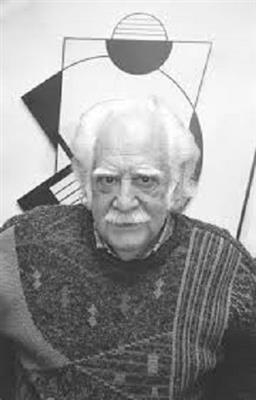
Carmelo Arden Quin was born Carmelo Heriberto Alves in 1913[1] in Rivera, Uruguay, his father murdered before his birth. He grew up with three uncles, one of them a painter and sculptor whose workshop became his first studio. At eleven he was selling decorated kites; by his early twenties he had made a painting and immediately cut irregular shapes into its borders, beginning the formal investigation that would occupy the rest of his long life.
Biography
The encounter that shaped his theoretical direction came in 1935[1], when Joaquín Torres-García lectured at the Theosophical Society in Montevideo. Torres-García's Constructive Universalism gave Arden Quin a framework, and the two became mentor and protégé. After moving to Buenos Aires in 1937, he gathered around him the poets, painters, and designers (Edgar Bayley, Rhod Rothfuss, Gyula Kosice, Tomás Maldonado) who produced the single issue of the journal Arturo in 1942 (approximately 250 copies, with contributors including Torres-García and Vicente Huidobro) and eventually co-founded the Madí movement in 1946.
The Madí manifesto was presented on 3 August 1946[1] at the French Institute for Higher Learning in Buenos Aires. Its defining formal characteristic was the shaped frame: the "forme galbée" (alternating concave and convex curves in wood), which made the support itself part of the composition. Madí also encompassed movable and transformable elements, pan-interval music, and invented poetic propositions. Arden Quin's own signature techniques included the formes galbées, the plastique blanche (polished enamelled wood), and coplanals (polygon series, sometimes with moveable elements).
He relocated permanently to Paris in 1948[1], working there for more than six decades. MoMA included him in its 1993 survey of Latin American artists, and the Madí Museum and Gallery opened in Dallas in 2003 with twenty-five of his works alongside artists from four continents. He died in Savigny-sur-Orge in September 2010[1], aged 97.
Timeline
- 1913Born Carmelo Heriberto Alves in Rivera, Uruguay. His father was murdered before his birth.
- 1935Heard Joaquín Torres-García lecture at the Theosophical Society in Montevideo. Torres-García's Constructive Universalism provided a framework for his work.
- 1937Moved to Buenos Aires.
- 1942Participated in the single issue of the journal Arturo with poets, painters, and designers.
- 1946Co-founded the Madí movement. The Madí manifesto was presented on 3 August at the French Institute for Higher Learning in Buenos Aires.
- 1948Relocated permanently to Paris.
- 1993His work was included in MoMA's survey of Latin American artists.
- 2003The Madí Museum and Gallery opened in Dallas, featuring twenty-five of his works.
- 2010Died in Savigny-sur-Orge in September, aged 97.
Notable Works
Tap to view larger.
Next stop
Browse the movements →
Every movement in the collection, from the Renaissance to Pop art.
Related Artists



Frequently Asked Questions
What is Carmelo Arden Quin known for?
Carmelo Arden Quin is known for co-founding the Madí movement, which was defined by the shaped frame, or "forme galbée", that made the support part of the composition. Madí also encompassed movable and transformable elements, pan-interval music, and invented poetic propositions.What should I know about Carmelo Arden Quin's prints?
Printmaking workshops are collaborative spaces with varied equipment. These include woodblocks, metal plates, and limestone or metal plates for lithography. They also use silk or synthetic fibre screens for screenprints. Printmaking involves drawing tools, greasy liquids, crayons, masking materials, gums, waxes and dangerous acids. Cans of ink, driers, and additives are essential for adjusting ink consistency. Various papers are also used. Universal Limited Art Editions (ULAE) drew New York artists to Long Island from the late 1950s. Gemini GEL became known for technological skill and use of materials. Tyler Graphics deepened its interest in handmade paper. These workshops share supplies and equipment for different processes. Relief printing uses woodblocks, etching uses metal plates, and lithography uses limestone or metal plates. Screenprints use synthetic fibre screens. Diverse drawing and processing supplies are also needed.What style or movement did Carmelo Arden Quin belong to?
Carmelo Arden Quin (born 1913[1]) was a key figure in the development of concrete art and the Madí movement. Concrete art, which emerged in the 1930s, rejected representational art in favour of geometric abstraction. Artists working in this style aimed to create purely non-objective works, using basic shapes and colours to explore spatial relationships and formal arrangements. Arden Quin co-founded the Madí movement in Buenos Aires in 1946[1]. Madí extended the principles of concrete art by embracing playful, irregular forms and challenging the traditional rectangular canvas. Madí artists often created shaped canvases, articulated objects, and mobile sculptures. The movement sought to integrate art into everyday life, breaking down the barriers between different artistic disciplines. Arden Quin's innovative approach to form and space made him a significant contributor to the development of both concrete art and the Madí movement in Latin America.What techniques or materials did Carmelo Arden Quin use?
Carmelo Arden Quin explored a variety of materials and techniques throughout his career. Initially a painter, he moved away from traditional canvas formats in the 1940s. He is most associated with shaped canvases and mobile artworks. Arden Quin co-founded the Arte Madí group in Buenos Aires in 1946[1]. Madí artists rejected conventional art forms. They experimented with articulated and mobile structures, often using industrial materials such as Perspex and aluminium. Arden Quin's work frequently incorporated movement, either through motorised elements or designs that shifted the viewer's perspective. His shaped canvases, sometimes called "coplanals", challenged the idea of the flat picture plane. These works extended into three-dimensional space. Later in his career, Arden Quin continued to explore geometric abstraction. He made works using painted wood and metal. These constructions maintained his interest in the interplay of form and space.What was Carmelo Arden Quin known for?
Carmelo Arden Quin (born 1913[1]) was an Uruguayan[1] artist associated with the development of MADI art. He is known for his innovative approach to geometric abstraction and his challenge to traditional art forms. In the 1940s, Arden Quin co-founded the MADI movement in Argentina, along with Rhod Rothfuss and Gyula Kosice. MADI rejected conventional painting and sculpture. Instead, it promoted the use of irregular frames, articulated and mobile forms, and non-traditional materials. The group sought to integrate art with life, breaking down the barriers between the artwork and the viewer. Arden Quin's work often incorporated movable parts and variable structures, inviting audience participation. He experimented with shaped canvases, creating works that extended into three-dimensional space. His theories rejected the idea of art as a sanctuary, instead arguing that it should be integrated into everyday life.When did Carmelo Arden Quin live and work?
Carmelo Arden Quin (1913[1]-2010[1]) was an Uruguayan[1] artist. He spent much of his career in Argentina and France. Born Carmelo Ardemagni in Cerro Chato, Uruguay, he moved to Buenos Aires in 1937[1]. There, he became involved with the avant-garde art scene. In 1944, he co-founded the Asociación Arte Concreto-Invención (Concrete-Invention Art Association). This group rejected representational art in favour of geometric abstraction. In 1946, Arden Quin helped establish the Madí movement. Madí artists explored new approaches to art making. They experimented with irregular frames, articulated surfaces, and movement. Arden Quin's work from this period included shaped canvases and mobile sculptures. Arden Quin relocated to Paris in 1948. He became associated with the Espace group, which promoted collaboration between artists and architects. He continued to develop his Madí ideas, creating works that challenged traditional notions of form and space. He remained in Paris for the rest of his life, exhibiting internationally and contributing to the development of geometric abstraction.Where can I see Carmelo Arden Quin's work?
Carmelo Arden Quin's works have appeared in many exhibitions. The Hirshhorn Museum in Washington, DC, held 'A New Romanticism: Sixteen Artists from Italy' in 1985[1]. The Solomon R. Guggenheim Museum in New York held the 'Guggenheim International Award 1956' exhibition, which travelled to the Musée National d'Art Moderne, Paris, in 1956. Also, the Guggenheim presented 'European Drawings' in 1966. Arden Quin's work was included in the 'Visione colore' exhibition at the Centro Internazionale delle Arti e del Costume, Palazzo Grassi, Venice, in 1963. The Stedelijk Museum, Amsterdam, displayed his art in 'Schrift en beeld' in 1963. Other museums that have exhibited his art include the Museum of Modern Art, New York; the Contemporary Arts Museum, Houston; and the Hara Museum of Contemporary Art, Tokyo. His art has also appeared at the Centre Georges Pompidou, Paris.Where was Carmelo Arden Quin from?
Carmelo Arden Quin was born in Rivera, Uruguay, in 1913[1]. His birth name was Carmelo Heriberto Alves. He moved to Buenos Aires, Argentina, in 1937[1], where he began his artistic career. Arden Quin co-founded the Arte Concreto-Invención Association in 1945. This group promoted concrete art, an abstract movement that rejected illusionism and subjective expression. In 1946, he co-founded the Madí Movement with Rhod Rothfuss and Gyula Kosice. Madí advocated for art that went beyond the frame, incorporating movement and irregular shapes. Arden Quin's work often involved articulated and transformable structures. He lived in Paris from 1948 until his death in 2010[1]. While based in France, he remained connected to artistic circles in Latin America. His theories and artworks had an impact on the development of kinetic and participatory art.Who did Carmelo Arden Quin influence?
Carmelo Arden Quin, active in Argentina and France, belonged to a generation of artists who saw new media as a means to integrate creative concepts. In 1952[1], Lucio Fontana stated that television would allow the integration of these ideas. Fontana predicted in 1948 that art would move away from traditional materials, like stones and colours, and incorporate light and television. He believed that these techniques could be transformed into art by creative artists. Fontana's theories resonated with younger artists. His monochrome paintings, particularly his white perforated works from around 1949, influenced Yves Klein. Fontana's reduction of pictorial means, such as making an incision on a monochromatic plane, introduced a new awareness of monochrome painting. His work retained relevance because his artistic ideas rapidly succeeded one another.Who influenced Carmelo Arden Quin?
Carmelo Arden Quin's artistic development occurred in dialogue with other artists and their work. In the 1940s, he was drawn to Matisse's use of colour; however, he felt more affected by Analytic Cubism's approach to drawing. By the early 1950s, Quin considered Pollock, de Kooning, and Rothko to be his mentors. He saw Gorky's 1947[1] Agony at the Whitney's 1951 show, which impressed him. He also saw many of Pollock's works from the 1940s. Quin also saw works by Still, Rothko, and Newman at Betty Parsons's gallery. Later, in the late 1950s and early 1960s, he became intrigued by Louis's Veils and Unfurleds and Noland's targets and chevrons. He also studied and analysed Analytic Cubist works by Braque and Picasso, early Kandinsky, and Miró. He also looked at Matisse, Mondrian, Léger, Renaissance and Quattrocento artists, Old Masters, American masters, and African art.Who was Carmelo Arden Quin?
Carmelo Arden Quin (1913[1]-2010[1]) was a Uruguayan[1] artist. He spent much of his career in France. He is best known as a co-founder of the Madí art movement. Born Carmelo Ardemagni, he began using the pseudonym "Arden Quin" in the 1930s. His early work included representational painting and poetry. By the 1940s, he was exploring abstraction. In 1944[1], he helped to establish Arte Madí in Buenos Aires, Argentina, with Gyula Kosice and Rhod Rothfuss. The Madí group rejected traditional art forms. They sought to create art that was dynamic and interactive. Madí works often featured irregular frames, articulated surfaces, and mobile components. Arden Quin's own Madí pieces included shaped canvases and sculptural objects. After travelling in Europe, Arden Quin settled in Paris in 1948. There, he continued to develop his Madí ideas. He experimented with different materials, such as Plexiglas and aluminium. He also created paintings on canvas. These explored geometric abstraction and colour theory. Arden Quin remained committed to the Madí aesthetic throughout his long career. His work has been exhibited internationally. It can be found in many public and private collections.Why are Carmelo Arden Quin's works important today?
Carmelo Arden Quin (1913[1]-2010[1]) was a Uruguayan[1] artist. He is best known as a co-founder of the Madí movement. This artistic group, established in Buenos Aires in 1946[1], rejected traditional art forms. They sought to integrate art with life. Arden Quin's importance stems from his radical approach to art making. He experimented with shaped canvases, moving away from the traditional rectangle. His work often incorporated articulated and mobile elements. These innovations challenged conventional notions of painting and sculpture. The Madí group also explored new approaches to poetry and music. His shaped paintings and sculptures are significant contributions to the development of geometric abstraction. Arden Quin's theories influenced later generations of artists interested in participatory art. His ideas about form, movement, and the artwork's relationship to space continue to be relevant in contemporary art discourse. He questioned the established categories of art. His work remains important for understanding the trajectory of Latin American art in the mid-20th century.
Sources
Editorial draws on the following primary and tertiary references for Carmelo Arden Quin.
- [1] wikipedia Wikipedia: Carmelo Arden Quin Used for: biography, birth dates, death dates, identifiers, movement attribution, nationality.
- [2] book guggenheim-masterp00solo Used for: biography.
- [3] book guggenheim-twopri00weis Used for: biography.
- [4] book Braun, Emily, 1957-; Asor Rosa, Alberto; Royal Academy of Arts (Great Britain), Italian art in the 20th century : painting and sculpture, 1900-1988 Used for: biography.
- [5] book Rüdiger Ahrens (editor); Florian Kläger (editor); Klaus Stierstorfer (editor); Keith A. Sandiford (editor), Symbolism _ an international annual of critical aesthetics. Volume 16 Used for: stylistic analysis.
- [6] book Rüdiger Ahrens (editor); Florian Kläger (editor); Klaus Stierstorfer (editor); Keith A. Sandiford (editor), Symbolism _ an international annual of critical aesthetics. Volume 16 Used for: stylistic analysis.
- [7] book Landauer, Susan, The not-so-still life : a century of California painting and sculpture Used for: stylistic analysis.
Editorial overseen by Solis Prints. Sources verified 2026-09-22. Click a source for details, or hover over [N] in the page above to preview.
Editorial standardsMethodologyCorrectionsAI disclosureAbout the editorial team