



Chang Dai-chien
In 1957[1], Chang Dai-chien sat across from Pablo Picasso in southern France and reportedly remarked that Western painters did not truly understand Chinese art. It was a characteristically bold claim from a man who had already mastered the styles of the Tang and Song dynasties, copied hundreds of murals in the cave complex at Dunhuang, and sold convincing forgeries of classical Chinese masters to leading collectors. By that point, he was also inventing something entirely his own.
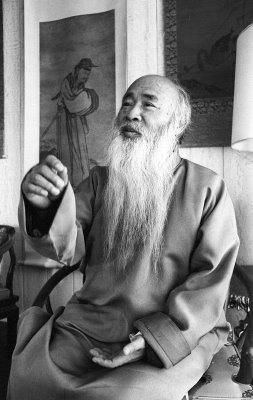
Biography
Born in Neijiang, Sichuan in 1899[1], Chang trained under Zeng Xi and Li Ruiqing in Shanghai after a brief period studying textile dyeing in Kyoto. He spent the 1920s and 1930s building a reputation as a painter of exceptional technical skill: landscapes, lotus flowers, and figure studies executed with complete command of the guohua tradition. His unmatched eye for old masters also translated into a sideline producing works that fooled leading dealers and scholars alike.
The years at Dunhuang from 1940[1] to 1943 transformed his understanding of Chinese art at its source. He documented hundreds of Tang dynasty murals in meticulous copies, work combining archaeological seriousness with physical hardship in the remote Gobi Desert. The French government had recognised his gifts as early as 1933, purchasing a work from his Paris exhibition that year.
In the late 1950s, after leaving China for Hong Kong, then Brazil, then California, Chang developed his "pocai" or splashed-colour technique: pools of ink and pigment allowed to bleed and settle before he drew in defining forms. The results read simultaneously as abstract expressionism and classical Chinese ink painting. He settled in Taiwan in his final years, completing "Peach Blossom Spring" shortly before his death in Taipei in 1983[1], a painting that brought the splash idiom back to the classical landscape tradition.
Timeline
- 1899Born in Neijiang, Sichuan.
- 1933Exhibited in Paris; the French government purchased one of his works.
- 1940Began copying murals at the Dunhuang cave complex, continuing until 1943.
- 1950Left China for Hong Kong, then Brazil, then California.
- 1950Developed his 'pocai' or splashed-colour technique.
- 1957Met Pablo Picasso in southern France.
- 1983Completed "Peach Blossom Spring" shortly before his death.
- 1983Died in Taipei.
Notable Works
Tap to view larger.
Next stop
Browse the movements →
Every movement in the collection, from the Renaissance to Pop art.
Related Artists
_%E2%80%93_LOC.jpg)


Frequently Asked Questions
What is Chang Dai-chien known for?
Chang Dai-chien is known for his mastery of Chinese painting styles, particularly those of the Tang and Song dynasties. He is also known for copying hundreds of murals in the Dunhuang cave complex and for his later development of the "pocai" or splashed-colour technique.Who was Chang Dai-chien?
Chang Dai-chien was a Chinese painter born in 1899[1], known for his mastery of traditional styles, his copies of murals, and his later invention of a unique splashed-colour technique. He trained in Shanghai and Kyoto, building a reputation for exceptional skill in guohua tradition.What was Chang Dai-chien's art style?
Chang Dai-chien's art style evolved over time, beginning with complete command of the guohua tradition, encompassing landscapes, lotus flowers, and figure studies. After studying murals at Dunhuang, he developed his splashed-colour technique, which combined abstract expressionism with classical Chinese ink painting. He brought this idiom back to the classical tradition in his later years.How did Chang Dai-chien die?
Chang Dai-chien died in 1983[1] at the age of 84.
Sources
Editorial draws on the following primary and tertiary references for Chang Dai-chien.
- [1] wikipedia Wikipedia: Chang Dai-chien Used for: biography, birth dates, death dates, identifiers, movement attribution, nationality.
- [2] book Beard, Lee, 1973- author, Butler, Adam, author; Van Cleave, Claire, author; Fortenberry, Diane, author; Stirling, Susan, author, Beard, Lee, 1973- author, Butler, Adam, author; Van Cleave, Claire, author; Fortenberry, Diane, author; Stirling, Susan, author - The Art Book_ New Edition, Mini Format Used for: biography, stylistic analysis.
- [3] book guggenheim-italianartnowame00wald Used for: biography.
- [4] book Palmer, Allison Lee, Historical Dictionary of Neoclassical Art and Architecture Used for: biography, stylistic analysis.
- [5] book Braun, Emily, 1957-; Asor Rosa, Alberto; Royal Academy of Arts (Great Britain), Italian art in the 20th century : painting and sculpture, 1900-1988 Used for: biography.
- [6] book Masterpieces of western art : a history of art in 900 individual studies from the Gothic to the present day Used for: biography, stylistic analysis.
Editorial overseen by Solis Prints. Sources verified 2026-10-07. Click a source for details, or hover over [N] in the page above to preview.
Editorial standardsMethodologyCorrectionsAI disclosureAbout the editorial team