



Charles-Andre van Loo (Carle van Loo)
Winning the Prix de Rome in 1724[1] at the age of nineteen was only the beginning for Carle van Loo. Born in Nice in 1705[1] into a dynasty of Dutch-origin painters, he trained under Benedetto Luti in Rome before spending years absorbing the classical tradition at its source. When he finally settled in Paris in 1734, he arrived not as an outsider but as a fully formed master of the academic idiom.
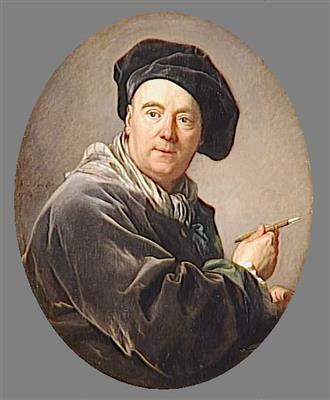
Biography
His ascent through French institutional life was swift and total. Accepted into the Académie royale in 1735[1], he attracted royal and aristocratic patronage across Europe, painting for the Sardinian court before returning definitively to France. In 1762, Louis XV appointed him Premier Peintre du Roi, the highest honour available to a working painter. The Order of Saint Michael followed. By mid-century, critics ranked him the finest painter in Europe.
Van Loo worked across every category the Academy recognised: religious subjects, history painting, mythology, portraiture, allegory, and genre. His *Marriage of the Virgin* hangs in the Louvre; his allegorical series on the arts, *Painting*, *Architecture*, *Sculpture*, *Music*, painted 1752[1]–53, demonstrate both his ambition and his facility. The style was rooted in Italian training: clear compositions, correct draughtsmanship, colour used in service of form.
Later generations revised his reputation sharply downward. Diderot praised him in his Salons yet also catalogued his limitations. By the nineteenth century the verdict had settled into qualified admiration: technically accomplished, institutionally dominant, yet rarely surprising. That judgement may be overly harsh. At his best, van Loo produced works of real grandeur, and his command of large-scale decorative programmes remained unmatched in France during his lifetime.
Timeline
- 1705Born in Nice into a family of painters of Dutch origin.
- 1724At 19, he won the Prix de Rome.
- 1734Settled in Paris as a master of the academic style.
- 1735Accepted into the Académie royale.
- 1752Painted the allegorical series on the arts, including "Painting", "Architecture", "Sculpture", and "Music".
- 1752Painted "Marriage of the Virgin", which hangs in the Louvre.
- 1762Appointed Premier Peintre du Roi by Louis XV.
- 1765Died, aged 60.
Notable Works
Tap to view larger.
Next stop
Browse the movements →
Every movement in the collection, from the Renaissance to Pop art.
Frequently Asked Questions
What is Charles-Andre van Loo (Carle van Loo) known for?
Charles-Andre van Loo is known for his work across various categories recognised by the Academy, including religious subjects, history painting, mythology, portraiture, allegory, and genre. He attracted royal and aristocratic patronage across Europe, painting for the Sardinian court before returning to France. His command of large-scale decorative programmes remained unmatched in France during his lifetime.Who was Charles-Andre van Loo (Carle van Loo)?
Charles-Andre van Loo, also known as Carle van Loo, was a painter born in Nice in 1705[1], into a family of Dutch-origin painters. He won the Prix de Rome in 1724[1] and was appointed Premier Peintre du Roi by Louis XV in 1762, the highest honour for a working painter. He was also admitted to the Académie royale in 1735.What was Charles-Andre van Loo (Carle van Loo)'s art style?
Charles-Andre van Loo's style was rooted in Italian training, with clear compositions, correct draughtsmanship, and colour used in service of form. His reputation did not rest on a particular stylistic idiom; rather, he adapted his approach to the work at hand. He painted mythological and allegorical scenes, as well as genre scenes.How did Charles-Andre van Loo (Carle van Loo) die?
Charles-Andre van Loo (Carle van Loo) died in 1765[1] at the age of 60.
Sources
Editorial draws on the following primary and tertiary references for Charles-Andre van Loo (Carle van Loo).
- [1] wikipedia Wikipedia: Charles-Andre van Loo (Carle van Loo) Used for: biography, birth dates, death dates, identifiers, movement attribution, nationality.
- [2] book Milam, Jennifer Dawn, Historical Dictionary of Rococo Art Used for: biography, stylistic analysis.
- [3] book Victoria Charles, Le Rococo Used for: biography, stylistic analysis.
Editorial overseen by Solis Prints. Sources verified 2026-10-07. Click a source for details, or hover over [N] in the page above to preview.
Editorial standardsMethodologyCorrectionsAI disclosureAbout the editorial team