


Charles Hinman
Before Charles Hinman became one of the inventors of the shaped canvas, he spent three seasons playing professional baseball for the Milwaukee Braves organisation. That background in spatial precision and physical geometry may not be coincidental: Hinman's breakthrough paintings of the 1960s treated the canvas itself as a three-dimensional object, folding, bowing, and extending it into forms that sat ambiguously between painting and sculpture.
Biography
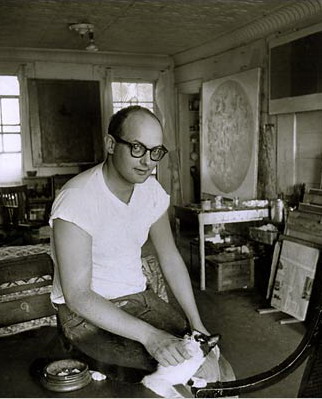
Born in Syracuse, New York in 1932[2], Hinman took his BFA from Syracuse University in 1955 before moving to New York and studying at the Art Students League. He found his studio on Coenties Slip in Lower Manhattan, a building already occupied by James Rosenquist in a vast sail-making loft. The neighbourhood attracted a cluster of young artists drawn to the scale and cheapness of the spaces; the conversations and exchanges there fed directly into Hinman's developing ideas about pictorial form.
His public breakthrough came in 1964 and 1965, when he appeared in 'Seven New Artists' at the Sidney Janis Gallery and held a solo exhibition at the Richard Feigen Gallery. The shaped canvases he showed were unlike anything else on the New York scene: stretcher bars bent into lozenges, parallelograms, and compound curves, the painted surface pulling taut across geometries that refused to lie flat. Critics placed him alongside Frank Stella, Lucio Fontana, and Kenneth Noland as a founder of the shaped canvas movement.
The work entered major collections quickly. MoMA, the Whitney Museum of American[2] Art, the Smithsonian American Art Museum[1], and the National Gallery of Art all hold examples. Hinman has continued painting into his nineties, refining a body of work that still poses its central question: where does a painting end and an object begin?
Timeline
- 1932Born in Syracuse, New York.
- 1955Received his BFA from Syracuse University, at 23.
- 1960Established his studio on Coenties Slip in Lower Manhattan.
- 1964Featured in 'Seven New Artists' at the Sidney Janis Gallery.
- 1965Held a solo exhibition at the Richard Feigen Gallery.
- 1965Critics identified him as a founder of the shaped canvas movement.
- 1965His shaped canvases were acquired by MoMA, the Whitney Museum of American Art, the Smithsonian American Art Museum, and the National Gallery of Art.
Notable Works
Tap to view larger.
Next stop
Minimalism →
Explore the artists and ideas of Minimalism.
Related Artists





Frequently Asked Questions
What is Charles Hinman known for?
Charles Hinman is known for his shaped canvases, which treat the canvas as a three-dimensional object. His paintings from the 1960s folded, bowed, and extended the canvas into forms that sat ambiguously between painting and sculpture. Critics placed him alongside Frank Stella, Lucio Fontana, and Kenneth Noland as a founder of the shaped canvas movement.Who was Charles Hinman?
Charles Hinman is one of the inventors of the shaped canvas, treating the canvas as a three-dimensional object. Before becoming an artist, he played professional baseball for the Milwaukee Braves organisation. He was born in Syracuse, New York, in 1932[2].What was Charles Hinman's art style?
Hinman's art style involves treating the canvas as a three-dimensional object. His shaped canvases feature stretcher bars bent into lozenges, parallelograms, and compound curves, with the painted surface pulled taut across geometries that refuse to lie flat.When was Charles Hinman born?
Charles Hinman was born in 1932[2].
Sources
Editorial draws on the following primary and tertiary references for Charles Hinman.
- [1] museum Smithsonian American Art Museum Used for: museum holdings.
- [2] wikipedia Wikipedia: Charles Hinman Used for: biography, birth dates, death dates, identifiers, movement attribution, nationality.
- [3] book guggenheim-emergingartists100wald Used for: biography.
- [4] book guggenheim-newhorizonsiname00denn Used for: biography.
- [5] book Landauer, Susan, The not-so-still life : a century of California painting and sculpture Used for: biography.
Editorial overseen by Solis Prints. Sources verified 2026-10-02. Click a source for details, or hover over [N] in the page above to preview.
Editorial standardsMethodologyCorrectionsAI disclosureAbout the editorial team