



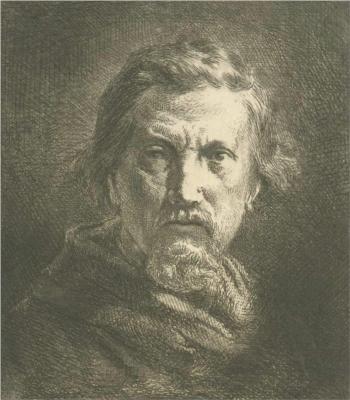
Biography
Solis Prints offers a selection of his work, including prints titled A Pond, Essais et Croquis (Cover Design), First Riding Lesson, Forge, and Landscape with a Mill.
Timeline
- 1813Born in Paris on 23 May.
- 1841Began working as an engraver, collaborating with Louis Marvy.
- 1844Started painting seriously at the age of 32.
- 1849Relocated to Barbizon, becoming a neighbour of Jean-Francois Millet.
- 1894Died in Barbizon on 7 May. He was 80 years old.
Notable Works
Tap to view larger.
Where to See Charles Jacque
3 museums worldwide.
-
3 works
Museum of Fine Arts of Reims
Reims, France
-
3 works
The Mesdag Collection
The Hague, Netherlands
8 June–31 August: Fri–Sun 10:00–17:00; 1 September–31 December: Wed–Sun 10:00–17:00
-
 2 works
Paisley Museum
Paisley, United Kingdom


Next stop
Browse the movements →
Every movement in the collection, from the Renaissance to Pop art.
Charles Jacque prints
Hand-finished archival prints from Charles Jacque's body of work.
 Forge - Charles-Émile Jacque
From £28.00
Forge - Charles-Émile Jacque
From £28.00
 Landscape with a Mill - Charles-Émile Jacque
From £28.00
Landscape with a Mill - Charles-Émile Jacque
From £28.00
 Essais et Croquis (Cover Design) - Charles-Émile Jacque
From £28.00
Essais et Croquis (Cover Design) - Charles-Émile Jacque
From £28.00
 Mémorial de Sainte-Hélène - Charles-Émile Jacque
From £28.00
Mémorial de Sainte-Hélène - Charles-Émile Jacque
From £28.00
 Landscape with Willows - Charles-Émile Jacque
From £28.00
Landscape with Willows - Charles-Émile Jacque
From £28.00
 Little Woman Holding a Pail at the Edge of a Well - Charles-Émile Jacque
From £28.00
Little Woman Holding a Pail at the Edge of a Well - Charles-Émile Jacque
From £28.00
Related Artists
%2C%20Frans%20kunstschilder%20en%20lithograaf%2C%20objectnr%20KA%206895.184.ti%EF%BC%88Cropped%EF%BC%89.jpg)


Take Charles Jacque home.
See all Charles Jacque prints →Frequently Asked Questions
What is Charles Jacque known for?
Charles Jacque is known for his pastoral paintings and etchings, particularly his depictions of sheep in pens and meadows, shepherds at dusk, and farmyard animals. His attention to detail and accurate portrayal of these subjects earned him the nicknames 'prince of sheep painters' and 'Raphael of sheep'.What should I know about Charles Jacque's prints?
Charles Jacque (1813[5]-1894[5]) was a French[5] painter and printmaker, known for his rural scenes. He is particularly noted for his etchings. Initially, Jacque trained as an engraver. He spent time in the French army before turning to art. His early career involved producing wood engravings for books and magazines. He worked as a wood engraver in London for a period, around 1836[5]-38; after this, he lived in Paris. Jacque's subject matter often included domestic animals, such as sheep, pigs, and poultry. He also depicted scenes of peasant life. His prints show a careful attention to detail and a strong sense of realism. He used etching techniques to create textures and tones that evoke the rustic atmosphere of the French countryside. Later in his career, Jacque became associated with the Barbizon School, a group of artists who focused on painting directly from nature. Although his paintings are well regarded, his prints remain a significant part of his artistic output. They offer insight into rural life in 19th-century France, and demonstrate his skill as a draughtsman and printmaker.What style or movement did Charles Jacque belong to?
Charles Jacque is associated with the Barbizon School, a group of artists who, beginning in the 1830s, painted outdoors near the village of Barbizon. This village was near the forest of Fontainebleau. The Barbizon artists aimed to paint the scenery and peasant life of their adopted locale in a direct manner. They were influenced by John Constable, who painted actual scenes, and by seventeenth-century Dutch landscapists such as Jacob van Ruisdael. Théodore Rousseau, who settled in Barbizon in 1848[5], became one of the founders of the Barbizon School. Other artists associated with the Barbizon School include Jean-Baptiste-Camille Corot and Jean-Francois Millet. Millet is known for his portrayals of rural labourers.What techniques or materials did Charles Jacque use?
Charles Jacque (1813[5]-1894[5]) was a French[5] animal painter, etcher and printmaker. He is known for his rustic scenes, particularly those featuring farm animals. Jacque began his career as a lithographer. He also worked as an engraver. His early professional life included a stint in the French army, during which he created wood engravings for military publications. Later, he supplied illustrations to L'Illustration, a French weekly magazine. He explored various printmaking techniques, including etching, drypoint, and aquatint. His etchings often depict sheepfolds, pigsties, and other rural subjects. These works show a careful attention to detail and a sensitivity to the textures of the natural world. Jacque's prints were often produced in multiple states, reflecting his experimental approach to the medium. He also used a technique of repeated biting to create a greater range of tones. Although he is best known for his prints and etchings, Jacque was also an accomplished painter. He worked in both oil and watercolour, creating similar subjects to his prints.When did Charles Jacque live and work?
Charles Jacque (1813[5]-1894[5]) was a French[5] animal painter and printmaker. He is particularly known for his etchings. Jacque began his career in a surprising field: he spent seven years as an army infantryman. After his service, he tried his hand at engraving, and then became a wood engraver for publishers. He also worked as a draughtsman for the paper *Le Charivari*. His painting career began around 1845[5]. At this time, he, along with fellow artists such as Jean-François Millet, were part of the Barbizon School. These artists favoured rural scenes. Jacque's paintings and prints often featured farm animals, particularly sheep. In 1849, Jacque briefly left France for a time, moving to the Netherlands. He returned to Barbizon in 1854. Later in his life, he moved away from animal painting. He began to paint genre scenes, and he also experimented with portraits. He died in 1894.Where can I see Charles Jacque's work?
Charles Jacque's etchings and paintings appear in numerous public collections. The Louvre in Paris holds examples of his prints, as does the British Museum in London. Other institutions with Jacque's work include the Metropolitan Museum of Art in New York, the Museum of Fine Arts in Boston, and the National Gallery of Art in Washington, D.C. These holdings often include prints of rural scenes, such as his depictions of sheep and farmyards. Smaller museums and galleries may also hold his work; however, these are often not as widely publicised. Auction catalogues are another source for tracking Jacque's artistic output. These sales records provide insight into the circulation and valuation of his pieces within the art market. Major auction houses, such as Sotheby's and Christie's, have handled Jacque's work, and their archives can be useful for research.Where was Charles Jacque from?
Charles Jacque was born in Paris in 1813[5]. He began his working life as an engraver. Jacque produced wood engravings for various publishers. He also worked as a draughtsman for the publisher M. Curmer. After a period of service in the army, Jacque turned his attention to painting. He developed an interest in rural subjects. These included scenes of animal husbandry and country life. Although born in Paris, Jacque is associated with the Barbizon School. This group of artists worked in and around the village of Barbizon, in the Forest of Fontainebleau. Other members included Jean-François Millet and Théodore Rousseau. These painters shared an interest in direct observation of nature. They often depicted peasant figures and unidealised views of the French[5] countryside. Jacque's paintings and etchings often featured sheep, poultry, and pigs. He gained a reputation for his sympathetic portrayals of these animals. He died in 1894[5].Who did Charles Jacque influence?
Charles Jacque's influence is complex. Although no passages directly discuss those he influenced, the passages do discuss the influence of others. Paul Cézanne, for example, was considered the 'godfather of Modernism'. Mid-twentieth-century critics and artists saw 'Cezanne's Courbet' as an important touchstone. Cézanne himself acknowledged a debt to Gustave Courbet as a modern painter; this has been well documented and continues to be discussed. Cézanne described Courbet as a 'builder' who applied paint like plaster and created compositions in his mind, like the old masters. Édouard Manet and the Impressionists were seen as Courbet's artistic descendants. Émile Zola praised the simplicity, forceful immediacy, and heroic frankness of Camille Pissarro's painting Jalais Hill, Pontoise, noting it as among the most Courbet-influenced paintings. Eugène Delacroix, Jean-Auguste-Dominique Ingres, Edgar Degas, Corot, Monet, Renoir, and Pissarro all painted into their sixties or later.Who influenced Charles Jacque?
Although specific influences on Charles Jacque are not widely documented, the artistic milieu of 19th-century France provides some context. Normandy painters such as Eugène Boudin and Johan Barthold Jongkind are known to have had an impact on Impressionist painters. Claude Monet, for instance, credited Jongkind with teaching him the nuances of his approach, building on the instruction he previously received from Boudin. Monet stated that Jongkind was his 'true master', to whom he owed the final education of his eye. The work of Boudin and Jongkind, therefore, represents a strand of direct influence on the Impressionists. This artistic lineage suggests a network of influence among artists working in similar genres and locations during that period.Who was Charles Jacque?
Charles Jacque was a 19th-century French[5] artist who initially drew military maps before becoming a productive printmaker and pastoral painter. He began his art career around 1841[5] as an engraver and later focused on painting in 1844. He is credited with reviving etching as a major printmaking form in France.Why are Charles Jacque's works important today?
Charles Jacque (1813[5]-1894[5]) was a French[5] animalier painter and printmaker. He is remembered for his rural scenes and sympathetic depictions of farm animals. Jacque's importance lies in his contribution to the Realist movement. His images of sheep, pigs, and chickens offered a counterpoint to the more idealised pastoral scenes popular at the time. He presented these creatures with an unvarnished realism. His work provides insight into 19th-century French agricultural life. He was also a skilled printmaker, producing many etchings and engravings. These prints made his work accessible to a wider audience. They circulated his vision of rural life beyond the confines of galleries and wealthy patrons. His prints influenced later generations of artists interested in rural subjects. His focus on the everyday lives of animals and rural people distinguishes him from many of his contemporaries. His art offers a valuable record of a disappearing way of life.
Sources
Editorial draws on the following primary and tertiary references for Charles Jacque.
- [1] museum The Mesdag Collection Used for: museum holdings.
- [2] museum Royal Pump Rooms Used for: museum holdings.
- [3] museum Museum of Fine Arts of Reims Used for: museum holdings.
- [4] museum Paisley Museum Used for: museum holdings.
- [5] wikipedia Wikipedia: Charles Jacque Used for: biography, birth dates, death dates, identifiers, movement attribution, nationality.
- [6] book Beard, Lee, 1973- author, Butler, Adam, author; Van Cleave, Claire, author; Fortenberry, Diane, author; Stirling, Susan, author, Beard, Lee, 1973- author, Butler, Adam, author; Van Cleave, Claire, author; Fortenberry, Diane, author; Stirling, Susan, author - The Art Book_ New Edition, Mini Format Used for: biography.
- [7] book Getty, Getty - Courbet and the Modern Landscape Used for: biography, stylistic analysis.
- [8] book Getty, Getty - Oudrys Painted Menagerie Used for: stylistic analysis.
- [9] book Masterpieces of western art : a history of art in 900 individual studies from the Gothic to the present day Used for: biography.
- [10] book Post-impressionism : cross-currents in European painting Used for: biography.
- [11] book Unknown, Reclaiming female agency : feminist art history after postmodernism Used for: biography.
- [12] museum Charles Émile Jacque | National Gallery of Art Used for: biography.
- [13] museum Charles Jacque | British Museum Used for: biography.
- [14] museum The Sheepfold Used for: notable works.
Editorial overseen by Solis Prints. Sources verified 2026-09-16. Click a source for details, or hover over [N] in the page above to preview.
Editorial standardsMethodologyCorrectionsAI disclosureAbout the editorial team