



Charles Meryon
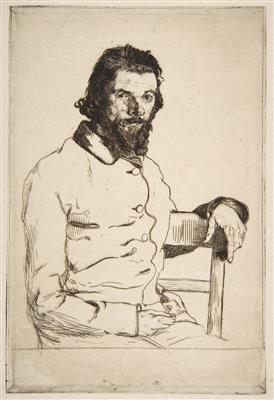
Charles Meryon came to etching by elimination. Born in Paris in 1821[1] to an English doctor and a dancer at the Paris Opera, he spent ten years in the French[1] Navy before discovering, during a four-year circumnavigation aboard the Rhin (1842[1]-1846[1]), that he was colour blind. Painting was out. On his return he sought instruction from the engraver Eugène Bléry and began working in a medium then considered thoroughly unfashionable.
Biography
Between 1850[1] and 1856 he produced the series for which he is now remembered: the Eaux-fortes sur Paris, twenty-two plates depicting the medieval fabric of a city then being demolished by Haussmann's renovation programme. The work is documentary in its accuracy and strange in its atmosphere, the old city rendered with almost obsessive precision against skies populated, in some states, with hallucinatory additions. *Le Stryge* (1853) shows a gargoyle crouching above Paris with an expression of weary malevolence; *Abside de Notre-Dame* (1854), often considered his masterpiece, turns the cathedral's apse and flying buttresses into a nearly abstract architectural diagram. *Le Pont Neuf* appeared the same year.
Mental deterioration set in during the mid-1850s, centred on persecutory delusions involving Napoleon III. Meryon admitted himself voluntarily to Charenton Asylum in 1858[1], remained fourteen months, resumed work on release, then re-entered permanently in 1866, dying there on 14 February 1868[1].
During his lifetime he sold prints for almost nothing. The market corrected slowly: *Le Stryge* fetched £5 in 1873 and £100 by 1905. He is now generally considered the most significant etcher of nineteenth-century France, though he remains less known outside specialist circles than that reputation suggests.
Timeline
- 1821Born in Paris to an English doctor and a dancer at the Paris Opera.
- 1842Began a four-year circumnavigation aboard the Rhin.
- 1846Discovered he was colour blind during his time on the Rhin, making painting difficult.
- 1850Began working on the series Eaux-fortes sur Paris, a set of twenty-two etchings.
- 1853Created the etching "Le Stryge", depicting a gargoyle above Paris.
- 1854Created the etching "Abside de Notre-Dame", often considered his masterpiece.
- 1854Created the etching "Le Pont Neuf".
- 1858Voluntarily admitted himself to Charenton Asylum.
- 1866Re-entered Charenton Asylum permanently.
- 1868Died at Charenton Asylum on 14 February, aged 46.
Notable Works
Tap to view larger.
Next stop
Browse the movements →
Every movement in the collection, from the Renaissance to Pop art.
Related Artists


Frequently Asked Questions
What is Charles Meryon known for?
Charles Meryon is known for his series Eaux-fortes sur Paris, a collection of twenty-two plates depicting the medieval structures of Paris during Haussmann's renovation programme. These etchings document the city with accuracy but also evoke a strange atmosphere, rendering the old city with precision and sometimes adding hallucinatory elements to the skies. His works include *Le Stryge*, *Abside de Notre-Dame*, and *Le Pont Neuf*.What should I know about Charles Meryon's prints?
When assessing Charles Meryon's prints, it is helpful to understand print terminology. A 'vintage print' is made around the time the negative was taken. A 'period print' is one made within roughly 10 to 15 years after. If the printing time is unknown, it is qualified as an 'old print'. A 'modern print' is a recent photograph from the original negative. An 'original print' is definitive and made by the artist or under their supervision. A 'facsimile' is a print made by re-photographing a print, or by using the original negative. Its print base and processing are, to the extent possible, identical to those used for the reference print (generally, a vintage print). Proofing is an important part of the print-making process, enabling the artist to test the feel of a print. It is wise to allow time for reviewing. Cutting the block does not make the finished print; printing does. In reality, cutting is just the beginning.What style or movement did Charles Meryon belong to?
Charles Meryon (1821[1]-1868[1]) was active before the Symbolist movement came to prominence in the late 1880s and 1890s. However, some later printmakers such as Mary Cassatt were part of the Symbolist movement, which followed the print revival. Symbolism moved away from representing reality, instead using objects as signs of ideas suggested by the subject. Symbolist painters and writers were interested in creating art that was both subjective and synthetic. Gustave Moreau, who created exotic fantasies, was a key figure in the evolution of Symbolist elements reacting against Impressionism. His influence extended to artists as different as Gauguin and Rouault. The transition from Impressionism involved writers such as Mallarmé, who hosted gatherings that became central to the Symbolist movement, uniting writers and painters.What techniques or materials did Charles Meryon use?
Charles Meryon was a 19th-century French[1] printmaker, known for his detailed etchings of Paris. He adopted etching after his hopes of becoming a naval officer were dashed by deafness and poor eyesight. Meryon's primary technique was etching, a printmaking process using acid to corrode a design into a metal plate. The plate is covered with a wax-like, acid-resistant ground. The artist scratches an image into this ground, exposing the metal. The plate is then immersed in acid, which bites into the exposed lines. The longer the plate remains in the acid, the deeper and wider the lines become. Ink is applied to the etched lines, the surface is wiped clean, and the image is transferred to paper under pressure in a printing press. Meryon favoured old paper for printing, as he preferred its colour and texture. He often reworked his plates, creating multiple states of the same image with variations in detail or shading. He sometimes employed drypoint, directly scratching into the plate with a sharp needle to create a burr, which holds additional ink and produces a soft, velvety line when printed. This is seen in some of his later states.What was Charles Meryon known for?
Charles Meryon (1821[1]-1868[1]) is best known for his etchings of Paris. He served in the French[1] Navy, travelling to places such as the South Pacific. In 1846[1], he abandoned his naval career and turned to art. Meryon initially wanted to be a painter, but problems with colour-blindness led him to focus on etching. He studied with Eugène Bléry, a specialist in reproducing paintings via etching. Meryon moved away from reproductive work, instead creating original compositions. His best-known works depict the architecture of Paris. He created a series of etchings called *Eaux-fortes sur Paris*. These plates presented detailed views of buildings and streetscapes. He often included dramatic skies and atmospheric effects in his prints. Some of his prints also incorporated elements of social commentary, with symbolic figures and details added to the urban scenes.When did Charles Meryon live and work?
Charles Meryon was born in Paris in 1821[1]. His father was French[1], and his mother was an Englishwoman from London. Meryon entered naval college at Brest in 1837[1], and he sailed as a midshipman to places including the Mediterranean, the South Pacific, and New Zealand. He left the navy in 1846, due to failing eyesight. Meryon then turned to art, studying painting with Eugène Bléry, and focusing on printmaking, especially etchings of Paris. He is known for his detailed and atmospheric depictions of the city's architecture and streets. By 1859, Meryon was exhibiting his works in London. He suffered from mental illness later in life, and was admitted to the Charenton asylum, where he died in 1868[1].Where can I see Charles Meryon's work?
To view Charles Meryon's prints, several museums hold significant collections. In Paris, the Bibliothèque Nationale and the Musée du Louvre both possess works by the artist. Outside France, several options exist. In the United Kingdom, the British Museum, the Victoria and Albert Museum, and the Fitzwilliam Museum in Cambridge all maintain collections that may include Meryon's pieces. In the United States, the Art Institute of Chicago, the Metropolitan Museum of Art in New York, and the Museum of Fine Arts in Boston are possible locations to view his art. Other museums such as the Los Angeles County Museum of Art and the Minneapolis Institute of Arts may also hold relevant works. Checking the museum's online catalogue or contacting the print and drawings department is recommended to confirm if they have pieces by Meryon on display or available for viewing in their study room.Where was Charles Meryon from?
Charles Le Brun (1619-1690[1]) was French[1]. He began his art studies in Paris with the painter Simon Vouet. Le Brun attracted royal attention early in his career; by 1638, he was designated Peintre du Roi (Painter to the King). From 1642 to 1646, he sojourned in Rome, where he absorbed the influences of Raphael, the Bolognese School, and Poussin. Upon his return to Paris, he co-founded the Royal Academy in 1648. He dominated the institution for many years, delivering discourses on art. In 1661, a royal commission brought him great success, leading to his appointment as chief painter to King Louis XIV of France. Louis’s minister, Jean-Baptiste Colbert, also appointed him chancellor of the French Academy of Painting and Sculpture. In this role, he dictated artistic taste in France. Colbert also appointed Le Brun director of the Gobelins and Savonnerie factories, which produced furnishings and carpeting for the royal residences. At these factories, Le Brun provided all the designs to be executed.Who did Charles Meryon influence?
Charles Meryon's influence can be seen in the work of Félix Bracquemond, who taught etching techniques to Edgar Degas and others. Bracquemond was a versatile artist known for his technical skill. Although he occasionally depicted city life, including scenes from the siege of Paris, his primary interest lay in animal studies. These studies were sometimes comical, such as his *Storm Cloud (La Nuée d’orage)*, which portrays a flock of geese in eleven different states. Bracquemond's etching *The Raven* (1854[1]) also shows Meryon's influence. Manet, who was a student in Couture’s studio at the time, may have seen it. Echoes of Bracquemond's *Raven* can be found in Manet's work, particularly in the beak of *The Crossing* and the shadow around the gallows. In 1891 Mary Cassatt began printing a set of multiple-plate etchings, combining aquatint with drypoint, a process similar to Bracquemond’s.Who influenced Charles Meryon?
Félix Bracquemond, a friend of Édouard Manet, influenced Edgar Degas and others with his etching technique. Bracquemond was a versatile artist, particularly regarding technical skill. Although he occasionally depicted city life scenes, such as the siege of Paris, his artistic focus was on animal studies. One such work is Storm Cloud (La Nuée d’orage), which portrays a flock of geese, in eleven distinct states, under the light of a Crucifixion by Rembrandt. In 1854[1], Bracquemond created his own version of "The Raven", after Baudelaire's translation of the poem. Manet, who was studying in Couture’s studio at the time, may have been inspired by Bracquemond's piece, as echoes of its compact form appear in Manet's work, specifically in the beak of The Crossing and the shadow at the base of the gallows.Who was Charles Meryon?
Charles Meryon (1821[1]-1868[1]) was a French[1] artist, best known for his etchings of Paris. He served in the French Navy, travelling to the South Pacific. Meryon's naval career ended due to hearing problems. He then turned to art, studying under Eugène Bléry. Meryon initially wanted to be a painter, but he shifted to etching, as colour-blindness made painting difficult. His best-known works depict Parisian cityscapes, often with a sense of the melancholic or macabre. Meryon's detailed etchings captured the architectural character of Paris before Haussmann's renovations. His prints often included imagined or symbolic elements. Later in life, Meryon suffered from mental illness and was confined to an asylum, where he died. Despite his struggles, his etchings secured his place in the history of printmaking.Why are Charles Meryon's works important today?
Charles Meryon (1821[1]-1868[1]) is best known for his etchings of Paris. He meticulously depicted the city's architecture, atmosphere, and urban fabric during a period of significant transformation. His prints offer a detailed record of Parisian life in the mid-19th century. Meryon's technical skill as a printmaker is a reason for his continuing appeal. He mastered the etching process, achieving remarkable precision and tonal range. His work influenced later generations of printmakers. Beyond their technical merit, Meryon's prints possess a distinctive artistic vision. He often imbued his cityscapes with a sense of drama and unease. Some scholars suggest that his personal struggles with mental health contributed to the emotional intensity of his images. His psychological perspective separates him from other topographical artists. His images of Paris document a specific time, but they also explore universal themes of urban change, alienation, and the relationship between the individual and the built environment. These themes resonate with contemporary audiences.
Sources
Editorial draws on the following primary and tertiary references for Charles Meryon.
- [1] wikipedia Wikipedia: Charles Meryon Used for: biography, birth dates, death dates, identifiers, movement attribution, nationality.
- [2] book Getty, Getty - Antiquity and Photography Early Views of Ancient Mediterranean Sites Used for: stylistic analysis.
- [3] book Getty, Getty - Historical Painting Techniques Materials and Studio Practice Used for: stylistic analysis.
- [4] book Getty, Getty - The Ruins of the Most Beautiful Monuments of Greece Used for: stylistic analysis.
- [5] book Masterpieces of western art : a history of art in 900 individual studies from the Gothic to the present day Used for: biography.
- [6] book Post-impressionism : cross-currents in European painting Used for: biography.
- [7] book Post-impressionism : cross-currents in European painting Used for: biography.
Editorial overseen by Solis Prints. Sources verified 2026-08-03. Click a source for details, or hover over [N] in the page above to preview.
Editorial standardsMethodologyCorrectionsAI disclosureAbout the editorial team