



Charles-Philippe Lariviere
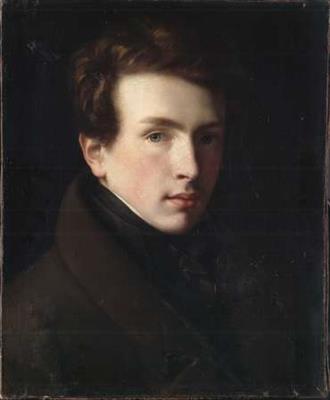
He won the Prix de Rome in 1824[1] with 'The Death of Alcibiades', having trained under Paulin Guérin, Girodet-Trioson, and Antoine-Jean Gros. The prize brought a six-year residency at the Villa Medici in Rome, where he absorbed the classical tradition and developed his characteristic blending of Romantic sensibility with academic discipline.
Biography
Larivière made his Salon debut in 1827[1] and continued exhibiting there for nearly three decades, earning medals in 1831 and 1855. His reputation rested on history painting at an institutional scale. Three of his canvases hang in the Galerie des Batailles at Versailles, the grand hall commissioned by Louis-Philippe to chronicle French[1] military achievement. His 'Battle of the Dunes' is among them, placing him alongside Vernet, Delacroix, and the painters who shaped the national historical imagination of the July Monarchy.
Beyond battlefield subjects, Larivière worked in religious painting and portraiture, accumulating the markers of official favour: the Legion of Honour in 1836[1] and the Tunisian Nichan Iftikhar. After his death in Paris in 1876[1], his family donated the remaining studio works to the Musée de Picardie in Amiens, where a significant portion of his output is held today.
Timeline
- 1798Born in France.
- 1824Won the Prix de Rome with 'The Death of Alcibiades'.
- 1824Studied under Paulin Guérin, Girodet-Trioson, and Antoine-Jean Gros.
- 1827Made his debut at the Salon.
- 1831Earned a medal at the Salon.
- 1836Received the Legion of Honour.
- 1855Earned a medal at the Salon.
- 1876Died in Paris.
Notable Works
Tap to view larger.
Next stop
Neoclassicism →
Explore the artists and ideas of Neoclassicism.
Related Artists




Frequently Asked Questions
What is Charles-Philippe Lariviere known for?
Charles-Philippe Lariviere is known for history painting at an institutional scale. Three of his canvases hang in the Galerie des Batailles at Versailles, including 'Battle of the Dunes'.What is Charles-Philippe Lariviere's most famous work?
It is difficult to name Charles-Philippe Lariviere's single most famous work, because his artistic output included many battle paintings and portraits. None is clearly singled out in the art-history literature. Nicolas de Largillière, an earlier French[1] artist, has several notable paintings, including *Tutor and Pupil* (1685), in Washington, National Gallery. It depicts figures in three-quarter length, indicating each individual's social rank. The pupil belongs to the aristocracy, indicated by his embroidered silk, lace costume, and fashionable long hair. The teacher wears an austere black-and-white costume and a simpler hairstyle. They stand in a loggia, through which one sees a lush garden. A dog, a symbol of high standing, faces its young master in the foreground. Largillière's training in the Netherlands and work for Peter Lely influenced his style, shown by his loose brushwork and colourism. Other paintings by Largillière include the portrait of Charles Le Brun (1686) in the Louvre; *La Belle Strasbourgeoise* (1703) in the Musée des Beaux-Arts, Strasbourg; and *Elizabeth Throckmorton* (1729), in Washington, National Gallery.What should I know about Charles-Philippe Lariviere's prints?
Charles-Philippe Lariviere (1798[1]-1876[1]) was a French[1] painter and lithographer who produced a varied body of work; however, there is little specific information readily available regarding his prints. When considering Lariviere's broader artistic approach, prints would likely mirror the characteristics found in his paintings, which often depict historical or genre scenes. Prints of this time served multiple purposes, such as disseminating images to a wider audience or documenting existing artworks. Depending on the subject, Lariviere's prints might offer insights into French history, culture, or social customs of the 19th century. Further research into specific collections or catalogues raisonnés may reveal more information about Lariviere's printmaking activities and the subjects he chose to represent.What style or movement did Charles-Philippe Lariviere belong to?
Charles-Philippe Lariviere (1798[1]-1876[1]) worked during a period when Neoclassicism[1] was a dominant style. This movement, which began in the 1750s, saw a revival of classical art and architecture, lasting until around 1830[1], though late Neoclassicism continued through the 1870s. In France, Neoclassicism was promoted through the Académie Royale de Peinture et de Sculpture. Artists were encouraged to study classical models from ancient, Renaissance, and 17th-century art. Jacques-Louis David’s studio became a key training centre for young French[1] artists well into the 19th century. Neoclassicism became associated with both royal authority and, later, the French Revolution. The style was linked to improving public morality through historical examples of virtue. During the French Revolution, Neoclassicism spread across Europe. The early style in France is known as the Louis XVI style; the second phase, under Napoleon, is called the Empire style. Even as Romanticism emerged in the early 19th century, Neoclassicism persisted, particularly among David’s students.What techniques or materials did Charles-Philippe Lariviere use?
Historical sources suggest several techniques and materials used by artists during Lariviere's era. These included oil paint, tempera, and watercolours. The choice of material influenced the final artwork, as each required specific handling and produced a distinct effect. Oil paint was a popular medium, involving pigments diluted in oil and applied with brushes. Watercolour techniques, wash drawings, and sepias also existed. The same colour would appear different depending on whether it was rendered in watercolour, oil, tempera, or fresco. Drawing materials included lead pencil, conte crayon, charcoal, chalks, and pastels. The artist's choice of material was conditioned by the effect they intended to achieve. Each material presented unique possibilities and limitations, influencing the nature of the work. Some artists sought to rediscover the techniques of earlier masters, such as Titian and Rembrandt. The preparation of the canvas itself was a detailed process, involving stretching, smoothing, sizing with glue, and applying a double ground.What was Charles-Philippe Lariviere known for?
Charles-Philippe Lariviere (1798[1]-1876[1]) was a French[1] painter best known for historical and military scenes. Neoclassicism[1] arose in France during the French Revolution, then spread across Europe during the French revolutionary wars. The early Neoclassical style in France is called the Louis XVI style; the second phase, under Napoleon's First French Empire, is called the Empire style. Lariviere's career developed after this period. He studied with Charles Meynier and Baron Gros, exhibiting at the Salon from 1824[1]. His paintings often depicted events from French history, particularly military victories and heroic episodes. Later in life, he also produced some genre paintings. Lariviere received several medals at the Salon and other exhibitions, and he is considered a significant, if not a leading, figure in 19th-century French historical painting.When did Charles-Philippe Lariviere live and work?
Charles-Philippe Lariviere was active as a painter in France during the first half of the 19th century. In 1819[1], he received second prize for painting at an unspecified event. He received third prize in 1820 at another event. By 1824, Lariviere had achieved first prize. During this period, the French[1] art world experienced considerable change. Jacques-Louis David, who had been Napoleon’s ‘premier peintre’, voluntarily went into exile in Brussels. Works of art seized by Napoleon during his European campaigns were returned to their country of origin under the terms of the Treaty of Vienna. The Galerie du Luxembourg was established as a museum for the work of living French artists in 1818; works would be kept there until five or ten years after the artist's death, when they would enter the Louvre or a suitable provincial museum.Where can I see Charles-Philippe Lariviere's work?
While specific locations of Charles-Philippe Lariviere's work are not widely published, several museums feature art from related periods and styles. These institutions may hold pieces by Lariviere or artists working in similar veins. In the United States, you might explore the Metropolitan Museum of Art (New York), the Los Angeles County Museum of Art (LACMA), the Minneapolis Institute of Arts, the Charles Hosmer Morse Museum of American Art (Winter Park, Florida), the Museum of Modern Art (New York), the Virginia Museum of Fine Arts (Richmond), and the Wolfsonian at Florida International University (Miami Beach). In the United Kingdom, consider visiting the Victoria & Albert Museum (London), the National Museums of Scotland (Edinburgh), the Manchester Art Gallery, the Geffrye Museum (London), the Brighton Museum & Art Gallery, and the Bakelite Museum. Other European museums include the Musées Royaux des Beaux-Arts de Belgique (Brussels).Where was Charles-Philippe Lariviere from?
Charles-Philippe Lariviere was a French[1] painter, born in Paris. Other artists of the period also had connections to Paris. Nicolas de Largillière, an accomplished portraitist of the late 17th and early 18th century, was born in Paris. Jean-Baptiste-Marie Pierre, a French painter and director of the Royal Academy of Paris, was also a native of Paris. Similarly, the French sculptor Jean-Baptiste Pigalle was born in Paris. Charles Le Brun, a French painter, architect, and theorist, was a pupil of Simon Vouet and François Perrier in Paris. He later studied with Nicolas Poussin in Rome. Nicolas de Largillière returned to Paris in 1679, where he remained for most of his life, except for a brief stay in England from 1685 to 1686. Jean-Baptiste Pigalle trained with Jean-Baptiste Lemoyne, and travelled to Italy from 1736 to 1739 as part of his academic training.Who did Charles-Philippe Lariviere influence?
It is difficult to determine definitively who Charles-Philippe Lariviere influenced directly. However, some contextual information may be useful. Jean-Auguste-Dominique Ingres taught many students and asked his best students to collaborate on paintings. In this, he followed the example of his master, David. Ingres's pupils and followers oriented themselves to examples such as Hippolyte Flandrin (1809[1]-64) in his Christian cycles. Ingres had a lasting effect on younger artists of the Restauration period and the Second Empire under Napoleon III. These included Joseph-Désiré Court (1797-1865[1]), Thomas Couture (1815-79), Adolphe-William Bouguereau (1825-1905), and Paul Baudry (1828-86). The Swiss painter Charles-Gabriel Gleyre (1806-74) also worked to bring the past to life in painting. He studied at the Ecole de Pierre in Lyons and in Paris under Louis Hersent (1777-1860), and practised watercolour with Richard Parkes Bonington.Who influenced Charles-Philippe Lariviere?
It is difficult to assess the influences on Charles-Philippe Lariviere based on the reference texts provided. However, several artists active in France and elsewhere during Lariviere's lifetime (1798[1]-1876[1]) are listed. These include Nicolas de Largilliere (1656-1746[1]), Nicolas Lancret (1690-1743), Jean-Baptiste-Pierre Le Brun (1748-1813[1]), François-Bernard Lépicié (1698-1755), and Jean-Baptiste Oudry (1686-1755). The list also contains Gaspard Poussin (1615-1675), Claude Lorrain (1600-1682), and Nicolas Poussin (1594-1665), who, although of an earlier generation, were highly influential on French[1] art. Other artists mentioned are Raphael (1483-1520), Bartolomé Esteban Murillo (1617-1682), Adriaen van Ostade (1610-1685), and Paulus Potter (1625-1654). These artists represent a range of styles and periods, from the Renaissance to the Dutch Golden Age, and may have contributed to Lariviere's artistic development.
Sources
Editorial draws on the following primary and tertiary references for Charles-Philippe Lariviere.
- [1] wikipedia Wikipedia: Charles-Philippe Lariviere Used for: biography, birth dates, death dates, identifiers, movement attribution, nationality.
- [2] book Beard, Lee, 1973- author, Butler, Adam, author; Van Cleave, Claire, author; Fortenberry, Diane, author; Stirling, Susan, author, Beard, Lee, 1973- author, Butler, Adam, author; Van Cleave, Claire, author; Fortenberry, Diane, author; Stirling, Susan, author - The Art Book_ New Edition, Mini Format Used for: biography.
- [3] book Getty, Getty - Adelaide Labille-Guiard Used for: biography.
- [4] book Lilian H. Zirpolo, Historical Dictionary of Baroque Art and Architecture Used for: biography, stylistic analysis.
- [5] book Masterpieces of western art : a history of art in 900 individual studies from the Gothic to the present day Used for: biography.
Editorial overseen by Solis Prints. Sources verified 2026-09-27. Click a source for details, or hover over [N] in the page above to preview.
Editorial standardsMethodologyCorrectionsAI disclosureAbout the editorial team