



Christen Kobke
- Danish Golden Age
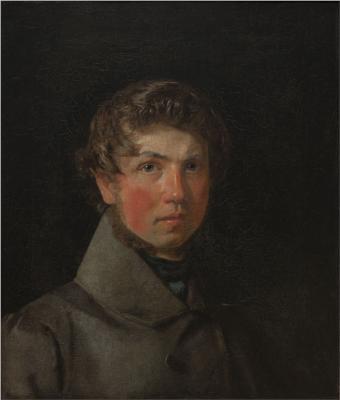
Christen Kobke painted almost everything within walking distance of where he lived, and became one of the great painters of his century as a result. Born in 1810[1] in Kastellet, Copenhagen's star-shaped military fortress where his father served as head baker, he took up drawing after rheumatic fever confined him at eleven. He entered the Royal Danish[1] Academy in 1822[1] and came under the decisive influence of Christoffer Wilhelm Eckersberg, whose emphasis on direct observation of nature shaped every subsequent Danish landscape painter of the period.
Biography
His early works are the fortification walls, embankments, and views across Sortedam Lake that surrounded his daily life: subjects most artists would have considered too familiar to paint. The portrait of fellow painter Frederik Hansen Sodring (1832[1]) shows the intimacy typical of his circle. Frederiksborg Slot ved Aftenbelysning (1835), an evening view of the castle reflected in still water, is among the most admired paintings of the Danish[1] Golden Age.
A travelling scholarship in 1838[1] took him to Rome and then Naples, Sorrento, Pompeii, and Capri, where he worked alongside Constantin Hansen. The Italian work he brought back proved a poor fit with the Danish[1] market: warmer and broader than his domestic scenes, it found limited favour. His application for full academy membership in 1846 was rejected. He died of pneumonia in February 1848[1], at thirty-seven.
He was largely forgotten at the time of his death. The international reassessment came slowly: his work now appears in the J. Paul Getty Museum in Los Angeles, the Scottish National Gallery in Edinburgh, the Metropolitan Museum of Art in New York, and the Ny Carlsberg Glyptotek in Copenhagen. He is now considered the most internationally recognised Danish[1] painter of his generation.
Timeline
- 1810Born in Kastellet, Copenhagen. His father was head baker at the military fortress.
- 1822Entered the Royal Danish Academy.
- 1832Painted a portrait of Frederik Hansen Sodring.
- 1835Painted "Frederiksborg Slot ved Aftenbelysning", an evening view of the castle.
- 1838Received a travelling scholarship and travelled to Rome, Naples, Sorrento, Pompeii, and Capri.
- 1846His application for full academy membership was rejected.
- 1848Died of pneumonia in February, aged 37.
Notable Works
Tap to view larger.
Next stop
Browse the movements →
Every movement in the collection, from the Renaissance to Pop art.
Related Artists


Frequently Asked Questions
What is Christen Kobke known for?
Christen Kobke is known for painting subjects most artists would consider too familiar to paint, such as fortification walls, embankments, and views across Sortedam Lake. One of his most admired paintings is Frederiksborg Slot ved Aftenbelysning (1835[1]), an evening view of the castle reflected in still water.What is Christen Kobke's most famous work?
Christen Købke, a Danish[1] artist of the Golden Age, is best known for his paintings depicting scenes of Copenhagen and its surroundings. Although it is difficult to identify a single "most famous" work, several paintings are particularly well regarded and frequently reproduced. One such painting is "View of a Street in Copenhagen" (1837[1], The National Gallery, London). This work presents a seemingly ordinary street scene, yet it demonstrates Købke's skill in capturing light and atmosphere. The painting's composition, with its careful arrangement of buildings and figures, creates a sense of depth and realism. Another notable painting is "The Little Turret on Frederiksborg Castle" (1834, National Gallery of Denmark, Copenhagen). This painting shows Købke's interest in architectural subjects and his ability to render the details of buildings with precision. The play of light on the castle walls and the reflection in the water add to the painting's visual appeal. Other well-known works include "Lake Sortedam near Dosseringen" (1838, National Gallery of Denmark) and various portraits of his family and fellow artists. These paintings, like "View of a Street in Copenhagen" and "The Little Turret on Frederiksborg Castle", contribute to Købke's reputation as one of Denmark's most important painters.What should I know about Christen Kobke's prints?
Christen Købke (1810[1]-1848[1]) was a Danish[1] painter, associated with the Golden Age of Danish Painting. He is known for his genre paintings, landscapes, and architectural scenes. Købke studied at the Royal Danish Academy of Fine Arts from 1822[1]. There, he trained with Christian August Lorentzen and Christoffer Wilhelm Eckersberg. Eckersberg, in particular, emphasised painting from nature, which had a great impact on Købke's style. Many of Købke's works depict scenes from in and around Copenhagen. He painted the city's lakes, streets, and buildings, often with careful attention to light and atmosphere. His paintings of Frederiksborg Castle are examples of his interest in architecture. Købke also painted portraits of his family and friends. These portraits offer an intimate look into the lives of people in the Danish Golden Age[1]. Although he achieved some recognition during his lifetime, Købke's work gained greater appreciation after his death. Today, he is considered one of Denmark's most important painters. Prints of Købke's paintings offer an accessible way to appreciate his contributions to Danish art.What style or movement did Christen Kobke belong to?
Christen Kobke (1810[1]-1848[1]) belonged to a younger generation of Danish[1] naturalists. These artists consciously tried to create an independent Danish style of painting. Kobke's teacher, Eckersberg (1783-1853[1]), was devoted to international Neoclassicism. Eckersberg gained experience in Rome, but the younger painters instead turned to the Danish homeland. They thought the views in their local area equalled any sun-drenched Italian or dramatic Nordic scene. Kobke's subjects included the tranquility of nature around villages and towns, the clarity of colour and light, and the ordinary lives of the people there. The Danish flag is sometimes included; its colours heighten the other hues in the painting. Figures gazing out over a lake do not embody the consciousness of the viewer, but seem like quiet objects in a quiet environment. Kobke's work seeks to reflect something of the clear order of this life.What techniques or materials did Christen Kobke use?
Christen Kobke was a 19th-century Danish[1] Golden Age painter known for his close observation and realistic depictions of everyday life. He favoured oil paint on canvas, applying it with careful attention to detail. Kobke's technique involved meticulous layering and glazing to achieve subtle tonal variations and capture the effects of light. He often worked on relatively small-sized canvases, allowing for a high degree of precision. His brushwork is characterised by its controlled and deliberate nature, avoiding broad or expressive strokes. Kobke's approach to colour was restrained, focusing on naturalistic hues and subtle gradations. He paid close attention to the atmospheric conditions and the way light affected the appearance of objects. His paintings often feature a limited range of colours, creating a sense of harmony and unity. Kobke's mastery of perspective and composition further enhanced the realism of his works, drawing viewers into the scenes he portrayed.What was Christen Kobke known for?
Christen Købke (1810[1]-1848[1]) was a Danish[1] painter associated with the Golden Age of Danish Painting. He is best known for his genre paintings, portraits, and architectural scenes. Købke studied at the Royal Danish Academy of Fine Arts from 1822[1]. There, he trained with Christian August Lorentzen and Christoffer Wilhelm Eckersberg. Eckersberg, a leading figure in Danish art, emphasised painting from nature. Købke adopted this approach, producing works characterised by careful observation and naturalistic light. Many of Købke's paintings depict scenes from in and around Copenhagen. These include views of the city's lakes, streets, and buildings. He also painted portraits of his family and fellow artists. His work often displays a quiet, contemplative mood. Some of his well-known paintings include "View of the Sortedam Lake near Dosseringen" (1838), "The North Gate of the Citadel" (1834), and various portraits of his mother. Although recognised during his lifetime, Købke's work gained greater appreciation in the later 19th century. Today, he is considered one of Denmark's most important artists.When did Christen Kobke live and work?
Christen Kobke was a Danish[1] painter who lived from 1810[1] to 1848[1]. He belonged to a younger generation of Danish naturalists. These artists consciously tried to create a uniquely Danish style of painting. Kobke's teacher, Christoffer Wilhelm Eckersberg (1783-1853[1]), had studied international Neoclassicism and gained experience in Rome. However, Kobke and other younger painters focused on the Danish countryside. They found beauty in the ordinary views of their homeland. They believed these local scenes were equal to Italian or Nordic ones. Kobke's paintings often depict tranquil nature near villages and towns. He captured the clarity of colour and light, as well as the everyday lives of the people there. One example is "The Shore at Dosseringen" (1838[1]).Where can I see Christen Kobke's work?
To view works by Christen Kobke, consider the following museums. In the United States, you can find art at the Metropolitan Museum of Art (New York), the Los Angeles County Museum of Art, the Minneapolis Institute of Arts, the Museum of Modern Art (New York), the Charles Hosmer Morse Museum of American Art (Winter Park, Florida), the Virginia Museum of Fine Arts (Richmond), and the Wolfsonian at Florida International University (Miami Beach). In the United Kingdom, visit the Brighton Museum & Art Gallery, the Geffrye Museum (London), the Manchester Art Gallery, the National Museums of Scotland (Edinburgh), the Victoria & Albert Museum (London), or the Towneley Hall Art Gallery (Burnley, Lancashire). Other museums include the Art Gallery of New South Wales (Sydney), the Musée d’Orsay (Paris), the Musée du Louvre (Paris), the National Gallery of Scotland (Edinburgh), the Fitzwilliam Museum (Cambridge), and the National Museum of Wales (Cardiff).Who influenced Christen Kobke?
Christen Købke (1810[1]-1848[1]) developed his artistic style within the context of Danish[1] Golden Age painting. He was a student at the Royal Danish Academy of Fine Arts. There, he trained with Christoffer Wilhelm Eckersberg (1783-1853[1]), who had a considerable impact on his artistic development. Eckersberg, a leading figure in Danish art, emphasised careful observation and accurate depiction of nature. His influence is evident in Købke's attention to detail, use of light, and interest in everyday subjects. Studies of Italian art also shaped Eckersberg's ideas, and by extension, Købke's. Købke's early works show a close adherence to Eckersberg's principles. However, Købke gradually developed his own distinctive style. This included a more romantic sensibility and an interest in capturing the atmosphere of specific places and times of day. Other possible influences include the work of Johan Christian Dahl (1788-1857), another prominent figure in the Danish art scene, and the general artistic trends of the Biedermeier period.Who was Christen Kobke?
Christen Kobke (1810[1]-1848[1]) was a Danish[1] painter. He is best known for his Copenhagen scenes and for his portraits. He studied at the Royal Danish Academy of Fine Arts from 1822[1]. There, he trained with Christian August Lorentzen and Christoffer Wilhelm Eckersberg. Eckersberg, a former student of Jacques-Louis David, encouraged painting from nature. Kobke debuted as an artist in 1828 at the Charlottenborg Spring Exhibition in Copenhagen. He travelled to Italy in 1838-1840[1], visiting Rome, Naples, and Pompeii. Kobke became a member of the Academy in 1846. Shortly before his death from pneumonia, he was appointed as an assistant professor there. Although appreciated during his lifetime, Kobke's work received greater attention in later years. Today, he is considered one of the most important artists of the Danish Golden Age[1]. His paintings are held in the collections of the National Gallery of Denmark (Statens Museum for Kunst), the Ny Carlsberg Glyptotek, and other museums.Why are Christen Kobke's works important today?
Christen Kobke (1810[1]-1848[1]) is remembered for his paintings of Copenhagen and its surroundings. He captured the city's architecture and atmosphere with a clear, objective eye. Kobke studied at the Royal Danish[1] Academy of Fine Arts. There, he was taught by Christoffer Wilhelm Eckersberg, who promoted careful observation and realism. Kobke's paintings often feature strong light and shadow, plus careful attention to detail. His work provides valuable insight into the appearance of Copenhagen during the Danish Golden Age[1]. Although he was well regarded in his time, Kobke's reputation increased significantly after his death. Interest in his paintings grew in the 20th century, as tastes shifted away from grand historical paintings and towards more intimate, naturalistic scenes. Today, Kobke is considered one of Denmark's most important artists of the 19th century. His images offer a glimpse into the daily life and aesthetic sensibilities of his era. They also demonstrate a mastery of light, colour, and composition.What was Christen Kobke's art style?
Christen Kobke was one of the younger generation of Danish[1] naturalists who consciously sought to create an independent Danish painting. He was influenced by Christoffer Wilhelm Eckersberg, whose emphasis on direct observation of nature shaped every subsequent Danish painter of the period.
Sources
Editorial draws on the following primary and tertiary references for Christen Kobke.
- [1] wikipedia Wikipedia: Christen Kobke Used for: biography, birth dates, death dates, identifiers, movement attribution, nationality.
- [2] book Natalya Strizhkova Andrei Sarabyanov, Art and Power_ The Russian Avant-garde under Soviet Rule, 1917–1928 Used for: biography, stylistic analysis.
- [3] book Art, the ape of nature : studies in honor of H. W. Janson Used for: stylistic analysis.
- [4] book Palmer, Allison Lee, Historical Dictionary of Neoclassical Art and Architecture Used for: biography.
- [5] book Masterpieces of western art : a history of art in 900 individual studies from the Gothic to the present day Used for: biography.
- [6] book Yevgenia Petrova (editor), Origins of the Russian avant-garde_ celebrating the 300th anniversary of St. Petersburg_ the Walters Art Museum, Baltimore (13 February-25 May 2003), Fine Arts Museums of San Francisco (29 June-21 September 2003) Used for: biography.
- [7] book Rolf Toman, Achim Bednorz, Romanesque _ architecture, sculpture, painting Used for: biography, stylistic analysis.
Editorial overseen by Solis Prints. Sources verified 2026-10-07. Click a source for details, or hover over [N] in the page above to preview.
Editorial standardsMethodologyCorrectionsAI disclosureAbout the editorial team