

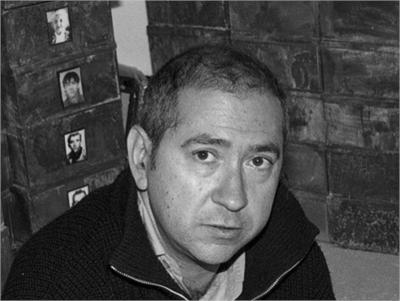
Christian Boltanski
- contemporary art
Few artists have made grief as structurally precise as Christian Boltanski. Born in Paris on 6 September 1944[2], weeks after the Liberation, he arrived into a family shaped by concealment: his father, a Russian-Jewish physician, had spent the German occupation hidden beneath the family's floorboards. That prehistory of erasure and survival runs through almost everything Boltanski made.
Biography
He left school at twelve and was largely self-taught, arriving at art through painting before abandoning it for installation and archival work in the late 1960s. His first solo exhibition, at the Théâtre Le Ranelagh in May 1968[2], announced a practice built around other people's possessions, photographs, and memories. The 1971 L'Album de la famille D., 1939-1964[2] assembles snapshots from an anonymous bourgeois family and presents them as documentary evidence of a life; the piece sets the template for much that followed.
Le Lycée Chases (1986[2]-87) is among his most studied works: photographs of Viennese Jewish schoolchildren from 1931, reproduced at large scale and lit by small lamps, transforming the faces of the living into something already elegiac. Reserve (1989) introduced stacked piles of used clothing, garments from unidentifiable former owners. The scale grew steadily: No Man's Land (2010), installed at the Park Avenue Armory in New York, filled the vast drill hall with 30-tonne mounds of second-hand clothes and a single operating crane.
Les Archives du Coeur, begun in 2010[2], records heartbeats from around the world and archives them on Teshima Island in Japan. Boltanski described it as an attempt to create an immortality machine. He received the Praemium Imperiale for Sculpture in 2006 and died in Paris on 14 July 2021[2].
Timeline
- 1944Born in Paris on 6 September. His father, a Russian-Jewish physician, had spent the German occupation hidden beneath the family's floorboards.
- 1968Had his first solo exhibition at the Théâtre Le Ranelagh in May.
- 1971Created "L'Album de la famille D., 1939-1964", assembling snapshots from an anonymous family.
- 1986Created "Le Lycée Chases" (1986-87), featuring photographs of Viennese Jewish schoolchildren.
- 1989Introduced stacked piles of used clothing in "Reserve".
- 2006Received the Praemium Imperiale for Sculpture.
- 2010Installed "No Man's Land" at the Park Avenue Armory in New York, filling the hall with second-hand clothes.
- 2010Began "Les Archives du Coeur", recording heartbeats from around the world and archiving them on Teshima Island in Japan.
- 2021Died in Paris on 14 July, aged 76.
Notable Works
Tap to view larger.
Where to See Christian Boltanski
1 museum worldwide.
-
1 works
Institut Valencià d'Art Modern
Valencia, Spain
Tue–Sun 10:00–19:00, closed Mondays

Next stop
Browse the movements →
Every movement in the collection, from the Renaissance to Pop art.
Related Artists



Frequently Asked Questions
What is Christian Boltanski known for?
Christian Boltanski is known for installations and archival work that often incorporates other people's possessions, photographs, and memories. His art explores themes of death and mortality, often using large-scale installations.What is Christian Boltanski's most famous work?
While it is difficult to identify one single "most famous" work, Christian Boltanski is well known for installations dealing with memory and loss, often incorporating photographs. His early career involved film; his first public exhibition was in a Paris cinema in 1968[2]. He made short films between 1969 and 1973, exploring the boundary between fiction and reality. One such film, *L'Homme qui tousse* (1969), depicts a character covered in mire and blood. From 1970 to 1984, Boltanski used photography, often with autobiographical references. Later, he moved away from images of himself, foregrounding the idea of the sacred. By 1985, recollections of the past, specifically references to Nazi concentration camps, became central to his art. Installations such as *Reserve of Dead Swiss* (1990) use photographs from obituaries, displayed with biscuit boxes and electric lamps, to evoke themes of life, death, and memory. The work creates a religious atmosphere. Boltanski has also created shadow sculptures from scrap material and rooms filled with clothes, also exploring these themes.What should I know about Christian Boltanski's prints?
Christian Boltanski (1944[2]-2021[2]) was a French[2] artist, known for his installation art and photography. Prints were a smaller, but still important, part of his overall output. Boltanski's prints often relate to his larger themes: memory, loss, childhood, and identity. He frequently used photographic processes in his printmaking, incorporating found photographs or images from his own archive. These images are often deliberately blurred, degraded, or otherwise manipulated to evoke the fragility and unreliability of memory. Many of his prints are photogravures, a process that gives a soft, tonal quality to the image. He also used screen printing and other techniques to achieve different effects. Boltanski frequently combined images with text, adding another layer of meaning to his work. The texts are often simple phrases or names, further emphasising the themes of identity and remembrance. His prints are often produced in series, echoing the seriality of his installations. This allows him to explore different facets of a single theme across multiple works. While Boltanski is best known for his large-scale installations, his prints offer a more intimate way to engage with his art.What style or movement did Christian Boltanski belong to?
Christian Boltanski's art resists easy categorisation, though it shares characteristics with several movements. Born in Paris in 1944[2], Boltanski began creating art in the late 1960s. His early work involved staged autobiographical narratives. Boltanski is often associated with Conceptual art, which prioritises ideas and meaning over traditional aesthetics. His installations frequently incorporate found photographs, personal documents, and everyday objects. These elements evoke memory, loss, and the passage of time, central themes within Conceptualism. Some critics link Boltanski to Arte Povera, an Italian movement that used humble, readily available materials. Boltanski's use of discarded clothing, rusty metal boxes, and dim lighting aligns with Arte Povera's aesthetic. Both explore themes of fragility and the human condition. While Boltanski's work touches on these movements, his unique approach sets him apart. His art is deeply personal, exploring universal themes through individual stories. He creates emotionally charged environments that invite viewers to contemplate their own memories and mortality.What techniques or materials did Christian Boltanski use?
Christian Boltanski, born in Paris in 1944[2], employed a variety of techniques and materials in his art. His early work included film; his first public exhibition took place in a Paris cinema in May 1968[2]. Between 1969 and 1973, he made short films, exploring the blurring of fiction and reality. One such film, *L'Homme qui tousse* (1969), featured a character covered in mire and blood. From 1970 to 1984, Boltanski explored photography, often using ordinary forms and autobiographical references. Later, he moved away from self-images and focused on the notion of the sacred. His installations often touched on memories of the past, with direct references to Nazi concentration camps from 1985 onwards. Boltanski also created 'Shadow' sculptures from scrap materials, illuminated by candles. He is known for using photographs, metal biscuit boxes, and electric lamps in large-scale installations, evoking powerful sensations of life and death.What was Christian Boltanski known for?
Christian Boltanski, born in Paris in 1944[2], is known for installation art, photography, and film. His first public exhibition took place in a Paris cinema in 1968[2]. He produced short films between 1968 and 1976, blurring the lines between fiction and reality. One of these films, *L'Homme qui tousse* (1969), depicts a character covered in mire, coughing and vomiting blood. From 1970 to 1984, Boltanski explored photography, often with autobiographical references. He gradually abandoned images of himself, foregrounding a sense of the sacred, which appeared with the *Monument* series in 1985. Recollections of a buried past, with references to Nazi concentration camps, became a central theme. His large-scale installations evoke powerful sensations of life and death. One such installation, *Reserve of Dead Swiss* (1990), consists of metal biscuit boxes and poorly illuminated black-and-white photographs taken from obituaries. Other works include glass display cabinets containing childhood memories and 'Shadow' sculptures made of scrap materials illuminated by candles.When did Christian Boltanski live and work?
Christian Boltanski was born in Paris in 1944[2]. His first public exhibition occurred in a Paris cinema in May 1968[2]. From 1968 to 1976, Boltanski produced short films that explored the boundary between fiction and reality. His 1969 film, *L'Homme qui tousse* (*The Coughing Man*) features a character covered in mire, spattered with blood from coughing and vomiting. From 1970, the year of his exhibition at ARC Musée d'Art Moderne de la Ville de Paris, until 1984, the year of his retrospective at the Centre Georges Pompidou, he explored photography. He gradually abandoned images of the self to foreground the notion of the sacred, which appears with the *Monument* series in 1985. His work often touches on memories of a buried past, with direct references to Nazi concentration camps. Boltanski continues to create installations in unusual places.Where can I see Christian Boltanski's work?
Christian Boltanski's art has been exhibited in many countries. His work is held in a number of public collections. In France, his art can be seen at the Musée National d’Art Moderne, Centre Pompidou, in Paris. Other European museums include the Van Abbemuseum, Eindhoven; the Kunstmuseum Liechtenstein, Vaduz; and the Moderna Museet, Stockholm. In North America, Boltanski is represented in the collections of the Museum of Modern Art, New York; the Los Angeles County Museum of Art; and the Art Institute of Chicago. His work can also be found in Australia, for example at the Museum of Contemporary Art Australia, Sydney. Boltanski also created site-specific installations. "Archives des Suisses Morts" (1990[2]) is located in Kaiseraugst, Switzerland. "The Missing House" (1990), a temporary installation, was later made permanent in Berlin.Where was Christian Boltanski from?
Christian Boltanski was born in Paris in 1944[2], not long after the Liberation. His first public exhibition, *La vie impossible de Christian Boltanski*, took place in a Paris movie theatre in 1968[2]. Between 1969 and 1973, Boltanski made short films. One, *L'Homme qui tousse* (1969), featured a seated character covered in mire, spattered with blood. From 1970 to 1984, the year of his retrospective at the Centre Georges Pompidou, he explored using photography. He gradually abandoned images of the self to foreground the notion of the sacred, which appears with the *Monument* series in 1985. Recollections of a buried past, with direct references to Nazi concentration camps, became a central theme. One large-scale installation consists of two walls of metal biscuit boxes and black-and-white photographs taken from obituaries in a local newspaper, illuminated by electric lamps.Who did Christian Boltanski influence?
Christian Boltanski, born in Paris in 1944[2], is known for installations and photographic works dealing with memory and death. His art evokes powerful sensations relating to life and mortality. Boltanski's initial public exhibition took place in a Paris cinema in May 1968[2]. Between 1968 and 1976, he created short films that explored the boundary between fiction and reality. His 1969 film, *L'Homme qui tousse*, has been interpreted as an influence from Boris Vian's play *Les Bâtisseurs d'Empire*. The play satirises the Theatre of the Absurd; Boltanski's film features a character resembling the Schmurz, a hybrid creature from Vian's play. His work touches on what is unsaid through mourning and absence. Boltanski's style, medium, and subject matter have made him one of the most acclaimed artists of his time. His influence can be seen in the work of artists who explore memory, subjectivity, and the psychological effects of cinema and theatre.Who influenced Christian Boltanski?
It is difficult to isolate specific influences on Christian Boltanski, but some general connections can be drawn. Many modern and contemporary artists have had their art shaped by spiritual interests. A surprisingly large number of artists, particularly those from the post-World War II era, had a Roman Catholic background. Their spiritual immersion during childhood, combined with the aesthetic atmosphere of Catholicism, seemed especially formative for artistically inclined children. Some professors of studio art have observed that art students are often taught to situate their work within a formalist lineage. This approach often assumes that serious contemporary art[2] should avoid anything considered sentimental, such as spiritual influences. However, many prominent artists have integrated spiritual explorations into their work, suggesting that such influences can be a significant aspect of artistic development.Who was Christian Boltanski?
Christian Boltanski (born in Paris, 1944[2]) was a French[2] artist known for his installations and photographic work. His first public exhibition occurred in a Paris movie theatre in May 1968[2]. Between 1969 and 1973, Boltanski created short films, and his early career centred on photography, installation, performance, mail art, and experimental film. From 1970 to 1984, the year of his retrospective at the Centre Georges Pompidou, he explored photography in its most ordinary form, increasingly referencing autobiographical elements. Later, he abandoned images of himself to foreground the notion of the sacred. His practice increasingly referenced a buried past, with direct references to Nazi concentration camps. One large-scale installation consisted of two walls of metal biscuit boxes and black-and-white photographs taken from obituaries in a local newspaper, illuminated by electric lamps. He also created glass display cabinets containing memories of childhood and shadow sculptures made of scrap materials lit by candles.
Sources
Editorial draws on the following primary and tertiary references for Christian Boltanski.
- [1] museum Institut Valencià d'Art Modern Used for: museum holdings.
- [2] wikipedia Wikipedia: Christian Boltanski Used for: biography, birth dates, death dates, identifiers, movement attribution, nationality.
- [3] book Beard, Lee, 1973- author, Butler, Adam, author; Van Cleave, Claire, author; Fortenberry, Diane, author; Stirling, Susan, author, Beard, Lee, 1973- author, Butler, Adam, author; Van Cleave, Claire, author; Fortenberry, Diane, author; Stirling, Susan, author - The Art Book_ New Edition, Mini Format Used for: biography, stylistic analysis.
- [4] book guggenheim-amsterdamparisdu00solo Used for: biography, stylistic analysis.
- [5] book guggenheim-invested00blis Used for: biography, stylistic analysis.
Editorial overseen by Solis Prints. Sources verified 2026-09-27. Click a source for details, or hover over [N] in the page above to preview.
Editorial standardsMethodologyCorrectionsAI disclosureAbout the editorial team