



Claude Cahun
Claude Cahun was born Lucy Schwob in Nantes in 1894[2], adopted her pseudonym around 1914[2], and spent the following four decades making some of the most unsettling self-portrait photographs of the twentieth century. She shaved her head, painted her face, dressed as a doll, a prisoner, a sailor, and various figures that resisted any fixed category. The question she posed in her 1930 photobook, "Masculine? Feminine? It depends on the situation," reads today less like provocation than plain statement of fact.
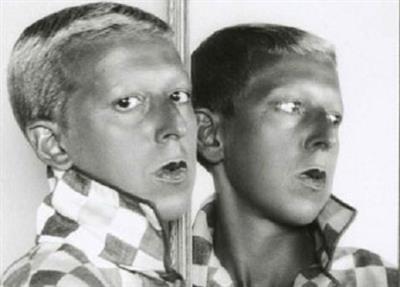
Biography
She moved to Paris in the early 1920s with her lifelong partner Suzanne Malherbe, who published under the name Marcel Moore. Together they held salons, produced photomontages and collages, and moved through the orbit of André Breton's Surrealist circle without fully submitting to its orthodoxies. Cahun's work was too personal, too self-directed to be easily absorbed into any collective programme.
In 1937[2] the couple moved to Jersey, and when the German occupation began in 1940 they became resistance operatives. Working under the pseudonym "The Soldier With No Name," they produced and distributed anti-Nazi leaflets designed to look as though they had been written by demoralised German soldiers. They were arrested in 1944, sentenced to death, and saved only by the liberation of the island in 1945. Cahun's health never fully recovered from her imprisonment. She died in Saint Helier in 1954[2].
For decades her work was almost entirely unknown outside a small circle. The rediscovery came in the 1980s and accelerated through the 1990s, as scholars of gender and Surrealism[2] recognised in her photographs a body of work that had anticipated questions the art world was only beginning to ask. Major museums including the Tate and the Museum of Modern Art now hold her work.
Timeline
- 1894Born Lucy Schwob in Nantes.
- 1914Adopted the pseudonym Claude Cahun around this time.
- 1920Moved to Paris with Suzanne Malherbe (Marcel Moore).
- 1930Published the photobook "Masculine? Feminine? It depends on the situation."
- 1937Moved to Jersey with Suzanne Malherbe.
- 1940Began working as a resistance operative under the pseudonym "The Soldier With No Name" during the German occupation.
- 1944Arrested for resistance activities.
- 1945Saved from a death sentence by the liberation of Jersey.
- 1954Died in Saint Helier, Jersey.
Notable Works
Tap to view larger.
Next stop
Surrealism →
Explore the artists and ideas of Surrealism.
Related Artists


Frequently Asked Questions
What is Claude Cahun known for?
Claude Cahun is known for her unsettling self-portrait photographs and her exploration of gender identity. She challenged conventional gender roles through her photographs and writings, often presenting herself in a gender-neutral or ambiguous way.What is Claude Cahun's most famous work?
Claude Cahun, born Lucy Schwob, was a French[2] artist best known for their photographic self-portraits. These images, mostly small black-and-white photographs, explore themes of gender, identity, and sexuality. Cahun adopted the pseudonym in 1919[2], reflecting a questioning of established gender norms that was central to their life and art. Many of these self-portraits feature Cahun in elaborate costumes and theatrical settings. The artist often stares directly at the viewer, creating an intense and confrontational gaze. These photographs were largely private, not intended for public display during Cahun's lifetime. One exception is a self-portrait published in the journal *Bifur* in 1930. Cahun's stepsister and lifelong partner, Marcel Moore (born Suzanne Malherbe), collaborated on many of these works. Moore is believed to have been the photographer behind most of Cahun's portraits. Some double portraits from 1926 evoke the couple's collaborative nature, showing masked figures made of sand. Cahun's work experienced a revival in the 1980s, leading to increased recognition within art history.What should I know about Claude Cahun's prints?
Claude Cahun (born Lucy Schwob in Nantes, 1894[2]; died 1954[2]) was associated with the Surrealist movement in Paris. Cahun adopted a gender-ambiguous first name, and often appeared in self-portraits as a dandy with masculine attire and short hair. Cahun's photographic work includes self-portraits and photomontages. These images explore themes of identity, gender, and the self as a performance. Cahun's prose poem *Aveux non Avenus* (1930[2]) includes photomontages created with Suzanne Malherbe (who used the name Moore). One image from this book, *I.O.U. (Self-Pride)* (1929-30), depicts multiple heads, seemingly all Cahun, rising from one neck. Cahun rarely exhibited her photographs during her lifetime, although she shared them with friends. A lithograph of Cahun's 1928 photograph *Que me veux-tu?* appeared on the cover of Georges Ribemont-Dessaignes’s novel *Frontières humaines* (1929). Cahun also created original art for an illustration in Lise Deharme's *Le Coeur depic* (1937).What style or movement did Claude Cahun belong to?
Claude Cahun (born Lucy Schwob in Nantes, 1894[2]) is associated with Surrealism[2]. By 1932[2], Cahun was active in the Association des Écrivains et Artistes Révolutionnaires. Soon after, she joined the Surrealist Group. Cahun participated in the 1936 Surrealist objects exhibition in Paris. She also contributed to the journals *Minotaure* and *Cahiers d’art*. Cahun's work explores themes of identity, gender ambiguity, and the performative nature of masculinity and femininity. Cahun adopted a gender-ambiguous pseudonym and often appeared in masculine attire and short hair in self-portraits. Cahun translated Havelock Ellis and, in her prose poem *Aveux non Avenus*, examined the divided self, continuing the literary legacy of Arthur Rimbaud and the Symbolists. Her exploration of identity as a masquerade is evident in her self-portraits, where she often wears masks and costumes.What techniques or materials did Claude Cahun use?
Claude Cahun was a multimedia artist who explored themes of identity, gender and sexuality through a variety of techniques. Photography became a dominant medium in Cahun's artistic output. Cahun frequently employed photography and photomontage to construct alternative possibilities for the lesbian subject. These techniques suited Cahun's agenda of creating identities that did not really exist, but which photography made into real possibilities. Cahun often created theatrical self-portraits using costumes, masks and make-up. These portraits, staged in domestic settings, challenge the idea that outward displays of masculinity and femininity are predicated upon biological sex. Cahun's partner, Marcel Moore, collaborated on much of this photographic work. Moore is credited with composing the heliogravures for Cahun's book *Aveux non avenus* ("Disavowals") from Cahun's designs.What was Claude Cahun known for?
Claude Cahun, born Lucy Schwob in Nantes in 1894[2], was a French[2] artist, photographer, and writer. Cahun is known for self-portraits that explore themes of gender, identity, and sexuality. The artist adopted the gender-ambiguous pseudonym Claude Cahun in 1919[2]. Cahun's work often involved photographic cross-dressing and a destabilising of established gender models. In self-portraits, Cahun appeared as a dandy in masculine attire, challenging conventional notions of femininity and masculinity. These images were often theatrical and staged in private, domestic settings. During the 1920s and 1930s, Cahun lived in Paris and was associated with the Surrealist movement. Cahun participated in Surrealist exhibitions and collaborated on various publications. Cahun was also politically active, joining the Association des Écrivains et Artistes Révolutionnaires and later the International Federation for an Independent Revolutionary Art. During the German occupation of Jersey, Cahun and partner Suzanne Malherbe (also known as Marcel Moore) produced anti-Nazi leaflets. Cahun died in Jersey in 1954[2].When did Claude Cahun live and work?
Claude Cahun was born in 1894[2] and died in 1954[2]. Cahun was born Lucie Schwob in Nantes, France. They were a writer, photographer, and performance artist, best known for their surrealist photography and gender-fluid self-portraits. In the 1930s, Cahun became involved with the Parisian Surrealist group, and later joined the French[2] Resistance during the Second World War. With their partner Marcel Moore, Cahun created anti-Nazi propaganda on the island of Jersey, where they lived. They were arrested in 1944[2] and sentenced to death, but this was later commuted. After the war, Cahun returned to Jersey, where they lived until their death in 1954. Cahun's work explores themes of identity, gender, and politics.Where was Claude Cahun from?
Claude Cahun, born Lucy Schwob, was French[2]. She was born in Nantes in 1894[2]. In 1917[2], she adopted the gender-ambiguous name Claude Cahun. The first name Claude is gender-ambiguous in French. Cahun's uncle, Marcel Schwob, was a friend of Jarry's. He was also a colleague of symbolist poets. In 1937, Cahun settled in Jersey with her lover, stepsister and artistic collaborator Suzanne Malherbe (Marcel Moore). During the 1920s and 1930s, Cahun lived in Paris, where her work led to a loose association with the Surrealist group. During the German occupation of Jersey in July 1940, Cahun and Malherbe produced anti-Nazi leaflets. In 1944, they were arrested and sentenced to death, but the sentence was not carried out. Much of Cahun’s work was destroyed. Cahun died in Jersey in 1954[2].Who did Claude Cahun influence?
Claude Cahun's explorations of gender ambiguity have influenced later artists. Cahun understood gender identity as a cultural construction, something performed rather than innate. Her portraits often feature costumes, theatrical make-up, and masks; this emphasis on the constructed nature of identity, rather than the body itself, sets her apart from some other Surrealists. Cahun's self-portraits, often taken in private settings, allowed her to explore androgynous or masculinised appearances at a time when cross-dressing was illegal in France. One photograph, taken in 1919[2], depicts Sylvia Beach, the famous lesbian owner of the bookshop Maison des Amis des Livres, in non-feminine clothing. Cahun's portraits from around 1920 show her in more masculine attire; a shaved head, dandy-like clothing, and cigarette. Comparisons have been drawn between Cahun and Cindy Sherman, although Cahun never widely circulated or exhibited her photographs during her lifetime. A lithograph of Cahun's 1928 photograph, Que me veux-tu?, appeared on the cover of Georges Ribemont-Dessaignes’s novel Frontières humaines in 1929.Who influenced Claude Cahun?
Claude Cahun (born Lucy Schwob) was influenced by a range of artistic and literary figures. Her uncle, Marcel Schwob, a friend of Alfred Jarry, was connected to symbolist poets. Cahun's own writing shows the impact of Arthur Rimbaud and the Symbolists. She translated Havelock Ellis, the sexologist, and wrote on human sexuality. Her 1930[2] book, *Aveux non Avenus*, shows a surrealist spirit, and Pierre MacOrlan compared it to Isabelle Eberhardt's memoirs. Cahun was close to the Surrealist Group by 1932, participating in the 1936 surrealist objects exhibition in Paris. She collaborated on journals such as *Minotaure* and *Cahiers d’art*. Some scholars compare Cahun to Cindy Sherman. One of Cahun's earliest self-portraits stages her as a double of the courtesan Cléo de Mérode. The lesbian painter Romaine Brooks, who often portrayed her sitters in similar garb, influenced Cahun's artistic identity.Who was Claude Cahun?
Claude Cahun (1894[2]-1954[2]) was a French[2] photographer, sculptor, and writer, born Lucy Renée Mathilde Schwob in Nantes. Cahun adopted this gender-ambiguous pseudonym in 1917[2]. The name Claude is itself gender-neutral in French. Cahun's work questioned and destabilised established models of gender identity. Cahun produced self-portraits that conveyed a gender-neutral status. In their autobiography *Disavowals* (1930), Cahun wrote, 'Masculine? Feminine? It depends on the situation. Neuter is the only gender that always suits me.' During the 1920s and 1930s, Cahun lived in Paris and became loosely associated with the Surrealist group. Cahun participated in the 1936 surrealist objects exhibition in Paris, illustrated Lise Deharme’s book, *The Woodpecker’s Heart*, in 1937, and collaborated on the journals *Minotaure* and *Cahiers d’art*. In 1937, Cahun settled in Jersey with Suzanne Malherbe (who used the name Marcel Moore), a lover, stepsister, and artistic collaborator. During the German occupation of Jersey, they produced anti-Nazi leaflets. They were arrested in 1944 and sentenced to death, though the sentence was not carried out. Much of Cahun’s work was destroyed.Why are Claude Cahun's works important today?
Claude Cahun (born Lucy Schwob) explored gender and identity through photography and writing. Cahun's work is important because it challenges conventional ideas about masculinity and femininity. Cahun adopted a gender-ambiguous name and often dressed in masculine clothing for self-portraits. These portraits question the idea that outward displays of gender are based on biological sex. Instead, they show the ability to cross artificially imposed boundaries and claim various gendered identities. Cahun's lesbianism allowed access to identities beyond those considered appropriately feminine. Cahun's photographs were often produced in a domestic setting and not widely circulated. This private nature may account for the degree of masculinity adopted in the images, as cross-dressing was illegal in France at the time. The artist's work thematises lesbianism and the creation of alternative possibilities for the lesbian subject. Cahun and partner Marcel Moore created images that revealed the many possibilities that invisibility afforded the lesbian subject.
Sources
Editorial draws on the following primary and tertiary references for Claude Cahun.
- [1] wikidata Wikidata: Q219634 Used for: identifiers.
- [2] wikipedia Wikipedia: Claude Cahun Used for: biography, birth dates, death dates, identifiers, movement attribution, nationality.
- [3] book Beard, Lee, 1973- author, Butler, Adam, author; Van Cleave, Claire, author; Fortenberry, Diane, author; Stirling, Susan, author, Beard, Lee, 1973- author, Butler, Adam, author; Van Cleave, Claire, author; Fortenberry, Diane, author; Stirling, Susan, author - The Art Book_ New Edition, Mini Format Used for: biography, stylistic analysis.
- [4] book guggenheim-rroseisr00bles Used for: biography, stylistic analysis.
- [5] book Penelope Rosemont, Surrealist Women Used for: biography, stylistic analysis.
- [6] book Hodge, Susie, 1960- author, The short story of women artists : a pocket guide to movements, works, breakthroughs, & themes Used for: biography.
Editorial overseen by Solis Prints. Sources verified 2026-10-05. Click a source for details, or hover over [N] in the page above to preview.
Editorial standardsMethodologyCorrectionsAI disclosureAbout the editorial team