



Claude Deruet
Claude Deruet was born in Nancy in 1588[1] and grew up in a ducal court with unusually high ambitions for its painters. He trained under Jacques Bellange, the idiosyncratic Mannerist who served Charles III of Lorraine, then spent seven years in Rome studying with Antonio Tempesta, whose prints of cavalry and battle scenes would leave a clear mark on Deruet's mature work. By the time he returned to Lorraine around 1619[1], he was ready to take Bellange's position at court.
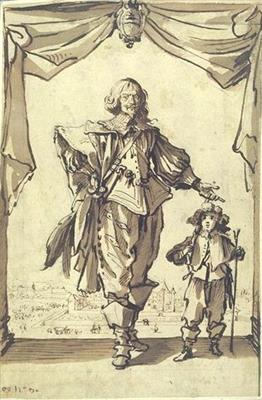
Biography
The connections he accumulated over the following decades were exceptional. In 1623[1] a young Claude Lorrain worked in his studio for a year, learning the trade before moving to Rome and transforming landscape painting entirely. In 1633 Deruet hosted Louis XIII and the Queen at his Nancy residence, a mark of standing that the Duke of Lorraine had already confirmed by granting him nobility in 1621. Louis XIII knighted him into the Order of Saint Michel in 1645.
One of the more unusual commissions of his career came earlier, in 1615[1], when the Japanese samurai and diplomat Hasekura Tsunenaga passed through Europe on a mission to the Spanish Crown and the Pope. Deruet painted his portrait in Nancy, producing one of the very few European paintings of a Japanese subject from that period. The "Departure of the Amazons," from 1620, shows the theatrical, equestrian side of his practice: elaborate costume, competitive pageantry, and the kind of decorative spectacle that Baroque courts required of their painters.
He died in Nancy in 1660[1], leaving behind a body of work that combined Italian training with the ceremonial demands of a provincial but ambitious court.
Timeline
- 1588Born in Nancy. He grew up in the ducal court.
- 1615Painted the portrait of Hasekura Tsunenaga in Nancy, a Japanese samurai and diplomat.
- 1619Returned to Lorraine after studying with Antonio Tempesta in Rome for seven years.
- 1620Painted "Departure of the Amazons."
- 1621Granted nobility by the Duke of Lorraine.
- 1623Claude Lorrain worked in his studio for a year before moving to Rome.
- 1633Hosted Louis XIII and the Queen at his Nancy residence.
- 1645Knighted into the Order of Saint Michel by Louis XIII.
- 1660Died in Nancy.
Notable Works
Tap to view larger.
Next stop
Mannerism →
Explore the artists and ideas of Mannerism.
Related Artists


%20(14578560789).jpg)


Frequently Asked Questions
What is Claude Deruet known for?
Claude Deruet is known for his connections to the ducal court and his work with other artists. Claude Lorrain worked in his studio for a year, learning the trade before moving to Rome. He also painted the portrait of Hasekura Tsunenaga, a Japanese samurai and diplomat.What is Claude Deruet's most famous work?
Claude Deruet, born in Nancy around 1588[1], was a painter of portraits and decorative designs. He studied in Rome with Antonio Tempesta and Cavalier d’Arpino. Deruet later returned to Nancy, where his work gained attention beyond Lorraine. Louis XIII even took painting lessons from him. A portrait in gouache of Deruet by Louis XIII is held in the Musée Lorrain at Nancy. In 1621[1], Deruet received letters of nobility. He served as painter-in-ordinary to Duke Henri II. Deruet employed assistants, including Claude Lorrain. Deruet, along with his assistants, was commissioned to decorate the roof of a Carmelite Monastery church. The Prince de Phalsbourg and the Prior oversaw the project. Sadly, the church and its decorations were destroyed during the French[1] Revolution.What should I know about Claude Deruet's prints?
Claude Deruet was a French[1] artist of the early Baroque period, working most actively for the court of Lorraine. While he is better known as a painter, he also produced prints. Deruet's skills as a draughtsman are evident in his prints. These works form a notable segment of his artistic output. Deruet's prints display considerable skill and delicacy. He is known to have worked with etching techniques. These prints are an important part of Deruet's wider artistic production. They show his attention to detail and mastery of line. Printmaking allowed Deruet to explore different subjects and compositions, and offered a way to circulate his artistic ideas to a wider audience.What style or movement did Claude Deruet belong to?
Claude Deruet is associated with Mannerism[1], a style that spread through Europe in the 16th century. Mannerism, deriving from the Italian "maniera" (meaning style or manner), was favoured by princely courts and reflected their refined tastes. Mannerist artists built upon the achievements of Raphael and Michelangelo. They placed emphasis on technical skill, erudite subject matter, and complex compositions designed to appeal to sophisticated viewers. The style valued grace, variety, and virtuoso display rather than clarity or unity. Artists explored new definitions of beauty, experimenting with proportions and idealised figures. Mannerism has been interpreted in different ways. Some see it as a decline from the High Renaissance, while others view it as an expression of cultural crisis, linked to the Reformation and Counter-Reformation, or as a product of elite identity. Regardless of its precise meaning, Mannerism marked a shift in artistic focus towards self-conscious artifice and intellectual complexity.What techniques or materials did Claude Deruet use?
Claude Deruet was a Lorraine painter, draughtsman and printmaker working in the first half of the 17th century. As a painter, he is best known for large-scale allegories and religious scenes, many of which were commissions for churches and civic buildings. Like many artists of his period, Deruet would have been trained in the standard techniques of painting, including preparing canvases, mixing pigments with oil, and applying paint in layers to achieve desired effects of colour and texture. Although no specific documentation of his methods survives, comparison with contemporary practice suggests that he employed preparatory drawings and underpainting to establish the composition before adding colour. Seventeenth-century artists often experimented with different materials and techniques to achieve particular aesthetic effects, and Deruet may have explored various approaches in his own work. However, without more specific information, it is difficult to provide a detailed account of his materials.What was Claude Deruet known for?
Claude Deruet (1588[1]-1660[1]) was a French[1] artist, active primarily in Lorraine. He is best known for his large-scale allegorical and mythological paintings, as well as his portraits. Born in Nancy, Deruet trained in Italy with Antonio Tempesta, and possibly worked with other artists such as Alessandro Turchi. He returned to Nancy around 1619[1], where he became court painter to the Duke of Lorraine, Charles IV. He received many commissions from the ducal family and other noble patrons. Deruet's style is characterised by its Mannerist tendencies, with elongated figures, theatrical compositions, and a bright colour palette. His paintings often feature elaborate costumes and settings, reflecting the opulence of the court. Among his most famous works is the series of four paintings depicting the "Four Elements", now in various museum collections. He also produced designs for engravings and theatrical productions. Deruet had a significant workshop, and he trained a number of artists, including Charles le Brun, who later became a leading figure in French art.When did Claude Deruet live and work?
Claude Deruet (1588[1]-1660[1]) was a French[1] artist of the Baroque period. He is known for portraiture and large-scale allegorical paintings. Born in Nancy, Lorraine, Deruet's early training is not well documented. However, by the early 1600s, he was working in Rome. There, he was a student of Antonio Tempesta, an Italian painter of the late Renaissance and early Baroque. Deruet absorbed Italian artistic styles during this period. Returning to Nancy, Deruet became court painter to the Duke of Lorraine, Charles IV. This position brought him considerable status and a steady stream of commissions. He produced portraits of the ducal family and other members of the Lorraine nobility. Deruet also received commissions for decorative work within the ducal palaces. His most famous works include a series of paintings, now in the Museo del Prado, Madrid, depicting stages in the "Little War" between Lorraine and France during the 1630s. Deruet also trained other artists in his studio, including Claude Lorrain, who became a significant figure in the development of idealised paintings of the countryside. Claude Deruet died in Nancy in 1660[1], leaving behind a substantial body of work that reflects the artistic tastes of his time.Where can I see Claude Deruet's work?
Paintings by Claude Deruet are held in several European museums. In France, his work can be viewed at the Musée des Beaux-Arts in Nancy, the Musée des Beaux-Arts in Nantes, and the Musée du Louvre in Paris. Other museums include the Musée des Beaux-Arts in Besançon, the Musée des Beaux-Arts in Dijon, the Musée de la Chartreuse in Douai, the Musée de Peinture et de Sculpture in Grenoble, the Musée Crozatier in Le Puy, and the Musée des Beaux-Arts in Lille. Additional venues are the Musée des Beaux-Arts in Orléans, the Musée Saint-Denis in Reims, the Musée des Beaux-Arts in Rennes, the Musée des Beaux-Arts in Rouen, the Musée d’Art et d’Industrie in Saint Etienne, the Musée du Prieuré in Saint Germain-en-Laye, the Musée de l’Annonciade in Saint Tropez, and the Musée d’Art Moderne in Strasbourg. The Musée des Augustins in Toulouse also holds his paintings. In Belgium, Deruet's paintings are in the Musées Royaux des Beaux-Arts de Belgique in Brussels.Where was Claude Deruet from?
Claude Deruet was an artist from Lorraine. He was born in 1588[1]; it is believed he was born in Nancy. Nancy was the capital of Lorraine and the seat of the Ducal Court. Deruet studied in Rome as a young man, under Antonio Tempesta and the Cavalier d’Arpino. He then returned to Nancy, where he painted portraits and decorative designs. His work became well-known outside of Lorraine. In 1621[1], Deruet received letters of nobility. He was the painter-in-ordinary to Henri II, and he was very influential in Lorraine's art community. Louis XIII even took painting lessons from him. Deruet later employed Claude Lorrain as one of his assistants. Together with his other assistants, Lorrain worked with Deruet to add decoration to the roof of a Carmelite Monastery.Who did Claude Deruet influence?
Claude Deruet (1588[1]-1660[1]) was a French[1] artist whose impact is complex to trace directly. He is best known as a master of Lorraine art, a style that blended French and Italian influences. His pupils included Charles Le Brun, who later became a dominant figure in French art under Louis XIV. Le Brun's later academic style, with its emphasis on grand compositions and classical ideals, contrasts with Deruet's more decorative and narrative approach. However, Deruet's studio provided Le Brun with foundational training. Other artists associated with Deruet's circle include his son, Henri Deruet, and Israël Silvestre. Henri followed in his father's footsteps as a painter. Silvestre became a noted printmaker, documenting French architecture and courtly life. While Deruet's personal style may not have been widely imitated, his role as an instructor and his connections within the artistic community helped shape the careers of significant artists in subsequent generations. His influence is therefore best understood through the work of his students and associates.Who influenced Claude Deruet?
Claude Deruet's artistic development occurred in a period with varied influences. One significant figure was Claude Lorrain, whom artists such as Thomas Couture regarded as a model of excellence. Couture admired how Lorrain's technique seemed invisible, freeing him from academic constraints while paradoxically becoming a standard for academics. Lorrain's style involved carefully differentiated light and colour, aligning with academic ideals of expressive technique. His compositions, exemplified by works such as *The Ford* (circa 1636[1]), demonstrated a hierarchical order of elements, guiding viewers through the artwork with continuous visual transitions. Another influence came from the independent artists and movements challenging the established Académie. Figures like Charles Gleyre and Thomas Couture, though not part of the Académie, offered alternative approaches. Couture, who taught Édouard Manet, encouraged rapid, simple work to capture vivid first impressions, suppressing detail in favour of spontaneity. He also instilled in Manet a love for the Old Masters, though Manet later diverged by blending classical themes with modern subjects.Who was Claude Deruet?
Claude Deruet (1588[1]-1660[1]) was a French[1] artist, active primarily in Lorraine. He is known for portraiture and large-scale decorative works. Born in Nancy, Deruet trained with several artists, including Claude Bellange, court painter to the Dukes of Lorraine. He travelled to Rome around 1612[1], where he studied with Antonio Tempesta, a Florentine mannerist. Deruet returned to Nancy and became court painter after Bellange's death in 1617. Deruet's commissions included paintings for churches and portraits of the nobility. He is perhaps best known for a series of paintings, *The Four Elements*, commissioned by Louis XIII for the Louvre (c. 1625-26). These paintings, now held at the Musée des Beaux-Arts in Orléans, demonstrate his skill in allegorical representation. He also produced designs for theatrical productions and festivals at the ducal court. Deruet's pupils included Claude Lorrain, who trained in his studio for a short period around 1623, and Charles Le Brun, who later became a dominant figure in French art under Louis XIV. Deruet's career reflects the artistic patronage and cultural life of Lorraine during the early 17th century.
Sources
Editorial draws on the following primary and tertiary references for Claude Deruet.
- [1] wikipedia Wikipedia: Claude Deruet Used for: biography, birth dates, death dates, identifiers, movement attribution, nationality.
- [2] book Gellée Lorrain , Claude, Masters of Art - Claude Lorrain Used for: biography, stylistic analysis.
Editorial overseen by Solis Prints. Sources verified 2026-09-19. Click a source for details, or hover over [N] in the page above to preview.
Editorial standardsMethodologyCorrectionsAI disclosureAbout the editorial team