



Clément-Auguste Andrieux
Clément-Auguste Andrieux arrived at painting via the roundabout route of political catastrophe. Born in Paris in 1829[1], he trained in Liège through the early 1860s before entering the studio of William-Adolphe Bouguereau in 1867[1], an academic formation that gave him meticulous draughtsmanship without Bouguereau's taste for mythological sweetness. Andrieux preferred smoke and mud.
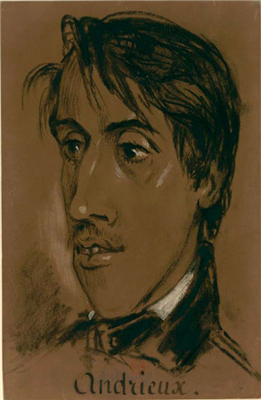
Biography
His career coincided almost exactly with the great upheavals in French[1] military history. He exhibited at the Paris Salon from 1850[1], building a reputation for Napoleonic and Crimean subjects before the Franco-Prussian War of 1870–71 handed him the story of his lifetime. He contributed journalistic images to "Le Monde Illustré" during the siege of Paris, then produced a series of thirty lithographs documenting the campaign. The work was immediate, witnessed, and unsentimental in a way that purely academic battle painting rarely achieved.
An early work, "The Capture of Sebastopol", was bought by a British institution, establishing him internationally before he had finished his academic training. His 1859[1] watercolour "Don Quixote Telling His Story to the Peasants" shows the breadth of his illustrative range: he was equally comfortable with literary subjects and battlefield panoramas.
Andrieux also produced illustrations for Harriet Beecher Stowe's "La Case de l'Oncle Tom", a commission that placed him in the company of a text then freighted with abolitionist urgency. He died in 1880[1] at Samois-sur-Seine, aged fifty, having compressed a significant amount of documentary and historical work into a career of barely three decades.
Timeline
- 1829Born in Paris.
- 1850Began exhibiting at the Paris Salon.
- 1859Created the watercolour "Don Quixote Telling His Story to the Peasants".
- 1860Received training in Liège through the early 1860s.
- 1867Entered the studio of William-Adolphe Bouguereau.
- 1870Contributed journalistic images to "Le Monde Illustré" during the siege of Paris.
- 1871Produced a series of thirty lithographs documenting the Franco-Prussian War campaign.
- 1880Died in Samois-sur-Seine, aged 50.
Notable Works
Tap to view larger.
Next stop
Browse the movements →
Every movement in the collection, from the Renaissance to Pop art.
Related Artists


Frequently Asked Questions
What is Clément-Auguste Andrieux known for?
Clément-Auguste Andrieux is known for his paintings of Napoleonic and Crimean subjects, as well as his lithographs documenting the Franco-Prussian War. He also produced illustrations for Harriet Beecher Stowe's "La Case de l'Oncle Tom".What style or movement did Clément-Auguste Andrieux belong to?
Without more information, it is difficult to assign Clément-Auguste Andrieux to a specific movement. However, contextual clues can be drawn from the period in which he was active. The late 19th century saw various styles, such as Impressionism and movements reacting to it. Artists like Charles Angrand, initially working with modern themes reminiscent of Bastien-Lepage, moved through Impressionism to Pointillism in the 1880s. Angrand associated with figures like Seurat, Signac, and Van Gogh. Another group, the Nabis, were active in the 1880s and inspired by Gauguin's use of pure colour. These examples demonstrate the cross-currents in European painting at the time. Without more specific information about Andrieux's works, it is difficult to place him within a particular style.What techniques or materials did Clément-Auguste Andrieux use?
Information regarding Clément-Auguste Andrieux's specific techniques is scarce; however, some context can be provided by examining the practices of his contemporaries. During the 19th century, artists like Ingres reacted against earlier sombre styles. They favoured pale grounds to ensure luminosity, as oil paint tends to become transparent with age when applied to dark grounds. Ingres often used strong, coarse canvas, unlike other Neoclassical painters who preferred finely woven canvas. He also innovatively used white in shadows, contrasting with the traditional approach of transparency for depth. Other artists, such as Bonnard, used finely grained canvas with a commercially prepared white ground. Bonnard did not paint directly from life; instead, he relied on memory and preliminary drawings. He would apply paint in layers, sometimes thinly and sometimes thickly, adding finishing touches after the canvas was stretched and framed. Experimentation with materials was common. Encaustic painting, using coloured waxes and a hot plate, was explored as a method to prevent deterioration. The choice of materials and techniques was significantly influenced by the artist's desired effect, with each medium, such as oil or watercolour, offering unique qualities.When did Clément-Auguste Andrieux live and work?
Clément-Auguste Andrieux (born 1829[1], died 1880[1]) was a French[1] painter and printmaker. He was a student of Léon Cogniet, a painter known for history paintings and portraits. Andrieux began exhibiting at the Salon, the official art exhibition of the Académie des Beaux-Arts in Paris, in 1857[1]. Andrieux is best known for genre scenes. These paintings depict everyday life, often with a sentimental or humorous tone. He also produced some portraits. His work was popular during his lifetime, and he achieved some commercial success. After his death in 1880, Andrieux's work fell into relative obscurity. However, there has been a renewed interest in his paintings in recent years, and they can be found in both public and private collections. His paintings offer a glimpse into French middle-class life during the Second Empire and the early years of the Third Republic.Where can I see Clément-Auguste Andrieux's work?
Clément-Auguste Andrieux's work can be viewed in several museums and collections. Many are located in France, including the Musée des Arts Décoratifs and the Musée d’Orsay, both in Paris. Other French[1] museums that hold his works are the Musée des Beaux-Arts in Nancy, the Musée des Beaux-Arts in Nantes, and the Musée des Beaux-Arts in Reims. You can also find his pieces at the Musée d’Art et d’Industrie in Saint Etienne, the Musée du Prieure in Saint Germain-en-Laye, and the Musée de l’Annonciade in Saint Tropez. Additional locations include the Musée des Beaux-Arts in Rouen, the Musée des Beaux-Arts in Dijon, and the Musée Crozatier in Le Puy. His art is also held in the Musée des Beaux-Arts in Lille, the Musée Toulouse-Lautrec in Albi, and the Musée des Augustins in Toulouse. Outside France, his work is in the Musées Royaux des Beaux-Arts de Belgique in Brussels.Where was Clément-Auguste Andrieux from?
Clément-Auguste Andrieux was a French[1] painter and illustrator, born in Paris in 1829[1]. He died there in 1880[1]. Andrieux is known for genre paintings and illustrations. He studied with Léon Cogniet, a noted history and portrait painter who also taught Léon Bonnat and Jean-Léon Gérôme. Cogniet's studio was a popular destination for students preparing for the École des Beaux-Arts competition. Andrieux exhibited at the Salon, the official art exhibition of the Académie des Beaux-Arts in Paris. He debuted in 1857[1]. He gained recognition for his paintings of everyday life, often featuring scenes of Parisian society. These works captured the fashions and pastimes of the period. He also produced illustrations for books and magazines.Who did Clément-Auguste Andrieux influence?
It is difficult to say exactly who Clément-Auguste Andrieux influenced. However, some Post-Impressionist artists were influenced by others of the period. Paul Signac, for example, was influenced by the colour theories of scientist and philosopher Charles Henry, whose theories were outlined in *Cercle chromatique* (1888), *Rapporteur esthetique* (1888) and *Education des senses des formes* (1890). There was also Henri Matisse, who trained as a lawyer before studying at the Ecole des Beaux-Arts under Gustave Moreau in 1895. His early works were Impressionistic, but around 1898, he became more interested in colour, partly as a result of reading Signac's *D'Eugene Delacroix au neo-impressionnisme*. By 1905, he abandoned this technique and started to give his colours a greater luminosity. Another artist, Armand Seguin, was converted to Paul Gauguin's style as a result of his visit to the Cafe Volpini exhibition in 1889.Who influenced Clément-Auguste Andrieux?
The passages contain indexes of names, but do not make direct claims about who influenced Clément-Auguste Andrieux. However, the index does provide some context on the artistic and intellectual milieu of the time. The passages list numerous figures, including artists, writers, and composers, who were part of the Art Nouveau and Surrealist movements. Some of the artists listed include Pablo Picasso, Peter Paul Rubens, Félicien Rops, and Gino Severini. Writers include William Shakespeare, Edgar Allan Poe, Arthur Rimbaud, and Marcel Proust. Composers include Richard Wagner, Erik Satie, Arnold Schoenberg and Igor Stravinsky. These individuals represent a range of artistic and intellectual influences that may have shaped Andrieux's work, though the passages offer no direct evidence.Why are Clément-Auguste Andrieux's works important today?
It is difficult to assess Clément-Auguste Andrieux's importance today, as there is little readily available information about him. However, we can consider the broader context of French[1] art and architecture to understand his potential place. The late 20th century saw a reaction against a perceived brutal break with tradition in French architecture. Some viewed the Modernism of the 1960s as superficial, leading to a return to urban contextualism. Exhibitions in the 1980s sought to demonstrate the persistence of Modernism, while also acknowledging the fragility of intergenerational connections. In painting, artists like Cézanne were linked to earlier masters such as Poussin. Critics suggested Cézanne sought to "revive Poussin through nature", balancing style and observation. Poussin himself was seen as revitalising antique art through his personal style. Therefore, Andrieux's work may be relevant in understanding the dialogues between tradition, Modernism, and individual expression in French art.What was Clément-Auguste Andrieux's art style?
Clément-Auguste Andrieux's academic training provided him with meticulous draughtsmanship. His work, such as the lithographs of the Franco-Prussian War, was immediate, witnessed, and unsentimental.
Sources
Editorial draws on the following primary and tertiary references for Clément-Auguste Andrieux.
- [1] wikipedia Wikipedia: Clément-Auguste Andrieux Used for: biography, birth dates, death dates, identifiers, movement attribution, nationality.
- [2] book Harding, James, Artistes pompiers : French academic art in the 19th century Used for: biography.
- [3] book Palmer, Allison Lee, Historical Dictionary of Neoclassical Art and Architecture Used for: biography, stylistic analysis.
- [4] book Post-impressionism : cross-currents in European painting Used for: biography, stylistic analysis.
- [5] book Post-impressionism : cross-currents in European painting Used for: biography, stylistic analysis.
Editorial overseen by Solis Prints. Sources verified 2026-09-30. Click a source for details, or hover over [N] in the page above to preview.
Editorial standardsMethodologyCorrectionsAI disclosureAbout the editorial team