



Columbano Bordalo Pinheiro
- French Realism
The son of a romantic painter and brother of Portugal's most famous caricaturist, Columbano Bordalo Pinheiro carved out a reputation that eclipsed both: by the time of his death in 1929[1], he was widely regarded as the greatest Portuguese painter of the 19th century. That assessment rested almost entirely on his portraits, which carried a psychological weight unusual in Iberian painting and drew comparisons with Wilhelm Leibl and John Singer Sargent.
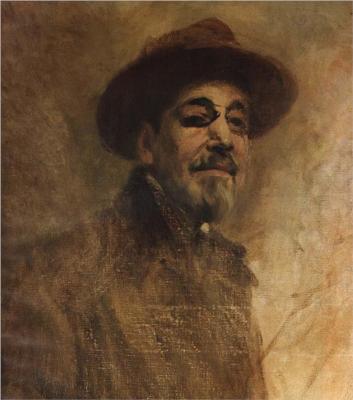
Biography
Columbano trained in Lisbon before travelling to Paris in 1881[1] under the patronage of the Countess of Edla. France gave him direct exposure to Courbet, Manet, and Degas, and the influence shows in his tonal economy and his refusal to flatter. Back in Lisbon, he co-founded the Grupo do Leão (the Lion's Group), an informal collective of Naturalist painters whose 1885 group portrait he produced as a kind of manifesto in oil. The painting captures seven colleagues around a café table with the same unsentimental attention he brought to individual sitters.
His most celebrated work is the 1889[1] portrait of the poet Antero de Quental, a study in restrained melancholy painted just two years before Quental's suicide. The canvas now hangs in the Chiado Museum, Lisbon, alongside the largest concentration of his paintings anywhere in the world.
After the fall of the Portuguese monarchy in 1910[1], Columbano turned his hand to an unlikely commission: designing the new republican flag. He served as director of the National Museum of Contemporary Art from 1914 to 1927, shaping the institutional context in which younger Portuguese artists would develop for a generation.
Timeline
- 1857Born in Portugal, the son of a romantic painter and brother of a caricaturist.
- 1881Travelled to Paris under the patronage of the Countess of Edla.
- 1885Co-founded the Grupo do Leão (the Lion's Group) in Lisbon, an informal collective of Naturalist painters.
- 1885Produced a group portrait of seven colleagues around a café table.
- 1889Painted a portrait of the poet Antero de Quental, now in the Chiado Museum, Lisbon.
- 1910Designed the new republican flag after the fall of the Portuguese monarchy.
- 1914Became director of the National Museum of Contemporary Art.
- 1927Retired as director of the National Museum of Contemporary Art.
- 1929Died, aged 72. He was considered the greatest Portuguese painter of the 19th century.
Notable Works
Tap to view larger.
Next stop
Browse the movements →
Every movement in the collection, from the Renaissance to Pop art.
Related Artists


Frequently Asked Questions
What is Columbano Bordalo Pinheiro known for?
Columbano Bordalo Pinheiro is known for his portraits, which had a psychological weight unusual in Iberian painting. Comparisons were drawn between him, Wilhelm Leibl, and John Singer Sargent. He is also known for co-founding the Grupo do Leão (the Lion's Group), an informal collective of Naturalist painters.Who was Columbano Bordalo Pinheiro?
Columbano Bordalo Pinheiro was a Portuguese painter, the son of a romantic painter and brother of a famous caricaturist. By the time of his death in 1929[1], he was considered the greatest Portuguese painter of the 19th century. He also served as director of the National Museum of Contemporary Art from 1914[1] to 1927.How did Columbano Bordalo Pinheiro die?
Columbano Bordalo Pinheiro died in 1929[1] at the age of 72.
Sources
Editorial draws on the following primary and tertiary references for Columbano Bordalo Pinheiro.
- [1] wikipedia Wikipedia: Columbano Bordalo Pinheiro Used for: biography, birth dates, death dates, identifiers, movement attribution, nationality.
- [2] book Koning, Jan,Uffelen, Gerda va,Zemanek, Alicja,Zemanek, Bogdan, Drawn After Nature: The Complete Botanical Watercolours of the 16th-Century Libri Picturati Used for: biography.
- [3] book Jennifer D. Milam, Historical Dictionary of Rococo Art Used for: biography, stylistic analysis.
- [4] book Leonor de Oliveira;, Portuguese Artists in London Used for: biography.
- [5] book "Michael Brand, Frederik J. Duparc, Ariane van Suchtelen, Anne T. Woollett, Tiarna Doherty, Mark Leonard and Jørgen Wadum", Rubens and Brueghel: A Working Friendship Used for: biography.
- [6] book Zuzanna Sarnecka, The Materiality of Terracotta Sculpture in Early Modern Europe Used for: stylistic analysis.
Editorial overseen by Solis Prints. Sources verified 2026-09-30. Click a source for details, or hover over [N] in the page above to preview.
Editorial standardsMethodologyCorrectionsAI disclosureAbout the editorial team