



Constantin Brâncuși
After working briefly in Auguste Rodin's studio in 1906[1], Brâncuși left after two months. "Nothing can grow under the shadow of a great tree," he reportedly said. The departure defined the trajectory of his career: a turn away from Rodin's modelled surfaces and psychological intensity, towards an abstraction grounded in Romanian[1] folk carving and the artefacts of cultures he studied in Paris's ethnographic museums.
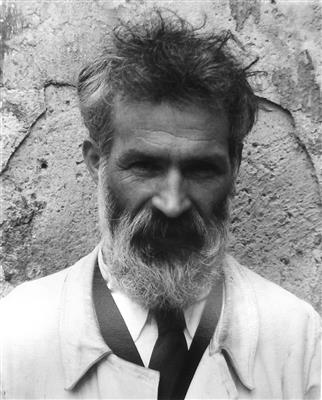
Biography
Born in 1876[1] in Hobitza, a village in the Carpathian foothills, Brâncuși grew up learning wood- and stonework. He enrolled at the School of Arts and Crafts in Craiova, then at the Bucharest School of Fine Arts, before making his way to Paris in 1904[1]. He enrolled at the École des Beaux-Arts the following year, working under sculptor Antonin Mercié.
His Paris circle brought him into contact with Modigliani (with whom he visited ethnographic museums in 1909[1]), Léger, Matisse, Duchamp, and the Dada circle around Tristan Tzara and Francis Picabia. Five of his sculptures appeared in the landmark 1913 Armory Show in New York, and his first solo American exhibition came the following year at Alfred Stieglitz's gallery "291," where collectors including John Quinn and Edward Steichen began acquiring his work.
The 1927[1]-1928[1] US Customs dispute over "Bird in Space" ended with a court ruling in Brâncuși's favour, establishing an early precedent for how abstract sculpture would be legally defined. He spent roughly two decades exploring the bird-in-flight motif, eliminating wings and feathers entirely to distil the form into its essential movement. Key works are held at the Metropolitan Museum, the Guggenheim, Tate Modern, and the Cleveland Museum of Art.
Timeline
- 1876Born in Hobitza, a village in the Carpathian foothills. He grew up learning wood- and stonework.
- 1904Moved to Paris.
- 1905Enrolled at the École des Beaux-Arts, working under sculptor Antonin Mercié.
- 1906Worked briefly in Auguste Rodin's studio, leaving after two months.
- 1909Visited ethnographic museums with Modigliani.
- 1913Five of his sculptures appeared in the Armory Show in New York.
- 1914His first solo American exhibition was held at Alfred Stieglitz's gallery "291".
- 1927The US Customs dispute over "Bird in Space" began.
- 1928The US Customs dispute over "Bird in Space" ended with a court ruling in Brâncuși's favour.
- 1957Died, aged 81.
Notable Works
Tap to view larger.
Next stop
Browse the movements →
Every movement in the collection, from the Renaissance to Pop art.
Related Artists


Frequently Asked Questions
What is Constantin Brâncuși known for?
Constantin Brâncuși is known for his sleek and simplified works. For around 20 years from the 1920s, he was absorbed by the theme of a bird in flight, and he wanted to depict the spirit of a bird as it moves its limbs in graceful harmony.What is Constantin Brâncuși's most famous work?
Constantin Brâncuși explored a few core themes in his sculpture: heads, embracing couples, and especially birds. From the 1920s, he became absorbed with the idea of a bird in flight. Brâncuși aimed to capture the essence of a bird's graceful, harmonic movements. He ignored wings and feathers, choosing to elongate the body while simplifying the head and beak. Brâncuși's preoccupation with bird imagery began around 1910[1]. His series of roughly thirty bird sculptures started with the theme of the Maiastra. In Romanian[1] folklore, the word 'maiastra' means 'master' or 'chief', but it also refers to a magically beneficent, dazzlingly plumed bird. Brâncuși had mystical leanings and a deep interest in peasant superstition, which made this motif a fitting one. One version, Maiastra (1911), can be seen at the Tate Modern in London.What should I know about Constantin Brâncuși's prints?
Constantin Brâncuși is better known as a sculptor than as a printmaker. He was born in Romania in 1876[1] and died in France in 1957[1]. Brâncuși's printmaking was closely related to his photography. He used photography to document his sculptures in his studio and also to explore themes of light and reflection. Some of his photographs were printed in magazines during his lifetime. Brâncuși's prints are not widely available. They consist mainly of photographs, some of which he cropped and manipulated. These photographic prints offer insight into his artistic process; they show how he viewed his sculptures and how he controlled their presentation. His prints are often more abstract than straightforward documentation. They capture the atmosphere of his studio and the essence of his sculptural forms.What style or movement did Constantin Brâncuși belong to?
Constantin Brâncuși (born in Romania, 1876[1]; died in France, 1957[1]) is considered a Modernist sculptor. His simplified, sleek work introduced abstraction and primitivism to three-dimensional art. After studying in Bucharest, Munich, and Paris, Brâncuși briefly worked in Rodin's studio. However, he soon departed, seeking his own direction. He combined the realism he learned from Rodin with Romanian[1] folk crafts and the abbreviated styles of what was then called primitive culture. This led to an original style. Brâncuși aimed to portray spiritual truths through abstracted art. He focused on themes like heads, birds, and embracing couples, favouring ovoid forms and curved lines. He condensed natural forms to near abstraction. His work has been linked to the Fauves and Post-Impressionism, sharing a "genius of omission" with Matisse. His sculpture *The Kiss* (1909[1]) shows his interest in formal simplicity and coherence, rather than savage expressiveness.What techniques or materials did Constantin Brâncuși use?
Constantin Brâncuși sculpted smoothly contoured forms in materials such as marble, stone, bronze, metal, and wood. He often produced alternative versions of a single theme. His simplified forms sought to reveal hidden truths. Brâncuși favoured direct carving, a technique rarely used by other sculptors who preferred preparatory models. Direct carving involves working the material directly, rather than using a model. During a brief period working in Rodin's workshop, he carved some of Rodin's marble sculptures. Brâncuși's sculptures often reduced natural forms to near abstraction. He focused on a few themes, such as heads, birds, and embracing couples, and favoured ovoid forms and curved lines. From the 1920s, he explored the theme of a bird in flight for about 20 years. He simplified the bird's form, elongating the body, slanting the head and beak, and omitting wings and feathers. He also paid attention to his materials, polishing his metal works to achieve a sheen.What was Constantin Brâncuși known for?
Constantin Brâncuși, born in 1876[1], was a Romanian[1] sculptor who became a major figure in early Modernism[1]. He is known for his simplified, sleek, abstract forms, which brought both abstraction and primitivism into three-dimensional art. Brâncuși's early life in Romania involved folk crafts of wood and stone carving. He studied at the School of Arts and Crafts in Craiova, and later at the National School of Fine Art in Bucharest. He moved to Paris, where he worked for Antonin Mercié at the École des Beaux-Arts for two years. He briefly worked in Rodin's workshop, but left after two months. From 1907[1], Brâncuși developed his personal style, blending academic realism with Romanian folk traditions and the simplified forms of what was then called primitive art. He aimed to portray spiritual truths through abstracted art, focusing on themes like heads, birds, and couples. He favoured ovoid shapes and smooth, curved lines. From the 1920s, he spent around two decades exploring the theme of a bird in flight, as seen in his 1941 bronze and marble sculpture, *Bird in Space*. Other important works include *Sleeping Muse* (1910), *Maiastra* (1911), *The Muse* (1912), and *Danaïde* (1918). Brâncuși died in 1957[1].When did Constantin Brâncuși live and work?
Constantin Brâncuși was born on 19 February 1876[1] in the village of Hobitza, Romania; he died in Paris on 16 March 1957[1]. Brâncuși studied art at the Craiova School of Arts and Crafts from 1894[1] to 1898. He then attended the Bucharest School of Fine Arts from 1898 to 1901. By 1904, he had moved to Paris to continue his education, enrolling in the École des Beaux-Arts in 1905. The following year, he exhibited his sculpture at the Salon d'Automne, where he met Rodin. After 1907, Brâncuși's mature period began. Although he settled in Paris, he maintained close contact with Romania, frequently returning and exhibiting in Bucharest almost every year. In Paris, his circle included Modigliani, Léger, Matisse, Duchamp, and Rousseau. In 1913, five of Brâncuși's sculptures were included in the Armory Show in New York. Alfred Stieglitz presented Brâncuși’s first solo exhibition at his gallery "291" in New York in 1914. By this time, several Americans, including Arthur B. Davies, John Quinn, Edward Steichen, and Eugene Meyers, were acquiring his sculpture. After 1939, Brâncuși worked alone in Paris. His last sculpture, a plaster Grand Coq, was completed in 1949. In 1952, Brâncuși became a French citizen.Where can I see Constantin Brâncuși's work?
Constantin Brâncuși's sculptures and other works can be found in collections around the world. He was born in Romania, but he lived and worked in Paris from 1904[1] until his death in 1957[1]. He maintained close contact with Romania, and in 1935, he was commissioned to create a war memorial in Tirgu Jiu. This complex incorporates gates, tables, stools, and an Endless Column. Examples of his sculpture can be seen in New York's Solomon R. Guggenheim Museum; their holdings include *The Muse* (1912). The Metropolitan Museum of Art, also in New York, holds *Sleeping Muse* (1910). In London, the Tate Modern has *Maiastra* (1911) and *Danaïde* (1918). The Cleveland Museum of Art in Ohio has *Torso* (1917). Brâncuși had one-man shows at the Wildenstein and Brummer Galleries in New York in 1926.Where was Constantin Brâncuși from?
Constantin Brâncuși was Romanian[1]. He was born in 1876[1], in the village of Hobitza, near the Carpathian Mountains. As a child, he helped his peasant parents and siblings tend their land. He also learned traditional folk crafts, such as wood and stone carving. He gained a local reputation for woodworking. Brâncuși received formal artistic training at the Craiova School of Arts and Crafts (1894[1]-1898[1]), then studied sculpture at the National School of Fine Art in Bucharest, until 1901. In 1904, eager to continue his education, Brâncuși moved to Paris. There, he worked for two years with sculptor Antonin Mercié at the École des Beaux-Arts. He would maintain close contact with Romania, exhibiting in Bucharest almost every year.Who did Constantin Brâncuși influence?
Constantin Brâncuși, a Romanian[1] sculptor who moved to Paris in 1904[1], is considered an influential figure in modern sculpture. His work introduced both abstraction and primitivism into three-dimensional art. Brâncuși's approach involved blending realism, which he learned from Antonin Mercié and Auguste Rodin, with the folk crafts of his native Romania and the simplified styles of what were then called 'primitive cultures'. Brâncuși aimed to portray a spiritual truth through abstract or abstracted art. He focused on themes like heads, birds, and embracing couples, favouring ovoid forms and curved lines. His style reduced elements to a minimum, condensing natural forms into near abstract simplicity. One example, *The Kiss* (1909), is a compact, self-sufficient group that marked a radical step beyond earlier sculpture. Brâncuși's 'primevalism' became the starting point for a sculptural tradition that continues. His influence is seen particularly in early works by Henry Moore.Who influenced Constantin Brâncuși?
Constantin Brâncuși's artistic development involved several influences, from his early life to his time in Paris. Born in Romania, he learned traditional wood- and stone-carving techniques, skills that would later inform his sculptural practice. He studied at the School of Arts and Crafts in Craiova, and then at the National School of Fine Art in Bucharest. In Paris, Brâncuși worked briefly with Antonin Mercié at the École des Beaux-Arts. He also spent a short time in Auguste Rodin's workshop in 1906[1], but left after two months, feeling he needed to forge his own path. Rodin's focus on naturalism and movement, however, left its mark. Brâncuși's exposure to the work of Paul Gauguin, and others at the Salon d’Automne, led him to believe that art should not merely imitate nature. Along with other artists like Matisse and Picasso, he became interested in the simplified forms of what was then called "primitive" art. In 1909, he met Amedeo Modigliani, and they visited ethnographic museums together, studying tribal masks. These experiences contributed to Brâncuși's move towards abstraction and the development of his unique style.Who was Constantin Brâncuși?
Constantin Brâncuși was a Romanian[1] sculptor, considered one of the most revered and influential modern sculptors. His works are cutting-edge, sleek, and simplified.
Sources
Editorial draws on the following primary and tertiary references for Constantin Brâncuși.
- [1] wikipedia Wikipedia: Constantin Brâncuși Used for: biography, birth dates, death dates, identifiers, movement attribution, nationality.
- [2] book Susie Hodge, Art Used for: biography, stylistic analysis.
- [3] book Susie Hodge, Art: Everything You Need to Know About the Greatest Artists and Their Work Used for: biography.
Editorial overseen by Solis Prints. Sources verified 2026-09-23. Click a source for details, or hover over [N] in the page above to preview.
Editorial standardsMethodologyCorrectionsAI disclosureAbout the editorial team