



Cope2
Fernando Carlo Jr., known as Cope2, grew up in the Kingsbridge neighbourhood of the Bronx and began writing graffiti in 1982, joining the crew Kids Destroy before founding Kings Destroy. By 1985 he was active across New York subway cars, developing a bold, colour-saturated wildstyle that became one of the defining signatures of the Bronx graffiti scene.
Biography
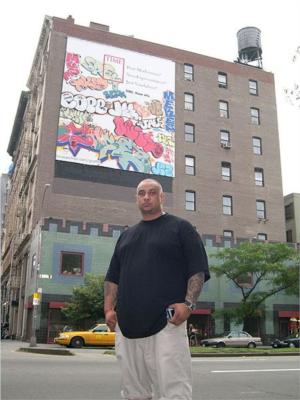
His reputation crossed into commercial culture in the 2000s. He produced cover art for Boogie Down Productions' *Sex and Violence*, contributed artwork to the 2002 film *Bomb the System*, and in 2005 was commissioned by Time magazine to paint a billboard in SoHo for $20,000. Converse and Adidas both produced collections featuring his lettering, and the 2006 video game *Marc Ecko's Getting Up* incorporated his work. His print collaborations include a screen print with Shepard Fairey and photographer Martha Cooper (450 editions, 2011) and an OBEY Clothing collaboration (300 editions, 2013).
Cope2's career has not been without friction. He faced multiple arrests through the 2010s, including a 2010 felony mischief charge that was resolved by plea agreement in 2012 and a 2015 incident at the Bowery Graffiti Wall. He has also faced sustained criticism over documented online conduct. Paintings sell at Christie's in the low hundreds to low thousands of dollars. He was honoured at the East Harlem Graffiti Hall of Fame in 2013.
Timeline
- 1968Born Fernando Carlo Jr., known as Cope2.
- 1982Began writing graffiti in the Kingsbridge neighbourhood of the Bronx.
- 1982Joined the graffiti crew Kids Destroy.
- 1985Active across New York subway cars, developing a bold, colour-saturated wildstyle.
- 2000Produced cover art for Boogie Down Productions' *Sex and Violence*.
- 2002Contributed artwork to the film *Bomb the System*.
- 2005Commissioned by *Time* magazine to paint a billboard in SoHo for $20,000.
- 2011Collaborated with Shepard Fairey and Martha Cooper on a screen print (450 editions).
- 2013Honoured at the East Harlem Graffiti Hall of Fame.
- 2013OBEY Clothing collaboration (300 editions).
Notable Works
Tap to view larger.
Next stop
Browse the movements →
Every movement in the collection, from the Renaissance to Pop art.
Related Artists
_%E2%80%93_LOC.jpg)



Frequently Asked Questions
What is Cope2 known for?
Cope2 is known for developing a bold, colour-saturated wildstyle that became one of the defining signatures of the Bronx graffiti scene. He has also worked on commercial projects, including cover art and collaborations with brands like Converse and Adidas.What is Cope2's most famous work?
It is difficult to name Cope2's single 'most famous work'. As a graffiti artist, his work is spread across the urban environment, often created without permission on public or private property. This makes documentation and tracking difficult. Cope2 is best known for his wildstyle graffiti, characterised by interlocking letters, dynamic movement, and bright colours. He is also known for his bubble letter graffiti, tags, and throw-ups, which can be found throughout New York City and internationally. He gained recognition in the 1980s for painting subway cars, and his work has since been exhibited in galleries and museums. He has collaborated with various brands and artists, further increasing his public profile. Without one single definitive piece, Cope2's fame rests on the large body of work he has produced over a long career.What should I know about Cope2's prints?
Cope2 is known for his graffiti art, and prints are one way his art is sold commercially. When buying a print, it is helpful to know some basic terminology. A 'vintage print' was made around the same time the original artwork was created, while a 'period print' was made within roughly ten to fifteen years of the original. A 'modern print' is a recent print made from the original negative or source. An 'original print' is one the artist made or directly supervised. A 'facsimile' is a copy that tries to match the original as closely as possible. Limited edition prints should be numbered, for example, 35/100. The first number is the print's individual number, and the second is the total number of prints in the edition. Artists sometimes create a small number of 'artist's proofs', marked AP. It is standard for artists to sign and number their prints in pencil. Because printmaking is unregulated, these conventions are not legally binding; however, they are widely followed. Claims about a print add to its value, so any description should be truthful.What was Cope2 known for?
Cope2, also known as Fernando Carlo, is a graffiti artist from New York. He is known for his 'wildstyle' tags and bubble letters on subway trains, walls, and other public surfaces in the Bronx and elsewhere. He began painting in 1978, developing his style throughout the 1980s. His crew, Kids Destroy, became well known. Cope2's work is characterised by dynamic compositions and bright colours. Later in his career, Cope2 moved into commercial art, creating work for companies such as Adidas and Converse, plus album art. He has had gallery shows internationally, and his paintings are collected. He also runs a graffiti art programme for young people in the Bronx, teaching them about the history and techniques of graffiti art.Who did Cope2 influence?
Identifying specific artists directly influenced by Cope2 requires careful consideration. Artistic influence is a complex phenomenon, often filtered through various sources and personal interpretations. Looking at the broader history of influence in art, we can see how artists build upon the work of their predecessors. For example, Paul Cézanne drew inspiration from Gustave Courbet. Cézanne's painting *Bridge at Maincy* (1879-80) invokes Courbet's *Shaded Stream* (1865). The connection between the two artists is evident in technique, such as Courbet's use of the palette knife. Willem de Kooning also expressed admiration for Courbet. He noted Courbet's ability to see something concretely, like the bark on a tree. De Kooning believed that contemporary artists could, in turn, influence how we see older masters. He suggested that artists like Clyfford Still could change how we view Monet, even if Still never directly looked at Monet's work. This reframes the idea of artistic influence as a dynamic, two-way exchange across generations.Who was Cope2?
Cope2, born Fernando Carlo in 1968[1], is a graffiti artist from New York City. Growing up in the South Bronx, he became immersed in the burgeoning hip-hop culture of the 1980s. He began tagging his name, 'Cope,' throughout the city, eventually adding the number '2' to distinguish himself. His work gained recognition for its wildstyle lettering, characterised by complex, interlocking shapes and bright colours. Cope2 became a respected figure within the graffiti community, known for his prolific output and dedication to the art form. Beyond the streets, Cope2 has exhibited in galleries and museums worldwide, bringing graffiti art to a wider audience. He has also collaborated with major brands, further cementing his place in popular culture. Cope2 continues to create art, inspiring a new generation of graffiti artists.What was Cope2's art style?
Cope2 developed a bold, colour-saturated wildstyle.When was Cope2 born?
Cope2 was born in 1968[1].
Sources
Editorial draws on the following primary and tertiary references for Cope2.
- [1] wikipedia Wikipedia: Cope2 Used for: biography, birth dates, death dates, identifiers, movement attribution, nationality.
- [2] book guggenheim-refigur00kren Used for: biography.
- [3] book Masterpieces of western art : a history of art in 900 individual studies from the Gothic to the present day Used for: biography.
- [4] book Gombrich, E. H. (Ernst Hans), 1909-2001, New light on old masters Used for: biography, stylistic analysis.
Editorial overseen by Solis Prints. Sources verified 2026-10-05. Click a source for details, or hover over [N] in the page above to preview.
Editorial standardsMethodologyCorrectionsAI disclosureAbout the editorial team