



Corita Kent
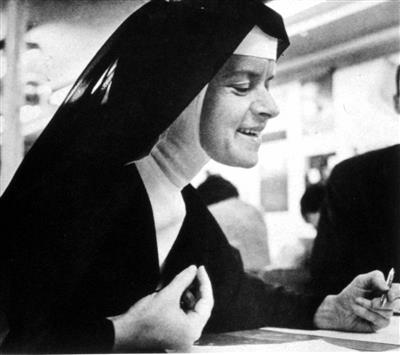
The silkscreens that made Corita Kent famous look almost accidental: swathes of saturated colour overlaid with clipped newspaper headlines, advertising copy, and calligraphic script. She made them in the early 1960s while running the Art Department at Immaculate Heart College in Los Angeles as a member of the Sisters of the Immaculate Heart of Mary, producing work that felt like pop art, protest, and prayer at the same time. Buckminster Fuller and Charles Eames were among her admirers.
Biography
Born in 1918[1], she had spent most of her adult life as a nun and educator. The late 1960s brought a rupture: she left the Order in 1968[1], relocated to Boston, and continued making work independently. Her output through the 1970s expanded into political poster design, book covers for Daniel Berrigan's publications, and a series of gift books and psalm collections that mixed her visual language with devotional text.
Two works define her public legacy. The first is the enormous rainbow stripe mural she painted on a natural gas storage tank in Boston, still visible from the highway. The second is the 1985[1] LOVE postage stamp, issued by the United States Postal Service and reproduced in the hundreds of millions. She died in Boston in 1986[1] at the age of 67. Her influence on graphic designers, particularly those working at the intersection of typography and image, remains considerable.
Timeline
- 1918Born as Frances Elizabeth Kent in Iowa.
- 1936Entered the Sisters of the Immaculate Heart of Mary convent.
- 1941Began teaching art at Immaculate Heart College in Los Angeles.
- 1960Became head of the Art Department at Immaculate Heart College.
- 1960Began creating her signature silkscreen prints, incorporating pop art elements.
- 1968Left the Order of the Immaculate Heart of Mary.
- 1968Relocated to Boston and continued creating art independently.
- 1970Designed political posters and book covers, including for Daniel Berrigan.
- 1971Painted a rainbow stripe mural on a natural gas storage tank in Boston.
- 1985Designed the LOVE postage stamp for the United States Postal Service.
- 1986Died in Boston at 67.
Notable Works
Tap to view larger.
Next stop
Pop Art →
Explore the artists and ideas of Pop Art.
Related Artists
_%E2%80%93_LOC.jpg)




Frequently Asked Questions
What is Corita Kent known for?
Corita Kent is known for her silkscreens, which combine saturated colour with newspaper headlines, advertising copy, and calligraphic script. She is also known for the rainbow stripe mural on a natural gas storage tank in Boston, and the 1985[1] LOVE postage stamp.What is Corita Kent's most famous work?
Corita Kent produced a large body of work, including prints, paintings and collages, from the 1950s until her death in 1986[1]. It is therefore difficult to name one single 'most famous work'. Her early pieces include 'Stairway' (1958[1]), 'Zone' (1960-61), 'I Love You with My Ford' (1961), 'Look Alive (Blue Feet, Look Alive)' (1961), '4-1949 Guys' (1962), 'Marilyn Monroe I' (1962), 'A Lot to Like' (1962), 'Sightseeing' (1962), and 'Untitled (Blue Sky)' (1962). Later works include 'F-lll' (1964-65), 'Spaghetti; Spaghetti (Red)' (1965), 'Someplace to be Tonight' (1966), 'Sauce' (1967), 'Sliced Bologna' (1968), 'Moon Beam Mistaken for the News' (1971), 'Horse Blinders (east)' (1972), 'Ins Lake' (1974-75), 'Midnight Sun' (1975), and 'Nasturtium Salad' (1984). Kent also produced a number of series, such as 'Welcome to the Water Planet' (1987-88) and 'The Swimmer in the Econo-mist' (1997-98).What should I know about Corita Kent's prints?
Corita Kent (1918[1]-1986[1]) was an American[1] Roman Catholic religious sister, artist, and educator. She is best known for her screen prints, especially those from the 1960s. Kent's printmaking often combined bold, colourful graphics with text. Her work incorporated slogans from advertising, biblical verses, and poetry. She addressed themes of peace, social justice, and faith. Her style is associated with Pop Art[1]. Kent taught art at Immaculate Heart College in Los Angeles for over 30 years. Her teaching methods were experimental and encouraged students to find inspiration in everyday life. She created prints for exhibitions, publications, and commissions. Some of her prints were produced as multiples, making her art accessible to a wider audience. Her work has been exhibited in museums such as the Museum of Modern Art in New York and the Contemporary Arts Museum in Houston.What techniques or materials did Corita Kent use?
Corita Kent is best known for her screen prints, a technique that allows printing on diverse surfaces like paper, fabric, wood, and vinyl. The process involves stretching a fine mesh over a frame, coating it with a light-sensitive emulsion, and exposing it to UV light with a film positive to create a stencil. Ink is then pushed through the mesh onto the desired surface using a squeegee. Kent's work often incorporated bold colours and text, reflecting her Pop Art[1] influences. She sometimes combined graphic images and 'found' objects with traditional paint media. Masking techniques, such as masking tape stencils and dry transfer lettering, also appear in her pieces, creating hard-edged forms and integrating varied elements. The juxtaposition of seemingly disparate components was a key aspect of her method.When did Corita Kent live and work?
Corita Kent (born Frances Elizabeth Kent) was an American[1] Roman Catholic religious sister, artist, and educator. She was born 20 November 1918[1] in Fort Dodge, Iowa. She entered the Immaculate Heart Community in Los Angeles in 1936[1] and died 18 September 1986[1] in Boston, Massachusetts. Kent's work evolved through several phases. In the 1950s, her prints and paintings incorporated biblical verses and text, with an increasing use of bold, abstract forms and colours. The 1960s saw her best-known serigraphs (silk screen prints), incorporating pop-art influences, advertising slogans, and civil rights messages. After leaving the order in 1968, Kent moved to Boston and adopted a more secular, less overtly political approach. She created designs for book covers and posters, including the 1985 'Love' stamp for the U.S. Postal Service.Where can I see Corita Kent's work?
Corita Kent's artworks have been featured in numerous museum exhibitions. Her prints were included in the 1997 show 'Prophets of Pop' at the Contemporary Arts Center, New Orleans. In 1999, her work was part of 'Pop Impressions U.S.A.' at the Museum of Modern Art, New York, and 'The American[1] Century: Art and Culture 1900-2000[1]' at the Whitney Museum of American Art, also in New York. Many institutions hold Kent's work in their permanent collections. These include the Museum of Modern Art, the Metropolitan Museum of Art, and the Solomon R. Guggenheim Museum in New York. Other locations include the Cincinnati Art Museum, the Cleveland Museum of Art, and the Carnegie Institute in Pittsburgh. European museums include the Musée National d'Art Moderne, Centre Georges Pompidou, in Paris; the Louisiana Museum of Modern Art in Humlebaek, Denmark; and the Kunstmuseum in Bern, Switzerland.Where was Corita Kent from?
Corita Kent was born Frances Elizabeth Kent in Fort Dodge, Iowa, in 1918[1]. Her family was Catholic; at the age of 18, she entered the order of the Immaculate Heart of Mary in Los Angeles. She took the name Sister Mary Corita. Kent remained in Los Angeles for most of her life. She taught art at Immaculate Heart College, eventually heading the art department. Her work gained notice in the 1950s and 1960s for its screen-printed designs with slogans. In the late 1960s, Kent left the order and moved to Boston. She continued to create art, focusing on social justice themes. Kent worked in a variety of media, including prints, billboards, and book covers, before her death in 1986[1]. Although she lived in other places later in life, she is most associated with Los Angeles.Who influenced Corita Kent?
Corita Kent's artistic development occurred in a context of several influences. The Bauhaus, with its synthesis of art and life, had an impact on American[1] artists after World War II. Josef Albers, a Bauhaus instructor, taught at Black Mountain College in North Carolina. He adapted Bauhaus pedagogy, emphasising visual perception and material analysis. Albers aimed to cultivate students' abilities to process information, deemphasising utilitarian design. Robert Rauschenberg, who studied with Albers, considered him his most important teacher. Albers' teaching methods, especially in visual perception, formal composition, and material analysis, influenced Rauschenberg's practice. Rauschenberg reinterpreted these ideas for an American consumer society. Paul Klee, associated with the Bauhaus, followed transcendentalism, believing in independence and multiple realities. Klee aimed to create his own style, avoiding artistic categorisation. Anni Albers, a Bauhaus student, combined weaving with modern art ideas. These figures contributed to the artistic environment that shaped Corita Kent's work.Who was Corita Kent?
Corita Kent (1918[1]-1986[1]) was an American[1] nun who worked almost exclusively with silkscreen. Her work incorporated signs, slogans, and packaging. She used these designs as a form of political protest. Kent is considered one of several female Pop artists who demonstrated their political or feminist beliefs. Other artists in this group include Nicola L and Marisol Escobar. Kent created versions of works by artists including Andy Warhol and Roy Lichtenstein. Her work deliberately raised awareness of authenticity, celebrity, and originality. Kent taught art at Immaculate Heart College in Los Angeles. She headed the art department there in the 1960s. She gained notice for her Pop art-influenced serigraphs, which often included words and phrases related to peace, social justice, and faith.Why are Corita Kent's works important today?
Corita Kent (1918[1]-1986[1]) was an American[1] nun who worked almost exclusively with silkscreen. Her art incorporated signs, slogans, and packaging. She used these elements as a form of political protest. Kent is often associated with Pop Art[1], a movement that questioned the boundaries between high and low culture. Pop Art's raucous spirit remains relevant today. It taught that there was no longer any barrier between high and low culture, the avant-garde and the masses. This idea continues to shape our world. Other female Pop artists also demonstrated their political or feminist beliefs. They addressed the constraints faced by women during that period. Kent's work, like that of other Pop artists, raised awareness of authenticity, celebrity, and originality. Her accessible style and messaging made art a tool for social commentary.How did Corita Kent die?
Corita Kent died in 1986[1] at the age of 68.
Sources
Editorial draws on the following primary and tertiary references for Corita Kent.
- [1] wikipedia Wikipedia: Corita Kent Used for: biography, birth dates, death dates, identifiers, movement attribution, nationality.
- [2] book Art Chantry, Art Chantry Speaks Used for: stylistic analysis.
- [3] book Jesse Bryant Wilder, Art History For Dummies Used for: biography.
- [4] book guggenheim-jennyholzer00wald Used for: biography.
- [5] book guggenheim-roylich00wald Used for: biography.
- [6] book Landauer, Susan, The not-so-still life : a century of California painting and sculpture Used for: biography.
- [7] book Charlene Spretnak (auth.), The Spiritual Dynamic in Modern Art _ Art History Reconsidered, 1800 to the Present Used for: biography.
- [8] book Penny Huntsman, Thinking About Art Used for: stylistic analysis.
Editorial overseen by Solis Prints. Sources verified 2026-09-30. Click a source for details, or hover over [N] in the page above to preview.
Editorial standardsMethodologyCorrectionsAI disclosureAbout the editorial team