



Czene Béla
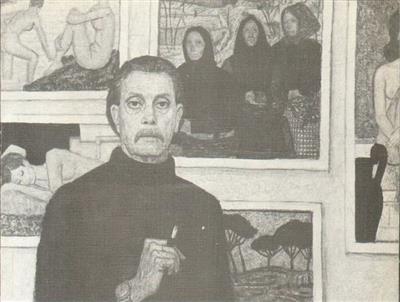
Béla Czene was born in Isaszeg in 1911[1] and trained at the Hungarian[1] College of Fine Arts in Budapest between 1930[1] and 1933, studying under Gyula Rudnay, a painter committed to the kind of sober Hungarian realism that looked back to the old masters rather than forward to abstraction. Rudnay's influence is legible in Czene's draftsmanship throughout his career: controlled, unhurried, attentive to volume.
Biography
A Rome scholarship to the Collegium Hungaricum in 1938[1]-1939[1] deepened that classical orientation. Czene studied Leonardo, Ghirlandaio, and the Greco-Roman sculptural tradition, and the Italian experience gave his figure painting a formal gravity that persisted long after he returned to Budapest. He accumulated prizes steadily through the 1940s and 1950s, including the Ede Balló Prize (1942), the Ferenc József Prize (1943), and the Folk Culture Prize (1953), the last reflecting the post-war expectation that Hungarian[1] painters depict ordinary working life.
Czene's subjects were frequently domestic: family groups, women at work, quiet interiors. His technique had a characteristic deliberateness, the surface built up in layers with a patience unusual in an era that rewarded spontaneity. He showed through the worst decades of Hungarian[1] cultural politics without obvious stylistic concessions, and died in Budapest in 1999[1] at eighty-eight. His wife Erzsébet Hikády was also a painter, as were his son Gábor and granddaughter Márta Czene, making the family one of the more sustained artistic dynasties in modern Hungarian art.
Timeline
- 1911Born in Isaszeg.
- 1930Began studies at the Hungarian College of Fine Arts in Budapest.
- 1933Completed studies at the Hungarian College of Fine Arts.
- 1938Awarded a Rome scholarship to the Collegium Hungaricum.
- 1939Returned to Budapest from Rome.
- 1942Received the Ede Balló Prize.
- 1943Awarded the Ferenc József Prize.
- 1953Received the Folk Culture Prize.
- 1999Died in Budapest at 88.
Notable Works
Tap to view larger.
Next stop
Browse the movements →
Every movement in the collection, from the Renaissance to Pop art.
Related Artists

Frequently Asked Questions
What is Czene Béla known for?
Czene Béla is known for his domestic subject matter, including family groups, women at work, and quiet interiors. He accumulated prizes steadily through the 1940s and 1950s, including the Ede Balló Prize, the Ferenc József Prize, and the Folk Culture Prize.What should I know about Czene Béla's prints?
Czene Béla's prints, like all fine art prints, exist in a space between unique artwork and mass-produced commodity. The value of a print depends on several factors, including the artist's intent, the printmaking process, and the size of the edition. An "original" print is conceived as a print, made via a matrix (plate, stone, screen, block), and individually inked and pulled. The artist typically decides the edition size. Numbering (e.g., 12/25) accounts for the prints. Early prints were often unsigned/unnumbered. A reproduction copies an artwork from another medium, often via photomechanical means. Numbering/signing does not make it an original print. The Professional Art Dealers Association of Canada defines an original print as "an image that has been conceived by the artist as a print and executed solely as a print, usually in a numbered edition, and signed by the artist." Printmakers often limit editions, marking each print with the edition number, title, and signature in pencil. This claim adds value if believed. The edition claim is written as a pair of numbers on the left bottom margin of the print, the title of the print is written in the middle of the bottom margin of the print, and the signature is on the right.What techniques or materials did Czene Béla use?
Czene Béla developed a method for glass wall-pictures. He used opaque rather than transparent glass, and a single pane for each picture. This allowed the work to be hung on a wall, or mounted into a wall (either indoors or outdoors). His technique involved sandblasting flashed glass. This type of glass typically features a milk-glass body covered with a thin coating of another colour, often black or red. The sandblasting is similar to the method used for engraving tombstones. The glass is covered with stencil paper or rubber, and the design is cut out. Sandblasting then grinds a relief into the exposed areas. A short sandblasting treatment can also create a dulling effect, producing frosted glass. Czene used this method to produce a dull dark grey on a shiny deep black, requiring a second cut of the stencil and a second sandblasting. He also used glass painters' colours, which were made permanent by burning in a kiln. Czene noted that the colour and form possibilities were limited, but that the colour intensity, pure whites, deep blacks, and preciseness offered a particular material and form effect.When did Czene Béla live and work?
Czene Béla was a Hungarian[1] artist who was active during the first half of the 20th century. László Moholy-Nagy, a contemporary, was born in 1895 in Bácsborsód, Hungary. He began his artistic career around 1915[1], while recovering from injuries sustained during military service. In 1917, he started painting portraits in watercolours and oil pencils. That same year, he co-founded an artistic group called "Ma," meaning "Today". After the war, Moholy-Nagy moved to Vienna in 1919 and then to Berlin in 1920, where he explored non-objective work, including collages and photograms. His first exhibition took place in Berlin in 1921. Later, in 1934, he relocated to Amsterdam, where he experimented with colour film and photography. By 1935, he had moved to London, working as an art advisor and publishing volumes of documentary photography. In 1937, Moholy-Nagy took on the directorship of the New Bauhaus in Chicago. He later established his own School of Design in Chicago in 1938. He continued to work as a designer and educator until his death in 1946.Where can I see Czene Béla's work?
During the early twentieth century, several museums in Russia acquired works by avant-garde artists like Czene Béla. Many of these museums were short-lived or underwent frequent reorganisations. Museums of Painterly Culture were established in numerous cities including Vitebsk, Yekaterinburg, and Kazan. The Museum Bureau of IZO-Narkompros dispatched artworks to locations such as Vitebsk (in 1919[1]), Samara, and Astrakhan. In 1920, further shipments went to Penza, Simbirsk, and Smolensk. The Petrograd Russian Museum also received works. The avant-garde collection of the Yekaterinburg Museum of Visual Arts includes pieces from the Museum of Painterly Culture. The Rostov Kremlin Museum held an exhibition of avant-garde works, 'Khvost komety', between 2018 and 2020. The National Art Museum of Belarus (in Minsk) also possesses a small number of works from the former Museum of Modern Art in Vitebsk.Who did Czene Béla influence?
Czene Béla's sphere of artistic influence is not well documented. However, we can consider the influences of artists with whom he shared aesthetic concerns. Paul Cézanne, active in France during the late 19th century, had a considerable effect on painters in the early 20th century, including those associated with Cubism. He urged artists to perceive nature through geometric forms: cylinders, spheres, and cones. Cézanne's approach to composition, with its careful arrangement of planes, also had a strong effect on younger painters. His work suggested that a painting's structure could become a tangible reality, separate from the objects it represented. Painters such as the Nabis, Kandinsky, and even the Surrealists all, to varying degrees, drew inspiration from Cézanne. He is now viewed as a wellspring for 20th-century painting, and critics depend on his visual assertions for their aesthetic principles. Cézanne admired Nicolas Poussin, the 17th-century French classicist, and aimed to synthesise impressionism with the solid, durable art found in museums. He also advised artists to study Veronese, Rubens, and Delacroix.Who influenced Czene Béla?
Czene Béla's artistic development was shaped by several influences. While studying at the Prague Academy, he was drawn to the Nazarene movement, which advocated a return to the spiritual orientation of late medieval German painting. This movement emphasised contemplation, allegory, and the creation of art with an effect similar to church music. Czene's professor, Frantisek Sequens, a Nazarene, initially directed him towards traditional techniques, such as drawing plaster copies and cartoons for murals. However, Czene also admired Josef Mánes, whose style Sequens allowed him to emulate. Mánes, who died the year Czene was born, stressed composition based on melodic line and a poetic interpretation of nature. Another significant influence was Mikulás Ales, a follower of Mánes, who integrated figures and other elements into ornamental space. Ales's illustrations of Czech folk songs, with their synthesis of music and the pictorial, resonated with Czene's later desire to fuse painting with music. The Jubilee Exhibition in Prague in 1891 exposed Czene to diverse trends, including realism, genre painting, and Czech folk art, further shaping his artistic direction.Why are Czene Béla's works important today?
Czene Béla's art is significant because he added to the history of art, rather than replacing it. The critic Roger Marx considered Cézanne an important link in an historical chain, an influence on following generations. Cézanne, in response to a review by Marx of paintings exhibited at the Salon d'Automne of 1904, stated that 'one does not substitute oneself for the past, one just adds a new link'. Cézanne aimed to communicate to the public and 'occupy a proper rank in the history of art' through his artistic temperament, conception of nature, and means of expression. He saw colour as the technical means of painting that gives the most immediate sensation of life. One critic, Vauxcelles, claimed that Cézanne's place was in the Louvre, a prophecy that proved accurate. Vauxcelles praised Cézanne for his achievements, taking a positive attitude, rather than indulging in one-upmanship.What was Czene Béla's art style?
Czene Béla's art style is characterised by a deliberate technique, with surfaces built up in layers. His draftsmanship was controlled and attentive to volume, showing the influence of his teacher Gyula Rudnay and his study of old masters.How did Czene Béla die?
Czene Béla died in 1999[1] at the age of 88.
Sources
Editorial draws on the following primary and tertiary references for Czene Béla.
- [1] wikipedia Wikipedia: Czene Béla Used for: biography, birth dates, death dates, identifiers, movement attribution, nationality.
- [2] book Natalya Strizhkova Andrei Sarabyanov, Art and Power_ The Russian Avant-garde under Soviet Rule, 1917–1928 Used for: biography, stylistic analysis.
- [3] book Graham-Dixon, Andrew, Caravaggio : a life sacred and profane Used for: biography, stylistic analysis.
- [4] book guggenheim-twentycontempora00dotr Used for: biography.
- [5] book Masterpieces of western art : a history of art in 900 individual studies from the Gothic to the present day Used for: biography.
- [6] book Gombrich, E. H. (Ernst Hans), 1909-2001, New light on old masters Used for: biography, stylistic analysis.
- [7] book Post-impressionism : cross-currents in European painting Used for: biography.
Editorial overseen by Solis Prints. Sources verified 2026-10-14. Click a source for details, or hover over [N] in the page above to preview.
Editorial standardsMethodologyCorrectionsAI disclosureAbout the editorial team