

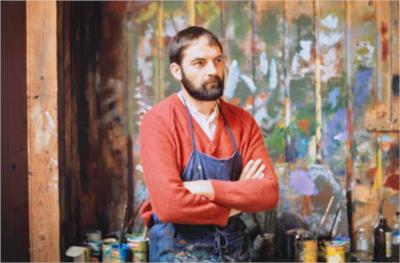
Dale Hickey
Dale Hickey came of age at the precise moment Australian[2] painting was turning towards the international. Born in Melbourne in 1937[2] and trained at Swinburne College of Technology, he held his first solo show at Toorak Galleries in 1964, when the local scene was still dominated by the Heidelberg tradition's long shadow.
Biography
Four years later he appeared in The Field at the National Gallery of Victoria, the exhibition that announced Australian[2] minimalism to a wider public. Hickey was alongside Robert Hunter, Robert Jacks, and Peter Booth, all of them engaging with ideas drawn from American formalism and the critical writing of Clement Greenberg. His own canvases from that period moved between hard-edged colour and something more allusive, resisting the reductive logic that Greenberg's followers often applied too mechanically.
What followed across the next decades was a sustained, deliberately various body of work. Rather than consolidating a signature, Hickey kept shifting register: geometric, painterly, referential. The critic Christopher Heathcote described it as a sustained investigation into the nature of art, which captures the restlessness without quite conveying how quietly assured each individual canvas tends to be.
He taught painting at the Phillip Institute of Technology in Melbourne from 1973 to 1989. Work is held in all major Australian[2] public collections.
Timeline
- 1937Born in Melbourne.
- 1964Held his first solo exhibition at Toorak Galleries in Melbourne.
- 1968Participated in The Field exhibition at the National Gallery of Victoria, Melbourne.
- 1973Began teaching painting at the Phillip Institute of Technology in Melbourne.
- 1989Stopped teaching painting at the Phillip Institute of Technology in Melbourne.
Notable Works
Tap to view larger.
Next stop
Browse the movements →
Every movement in the collection, from the Renaissance to Pop art.
Related Artists

Frequently Asked Questions
What is Dale Hickey known for?
Hickey is known for his contributions to Australian[2] minimalism and his varied body of work. His canvases from the late 1960s moved between hard-edged colour and more allusive styles. Over the following decades, he shifted between geometric, painterly, and referential styles, avoiding a consolidated signature style.Who was Dale Hickey?
Dale Hickey was an Australian[2] painter who came of age as Australian painting turned towards the international scene. Born in Melbourne in 1937[2], he trained at Swinburne College of Technology and had his first solo show in 1964. He appeared in The Field exhibition at the National Gallery of Victoria in 1968.What was Dale Hickey's art style?
Hickey's art style varied throughout his career. His early work engaged with ideas drawn from American formalism, incorporating hard-edged colour. Later, he shifted between geometric, painterly, and referential styles.When was Dale Hickey born?
Dale Hickey was born in 1937[2].
Sources
Editorial draws on the following primary and tertiary references for Dale Hickey.
- [1] museum Victoria and Albert Museum Used for: museum holdings.
- [2] wikipedia Wikipedia: Dale Hickey Used for: biography, birth dates, death dates, identifiers, movement attribution, nationality.
- [3] book Doss, Erika, 1956-, Benton, Pollock, and the politics of modernism : from regionalism to abstract expressionism Used for: biography.
- [4] book guggenheim-19artistsemergen00solo Used for: biography.
- [5] book guggenheim-australianvision00wald Used for: biography.
- [6] book guggenheim-roylich00wald Used for: biography.
- [7] book Landauer, Susan, The not-so-still life : a century of California painting and sculpture Used for: biography.
Editorial overseen by Solis Prints. Sources verified 2026-10-21. Click a source for details, or hover over [N] in the page above to preview.
Editorial standardsMethodologyCorrectionsAI disclosureAbout the editorial team