



Dan Christensen
Dan Christensen arrived in New York from rural Nebraska in the mid-1960s and within a few years had developed one of the most distinctive techniques in American abstraction: successive layers of airbrushed paint producing spiralling, looping forms that seemed to float just above an atmospheric ground. His practice was less a reaction against colour field painting than a complication of it, introducing gesture and spatial tension into the same luminous surface that painters like Helen Frankenthaler had been exploring.
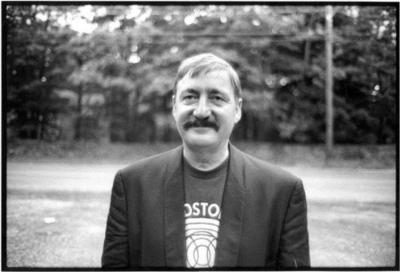
Biography
Born in Lexington, Nebraska in 1942[1], Christensen trained at the Kansas City Art Institute, graduating in 1964[1]. By 1969 he had his first solo exhibition at the Andre Emmerich Gallery in New York, a milestone in what critics were calling Lyrical Abstraction: a tendency that loosened the geometric rigidity of 1960s colour abstraction without returning to the loaded gesturalism of Abstract Expressionism. That year the Guggenheim included him in Nine Young Artists, positioning him alongside a group collectively rethinking the figure-ground relationship in paint.
What distinguished Christensen was the soft-focus quality of his forms. By layering airbrush applications, he obliterated hard edges so that both figure and ground remained atmospheric: the looping bar forms registered as presences rather than objects. His works achieved a spatial ambiguity; the canvas felt neither deep nor entirely flat, but suspended somewhere between the two.
He continued working until his death in 2007[1], maintaining a practice rooted in the same concerns he had identified nearly forty years earlier. His paintings are held in major American collections including the Hirshhorn Museum, the Corcoran Gallery, and the Whitney Museum of American Art.
Timeline
- 1942Born in Lexington, Nebraska.
- 1960Moved to New York from rural Nebraska in the mid-1960s.
- 1964Graduated from the Kansas City Art Institute.
- 1969Had his first solo exhibition at the Andre Emmerich Gallery in New York.
- 1969Included in Nine Young Artists at the Guggenheim.
- 2007Died in 2007. He maintained his artistic practice until his death.
Notable Works
Tap to view larger.
Next stop
Browse the movements →
Every movement in the collection, from the Renaissance to Pop art.
Related Artists


Frequently Asked Questions
What is Dan Christensen known for?
Dan Christensen is known for developing a distinctive technique in American abstraction. He used successive layers of airbrushed paint, producing spiralling, looping forms that seemed to float just above an atmospheric ground.What should I know about Dan Christensen's prints?
Dan Christensen (1942[1]-2007[1]) was an American abstract expressionist painter. He is associated with colour field painting and lyrical abstraction. His prints often translate the spontaneous gestures of his paintings into a more accessible medium. Christensen began his career in the late 1960s in New York City. He developed a distinctive style characterised by looping lines and fields of colour. His early work often involved spraying paint onto large canvases, creating a sense of immediacy and energy. Later, he moved towards looser, more atmospheric compositions. His prints are usually serigraphs or lithographs. These techniques allowed him to reproduce the textures and colour gradations of his paintings. The prints often feature bold, sweeping lines and layered colours, reflecting his interest in movement and light. Some of his prints are based directly on his paintings, while others are unique works in their own right. Collectors value Christensen's prints for their visual impact and their connection to a significant figure in American abstract art. They provide an opportunity to own a piece related to his larger body of work at a lower price point than an original painting.What style or movement did Dan Christensen belong to?
Dan Christensen (born 1942[1]) is associated with Lyrical Abstraction, a movement that emerged in the late 1960s as a reaction against the rigid geometry of Minimalism and Hard-Edge painting. It is characterised by a renewed emphasis on painterly gesture, colour, and subjective expression. Christensen's work from this period often featured all-over compositions, with spiral loops or bars superimposed on atmospheric fields of colour. He employed techniques such as airbrushing to build up successive layers of paint, creating a soft focus and dissolving the contours between figure and ground. This approach allowed him to explore the interplay between different types of spaces, atmospheric fields, and planar figures, while affirming the actuality of the painted surface. His art reformulates some of the issues raised by Rothko and Pollock.What techniques or materials did Dan Christensen use?
Dan Christensen, born in Lexington, Nebraska, in 1942[1], is associated with a reaction against the art of the 1960s. This involved a rejection of hard edges, brilliant colour, and schematic arrangements that were favoured by both pop and colour abstraction. Some painters returned to considerations of work from the 1950s. For Christensen, this resulted in a body of work that reformulates some of the issues raised by Rothko and Pollock. Despite an affinity to Pollock, particularly in the use of an all-over configuration, Christensen was also concerned with the potential of colour overlays rather than a single application of paint. He preferred two types of spaces: an atmospheric field and a planar one consisting of figures (usually spiral loops or bars) superimposed on the field. Christensen used either a rectangular format whose axes parallel the canvas support or an asymmetrical configuration that coincided in several places with the edge. He used airbrushing of successive layers of paint, which stressed the actuality of the surface and limited the distance between the two spaces.What was Dan Christensen known for?
Dan Christensen (1942[1]-2007[1]) was an American abstract painter. He is most associated with lyrical abstraction, and with colour field painting. He is known for the gestural use of colour. Christensen's early work involved hard-edge painting. These paintings used geometric shapes and flat, unmodulated colour. By the late 1960s, he began to experiment with looser, more expressive techniques. He used spray guns to apply thin layers of paint to large canvases. This method allowed him to create soft, atmospheric effects and subtle gradations of colour. His work from this period often featured looping, ribbon-like forms. In the 1970s, Christensen further developed his signature style. He used long, flexible paint applicators, such as squeegees and rollers, to create sweeping lines and bold, gestural marks. He often worked on a large scale, producing paintings that enveloped the viewer in fields of colour. He explored the interaction of colour, line, and texture. Christensen's paintings are held in many collections, including the Museum of Modern Art and the Metropolitan Museum of Art in New York.Where can I see Dan Christensen's work?
Dan Christensen's paintings are held in many public collections. These include museums in the United States and the United Kingdom. In New York City, his work can be viewed at the Metropolitan Museum of Art, the Museum of Modern Art, the Solomon R. Guggenheim Museum, and the Whitney Museum of American Art. Outside New York, major holdings of Christensen's paintings are at the Albright-Knox Art Gallery, Buffalo; the Art Institute of Chicago; the High Museum of Art, Atlanta; the Hirshhorn Museum and Sculpture Garden, Washington, D.C.; the Museum of Fine Arts, Boston; the Philadelphia Museum of Art; and the Walker Art Center, Minneapolis. For those in the United Kingdom, the Tate in London holds examples of his work. These collections allow the public to view and study his contributions to abstract painting. Check museum websites for current exhibitions.Who did Dan Christensen influence?
Dan Christensen's work, particularly his spray paintings, had an impact on artists associated with Post-Minimalism and Lyrical Abstraction. These movements valued process, gesture, and colour. Christensen's techniques with line and colour influenced a number of younger artists who explored similar themes in their own work. While it is difficult to pinpoint direct disciples, Christensen's influence can be seen in the work of artists who adopted similar methods of paint application and explored the expressive potential of colour. His emphasis on spontaneity and improvisation resonated with artists seeking to move beyond the rigid structures of Minimalism. Christensen's contributions to the field of abstract painting are recognised through museum collections and exhibitions. His work continues to be studied by artists interested in the history of American abstraction and the development of alternative painting techniques. He remains an important figure for those exploring colour field painting and its subsequent developments.Who influenced Dan Christensen?
Dan Christensen (1942[1]-2007[1]) was associated with Lyrical Abstraction, a movement that emerged in the late 1960s as a reaction against Minimalism and hard-edge painting. This style prioritised painterly gesture and colour over formal structure. Early influences on Christensen include the Abstract Expressionists. Their emphasis on spontaneous action and subjective feeling resonated with him. Artists like Jackson Pollock, with his drip technique, and Willem de Kooning, known for his energetic brushwork, provided examples of how to create dynamic compositions. Christensen's use of colour can be linked to colour field painting. This is another branch of Abstract Expressionism. Artists such as Barnett Newman and Mark Rothko explored the expressive potential of large, uniform areas of colour. Although Christensen did not adopt their minimalist approach, he shared their interest in colour as a primary subject. He experimented with different application methods, including spraying and staining, to achieve unique optical effects. These techniques allowed him to create luminous surfaces and atmospheric depth.Who was Dan Christensen?
Dan Christensen (1942[1]-2007[1]) was an American painter associated with lyrical abstraction and colour field painting. Born in Cozad, Nebraska, he moved to New York City in the late 1960s. Christensen's early work involved shaped canvases and spray-gun techniques. These methods aligned him with the lyrical abstraction movement, which moved away from the rigid geometry of minimalism toward more expressive, fluid forms. His paintings often featured bright colours and gestural marks, applied with a distinctive sense of spontaneity. During the 1970s, Christensen experimented with different approaches, including looser brushwork. His work can be seen as a contribution to the ongoing dialogue between colour, form, and process in abstract painting. He exhibited at institutions such as the André Emmerich Gallery and the Salander-O'Reilly Galleries. Although his style evolved over time, Christensen remained committed to exploring the possibilities of abstract painting throughout his career.Why are Dan Christensen's works important today?
Dan Christensen (born 1942[1], Nebraska; died 2007[1], New York) was an American abstract painter associated with lyrical abstraction and colour field painting. He is best known for his spray paintings of the late 1960s and early 1970s. Christensen's works are important because they represent a specific moment in the development of abstract painting in the United States. His use of spray paint, combined with loose, gestural marks, created a distinctive style that set him apart from other artists working in the colour field tradition. His art also engages with questions about originality, authorship, and the role of the artist. By using unconventional techniques and materials, he challenged traditional notions of what painting could be. This makes his output relevant to contemporary discussions about art and its place in culture.What was Dan Christensen's art style?
Dan Christensen's art style is best described as Lyrical Abstraction. It loosened the geometric rigidity of 1960s colour abstraction without returning to the loaded gesturalism of Abstract Expressionism; his work featured soft-focus forms achieved by layering airbrush applications.
Sources
Editorial draws on the following primary and tertiary references for Dan Christensen.
- [1] wikipedia Wikipedia: Dan Christensen Used for: biography, birth dates, death dates, identifiers, movement attribution, nationality.
- [2] book Ansel Adams; Beaumont Newhall; Nancy Newhall; Louise Dahl-Wolfe; Aaron Siskind; Richard Avedon; Harry Callahan; Lee Friedlander; Tina Modotti; W. Eugene Smith; Paul Strand; Edward Weston; Garry Winogrand; Amy Rule, Ansel Adams; Beaumont Newhall; Nancy Newhall; Louise Dahl-Wolfe; Aaron Siskind; Richard Avedon; Harry Callahan; Lee Friedlander; Tina Modotti; W. Eugene Smith; Paul Strand; Edward Weston; Garry Winogrand; Amy Rule - Original sources _ art and ar Used for: stylistic analysis.
- [3] book Art Chantry, Art Chantry Speaks Used for: biography, stylistic analysis.
- [4] book downmagaz.net, downmagaz.net Used for: biography.
- [5] book guggenheim-nineyoungartists00solo Used for: biography.
- [6] book guggenheim-northernvisionss03solo Used for: biography.
- [7] book Landauer, Susan, The not-so-still life : a century of California painting and sculpture Used for: biography.
Editorial overseen by Solis Prints. Sources verified 2026-09-30. Click a source for details, or hover over [N] in the page above to preview.
Editorial standardsMethodologyCorrectionsAI disclosureAbout the editorial team