



David Kakabadze
Few artists of the early twentieth century crossed as many disciplines as David Kakabadze. Born in 1889[1] in Kukhi, a village in the Imereti region of western Georgia, he grew up in rural poverty before winning a scholarship that took him first to St Petersburg, where he studied natural sciences while attending painting classes, and then, in 1919[1], to Paris. The move transformed him.
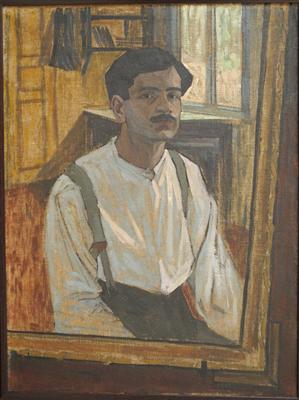
Biography
In Paris, Kakabadze abandoned conventional representation and threw himself into non-objective work, experimenting with metal foils, mirror glass, and stained glass alongside oil paint. The city also pulled him toward optics and cinema: in 1923[1] he constructed a stereoscopic film camera that produced a convincing illusion of depth, making him one of the earliest pioneers of three-dimensional cinema. A year later he was incorporating lenses and mirrors directly into constructive collages, folding his engineering instincts into his pictorial practice.
He returned to Georgia in the late 1920s and became a professor at the Tbilisi State Academy of Arts in 1928[1]. The relationship with Soviet cultural authority was always uneasy. Soviet officials pressured him to abandon what they termed Formalism and conform to Socialist Realism, and in 1948 he was dismissed from the Academy. He spent his last years working in relative isolation and died in Tbilisi on 10 May 1952[1].
What makes Kakabadze unusual is the coherence beneath the variety. Whether painting, designing theatre sets, or filing patents for optical devices, he pursued the same underlying question: how to make the eye feel the difference between surface and depth. His work sits at a rare intersection of European modernism and Georgian visual culture, each informing the other rather than one simply displacing the other.
Timeline
- 1889Born in Kukhi, a village in the Imereti region of western Georgia. He grew up in rural poverty.
- 1919Moved to Paris at 30, which transformed his artistic style.
- 1923Constructed a stereoscopic film camera in Paris, becoming an early pioneer of three-dimensional cinema.
- 1924Began incorporating lenses and mirrors into constructive collages in Paris.
- 1928Returned to Georgia and became a professor at the Tbilisi State Academy of Arts.
- 1948Dismissed from the Tbilisi State Academy of Arts due to pressure to conform to Socialist Realism.
- 1952Died in Tbilisi at 63. He spent his last years working in relative isolation.
Notable Works
Tap to view larger.
Next stop
Browse the movements →
Every movement in the collection, from the Renaissance to Pop art.
Related Artists



Frequently Asked Questions
What is David Kakabadze known for?
David Kakabadze is known for his diverse artistic pursuits, which included painting, theatre set design, and inventions in the field of optics. He constructed a stereoscopic film camera and incorporated lenses and mirrors into his collages.What is David Kakabadze's most famous work?
It is difficult to name one single work as David Kakabadze's most famous. He produced work in Constructivism, Dadaism, and Expressionism, and he also explored set design. Kakabadze is known for embracing modernism in Georgia. He returned to his home country in 1919[1], after a period in Paris, and his art shifted to incorporate both national subject matter and modern forms. Some of his noted paintings include "Imeretia-My Mother" (1918), a Cubist-inspired composition, and his series of paintings of Georgian regions. He also explored kinetic sculpture and film animation. His set designs for plays such as "The Caucasian Chalk Circle" also received attention. Due to the range of his artistic output, pinpointing one piece as his "most famous" is open to interpretation.What style or movement did David Kakabadze belong to?
David Kakabadze was part of the early 20th-century avant-garde movement. More specifically, he was associated with Cubo-Futurism, a style that combined elements of Cubism and Futurism. Russian[1] Cubo-Futurism, also called "first wave" Futurism, was influenced by Mikhail Larionov. Kakabadze explored primitivism in his art, drawing inspiration from folklore, Scythian artefacts, and peasant art. This interest in primitivism aligned with a broader avant-garde trend that sought to challenge established artistic tastes and incorporate elements of folk art. Movement, dynamism, and rhythm were important themes, not just in painting but also in dance and other art forms. This reflects a self-conscious awareness of movement and a rejection of rigidity in traditional art.What techniques or materials did David Kakabadze use?
David Kakabadze's artistic techniques involved a diverse approach to materials and methods. He did not limit himself to any single medium, instead incorporating various materials into his creations. This aligns with a broader artistic practice where artists selected materials based on their symbolic value and aesthetic qualities, rather than adhering to a 'pure' technique using one tool for one material. Kakabadze's techniques also included drawing, and he created set designs using both drawing and painting. These designs often integrated collage elements, demonstrating his innovative approach to combining different artistic media. His methods reflect a resourcefulness in utilising diverse means to achieve artistic goals, a concept where technique is viewed as a tool for attaining art.What was David Kakabadze known for?
David Kakabadze (1889[1]-1952[1]) was a Georgian avant-garde artist, sculptor, graphic artist, and stage designer. He is known for his contributions to constructivism, futurism, and Dadaism. Kakabadze studied at the St Petersburg Academy of Art from 1910[1] to 1915. His early paintings show the influence of cubism. He travelled to Paris in 1919, where he worked in several media; he was interested in the possibilities of cinema and spatial construction. On his return to Georgia in the 1920s, Kakabadze combined modern European trends with Georgian national traditions. He taught at Tbilisi State Academy of Arts from 1928 to 1948, but was later dismissed for his formalist approach. Kakabadze's set designs are considered particularly innovative. He also experimented with three-dimensional film. His theoretical writings promoted new approaches to art. Kakabadze's varied output made him a significant figure in twentieth-century Georgian art.When did David Kakabadze live and work?
David Kakabadze was a Georgian avant-garde artist, born on 20 August 1889[1] in Kukhi, Georgia. He died on 13 May 1952[1] in Tbilisi. Kakabadze's career spanned several artistic movements, including Symbolism, Cubism, and Dadaism. He is also considered one of the founders of Georgian Modernism. From 1910[1] to 1915, Kakabadze lived in St Petersburg, where he studied at the university's Faculty of Natural Science and took art lessons in private studios. During this period, he engaged with Symbolist circles. In 1919, he began teaching at Tbilisi State Academy of Fine Arts. From 1928 to 1930, he worked in Paris, exploring the possibilities of cinema and spatial art. He returned to Georgia in 1931, where he continued to paint and teach.Where was David Kakabadze from?
David Kakabadze was from Georgia, a country in the Caucasus region. This area, located between modern-day Russia and Turkey, has a long and complex history, with periods of independence and foreign rule. In the medieval era, the Bagratid dynasty held the rank of kouropalates, and they ruled territories largely within modern Georgia and Armenia. Later, these descendants became nobles in the Russian[1] empire until the Bolshevik revolution. Throughout this time, Georgian culture was influenced by Byzantium, especially in religious and intellectual life. Georgian scholars received education in Constantinople, and Byzantine melodies were combined with Georgian polyphony. Even after Georgia accepted Mongol suzerainty and partition, its Christian culture, patterned after Byzantium, was reaffirmed in its arts and liturgical practice.Who did David Kakabadze influence?
David Kakabadze's influence is most clearly seen in the work of later Georgian artists. Avtandil Varazi and Alexander Bandzeladze, in particular, sought to connect their art with Kakabadze's. Bandzeladze's paintings from the late Soviet period share some qualities with Kakabadze's work, such as the exploration of self-expression through varied media. Bandzeladze, like Kakabadze, moved between official and unofficial artistic circles. Gia Edzgveradze, a younger artist, was influenced by Bandzeladze, continuing the line of artistic connection. Kakabadze's long career in Paris and his connections to pre-revolutionary Russian[1] and Georgian avant-garde movements made him a known figure to many painters. His impact extended beyond Moscow, reaching the artistic community in Tbilisi. Although Kakabadze's work deserves greater recognition in the West, his importance within the Georgian art scene is clear.Who influenced David Kakabadze?
David Kakabadze, like many other avant-garde artists, was influenced by Mikhail Vrubel. Other artists who saw Vrubel's work in Kiev in the early 1900s include Natalia Goncharova, Mikhail Larionov, Alexandra Ekster, Alexander Archipenko, David Burliuk, and Kazimir Malevich. Naum Gabo stated that Vrubel freed painting and sculpture from academic schemata. Gabo considered Vrubel's impact on visual consciousness as decisive as Cézanne's, and equivalent to the latter's on painting in western Europe. Gabo suggested that even Cubism was not entirely a surprise because of Vrubel. John Bowlt attributes Gabo's, Rodchenko's, and Tatlin's interest in Vrubel's art to his unique constructive method. Bowlt noted two distinctive properties in Vrubel's painting: his broken composition, divided into geometric patterns, and his conscious use of texture. Vrubel's painting often produces a peculiarly constructive effect, as if the artist built the canvas vertically, horizontally, and in relief.Who was David Kakabadze?
David Kakabadze (1889[1]-1952[1]) was a Georgian avant-garde artist, art scholar, and stage designer. He is known for his diverse artistic output, which included painting, graphic art, and set design. Kakabadze explored various styles, including symbolism, futurism, and cubism, often blending them with Georgian national motifs. Born in the village of Kukhi, in the Kutaisi province of Georgia, Kakabadze studied physics and mathematics at St Petersburg University from 1910[1] to 1915. Simultaneously, he attended classes at Simon Schweizer's private art academy and took lessons from Dmitrii Kardovskii. His early paintings show the influence of symbolism. He travelled to Paris in 1919, where he encountered cubism and other modern movements. This exposure shaped his later artistic direction. After returning to Georgia in the 1920s, Kakabadze taught at Tbilisi State Academy of Arts. However, his artistic experimentation often clashed with the prevailing Socialist Realism of the Soviet era. He faced criticism and isolation in his later years, as his work was seen as incompatible with the ideological requirements of the time. Despite these challenges, Kakabadze continued to create, leaving behind a varied body of work that blends modernism with Georgian culture.Why are David Kakabadze's works important today?
David Kakabadze (1889[1]-1952[1]) was a Georgian avant-garde artist, theatre designer, and art scholar. His importance stems from his fusion of modern European artistic trends with Georgian national artistic traditions. Kakabadze explored Cubism, Futurism, and Dadaism, adapting these styles to reflect Georgian themes and aesthetics. His theoretical work on stereoscopy also marks him as an early innovator. Kakabadze's artistic significance lies in his role as a cultural bridge. He connected Georgia to the broader European art world during a period of significant political and cultural change. His diverse body of work, ranging from paintings to stage designs, demonstrates a synthesis of international modernism and local artistic identity. This fusion is a valuable contribution to the history of modern art.What was David Kakabadze's art style?
In Paris, David Kakabadze moved away from conventional representation and embraced non-objective work. He experimented with materials such as metal foils, mirror glass, and stained glass, alongside oil paint.
Sources
Editorial draws on the following primary and tertiary references for David Kakabadze.
- [1] wikipedia Wikipedia: David Kakabadze Used for: biography, birth dates, death dates, identifiers, movement attribution, nationality.
- [2] book Gurianova, Nina, Aesthetics of Anarchy Used for: biography, stylistic analysis.
- [3] book Myroslav Shkandrij, Avant-Garde Art in Ukraine, 1910–1930 _ Contested Memory Used for: biography, stylistic analysis.
- [4] book Shkandrij, Myroslav, Avant-Garde Art in Ukraine, 1910–1930 _ Contested Memory Used for: biography, stylistic analysis.
- [5] book Iftikhar Dadi, Modernism and the Art of Muslim South Asia (Islamic Civilization & Muslim Networks) Used for: biography.
- [6] book The glory of Byzantium Used for: biography.
Editorial overseen by Solis Prints. Sources verified 2026-09-30. Click a source for details, or hover over [N] in the page above to preview.
Editorial standardsMethodologyCorrectionsAI disclosureAbout the editorial team