



David Lynch
David Lynch thought of himself as a painter who happened to make films. Born in Missoula, Montana, on 20 January 1946[1], he enrolled at the Pennsylvania Academy of the Fine Arts in Philadelphia after an aborted attempt to study with Expressionist Oskar Kokoschka in Austria. It was at PAFA that the boundary between canvas and cinema dissolved: in 1967[1] he created Six Men Getting Sick, a looped animated projection onto a sculptural painting, which became his first film almost by accident.
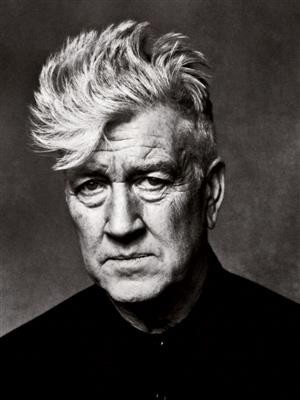
Biography
The pictures Lynch made throughout his life share the same preoccupations as his cinema: suburban surfaces disturbed by something rotting underneath, bodily decay rendered in thick impasto, figures dissolving into industrial residue. Francis Bacon was a formative influence, and the debt shows in the flattened perspectives, the bruised palettes, and the willingness to treat the human form as unstable material rather than dignified subject. Lynch drew also on Surrealism[1] and Art Brut, building semi-abstract canvases that resist legible narrative while radiating menace.
His gallery career ran parallel to his filmmaking across more than five decades. A major retrospective, The Air is on Fire, opened at the Fondation Cartier pour l'art contemporain in Paris in March 2007[1], and subsequent survey shows appeared in Brisbane, Poland, and Maastricht. He worked in painting, drawing, photography, printmaking, lithography, and sculpture, as well as composing music and recording ambient sound.
Lynch died on 15 January 2025[1], ten days before his seventy-ninth birthday. The paintings are stranger than most of his films, and that is a significant observation.
Timeline
- 1946Born in Missoula, Montana, on 20 January.
- 1967Created "Six Men Getting Sick" at the Pennsylvania Academy of the Fine Arts (PAFA); this was a looped animated projection onto a sculptural painting.
- 2007A major retrospective, "The Air is on Fire", opened at the Fondation Cartier pour l'art contemporain in Paris.
- 2025Died on 15 January, ten days before his seventy-ninth birthday.
Notable Works
Tap to view larger.
Next stop
Surrealism →
Explore the artists and ideas of Surrealism.
Related Artists


Frequently Asked Questions
What is David Lynch known for?
David Lynch is known for his paintings and films, which often explore disturbing themes. His artwork shares similar themes to his cinema, such as suburban unease and bodily decay.What is David Lynch's most famous work?
David Lynch is a director, screenwriter, producer, and visual artist. He is known for his surrealist films, television programmes, and other works. Although it is subjective, many would consider *Mulholland Drive* (2001[1]) to be Lynch's most famous film. It is a psychological thriller set in Hollywood, and it concerns an aspiring actress and an amnesiac woman who become entangled. The film is noted for its non-linear narrative, surreal imagery, and exploration of the dark side of Hollywood. Other works that might be considered his most famous include the television series *Twin Peaks* (1990-1991[1], 2017), and the films *Eraserhead* (1977), *The Elephant Man* (1980), *Blue Velvet* (1986), and *Lost Highway* (1997). *Twin Peaks*, in particular, had a significant effect on television. These productions share similar qualities, such as dream logic, unsettling atmospheres, and combinations of humour and horror.What should I know about David Lynch's prints?
When considering David Lynch's prints, it is helpful to understand the different types of prints available. Original prints, such as woodcuts, etchings, or lithographs, are produced by the artist's own hand, with the work created specifically to be a print. Each one is considered an original because the artist directly creates the artwork on the plate, block, stone, or screen. Offset reproductions, also known as posters, are created using photochemical means. Giclée prints are fine art prints made using inkjet technology. Canvas transfers involve transferring an image onto canvas, giving it the appearance of a painting. Original prints are usually sold in limited editions, commanding higher prices than posters, which are not numbered. The number of prints in an edition is limited by the number of impressions that can be made before the plate wears out, or by the publisher to increase a print’s value. Prices vary depending on factors such as the artist’s reputation, the image's popularity, and the quality of materials used.What style or movement did David Lynch belong to?
David Lynch is associated with Surrealism[1], an artistic and literary movement that began in the early 1920s. Surrealism is not defined by shared visual qualities; instead, it is more of a method of combining visual references to the conscious and unconscious. Surrealist artists aimed to liberate the imagination by creating illogical and strange scenes from everyday objects; they sought to challenge viewers' assumptions and explore the unconscious mind. Salvador Dalí, René Magritte, Max Ernst, and Joan Miró are other artists associated with the movement. Dalí, in collaboration with Luis Buñuel, produced the first Surrealist film, *Un Chien Andalou*, in 1929. The film uses 'shock montage' to show bizarre and shocking images, reflecting conscious psychic automation. Surrealism relies on the contrast created by combining the realistic and the fantastical.What was David Lynch known for?
David Lynch is known as a film director who employs a surrealist style. Surrealism[1], which began in the early 20th century, is a movement that juxtaposes realistic and fantastical elements. Surrealist artists render everyday objects in unfamiliar ways, with the intention to jolt viewers out of their familiar assumptions. Artists such as Salvador Dalí, René Magritte, and Joan Miró took recognisable objects and presented them in unusual ways. Magritte often painted bowler hats, which some believe represented bourgeois life, contrasting with the more fantastical elements of his work. Dalí often included ants and eggs in his work. Surrealist film, such as *Un Chien Andalou* (1929), uses bizarre and shocking images and shock montage to create a dreamlike effect.Where can I see David Lynch's work?
Works by David Lynch can be viewed in several museums. These include the Museum of Modern Art in New York; the Los Angeles County Museum of Art (LACMA) in Los Angeles; the Metropolitan Museum of Art in New York; the Minneapolis Institute of Arts; the Royal Ontario Museum in Toronto; and the Virginia Museum of Fine Arts in Richmond. Other museums that hold works by artists from a similar period are the National Museums of Scotland (Royal Museum) in Edinburgh; the Victoria & Albert Museum in London; the Brighton Museum & Art Gallery; and the Manchester Art Gallery. You may also find artworks at the Yale University Art Gallery in New Haven; the Solomon R Guggenheim Museum in New York; the Hispanic Society of America Museum in New York; the Whitney Museum of American[1] Art in New York; the George Eastman House in Rochester; the Pennsylvania Academy of the Fine Arts in Philadelphia; the Philadelphia Museum of Art; the Carnegie Museum of Art in Pittsburgh; the Corcoran Gallery of Art in Washington DC; the Hirshhorn Museum and Sculpture Garden in Washington DC; the Library of Congress; the National Gallery of Art in Washington DC; the National Museum of American Art in Washington DC; and the Phillips Collection in Washington DC.Where was David Lynch from?
David Lynch was born in 1946[1] in Missoula, Montana. His family moved frequently during his early years, due to his father's work as a research scientist for the US Department of Agriculture. Lynch spent portions of his childhood in Idaho and Washington state. Later, the family relocated to Alexandria, Virginia, a suburb of Washington, D.C. These varied environments had an impact on his developing artistic sensibilities. Lynch studied painting at the School of the Museum of Fine Arts, Boston, but left after a year to study at the Pennsylvania Academy of the Fine Arts in Philadelphia. He committed himself to becoming an artist during his time in Philadelphia, where he made short experimental films.Who did David Lynch influence?
David Lynch's influence can be traced through various contemporary artists. One notable example is Ryan Trecartin, an American[1] artist who creates films exploring the impact of digital technology on communication and interaction. Trecartin's work, often made in collaboration with Lizzie Fitch, uses sounds, colours, and editing techniques to interrogate and parody the conventions of the digital age. His films feature performers with outlandish wigs and make-up, reminiscent of Andy Warhol's superstars. Trecartin's approach owes a debt to the experimental film-making career of Warhol, an important figure in American Pop art. Warhol's obsessions, such as celebrity, shopping, socialising, and sex, are now central to online culture. Jeremy Deller even suggested that Warhol was "a one-man Internet before it was invented." Warhol's brand of Pop has been a fundamental influence on Trecartin, a figurehead of millennial artists responding to the Internet and social media.Who influenced David Lynch?
David Lynch has cited a variety of figures as inspiration. The Zen master Tanaka Sensei, who taught Lynch "five days equals five seconds", appears to have been important. Lynch also visited fresco cycles by Italian Renaissance artists in Tuscany, admiring how they created narrative sequences within architectural spaces. He considers these works to be early forms of cinema and installation art. Other artists admired by figures in Lynch's milieu included Piero della Francesca, Titian, Rembrandt, Utamaro, Rubens, Velasquez, Goya, Fragonard, Ingres, Corot, Seurat, Renoir, Bonnard, Matisse and Miro. These artists were admired by William Baziotes, who felt that "unconscious collaboration" occurred among artists. Baziotes felt it was important for artists to see each other, to avoid isolation. He also noted the presence of Mondrian, Duchamp, and Max Ernst in the art community. Hans Hofmann and David Smith were important to another artist, who felt that healthy competition with other artists was helpful, and that it was important to have other artists one respects "out there". That artist was influenced by Analytic Cubism, early Kandinsky, Miro, Matisse, and Mondrian.Why are David Lynch's works important today?
David Lynch's importance arises from his challenge to conventional artistic boundaries. Like conceptual artists such as Marcel Duchamp and John Cage, Lynch explores new ways of seeing and experiencing art. He questions the established rules and expectations within the art world, pushing the boundaries of what art can be. Lynch, similar to other artists, contests the limits that art has imposed on itself. He seeks to dissolve these limits by challenging traditional systems of judgement and encouraging a larger dialogue about the meaning and purpose of art. His work invites viewers to reconsider their understanding of art and its potential. He prompts a re-evaluation of artistic values; this makes his work relevant in contemporary discourse.What was David Lynch's art style?
Lynch's art style drew influence from Francis Bacon, Surrealism[1], and Art Brut. He created semi-abstract canvases that resisted clear narratives, while still conveying a sense of menace.
Sources
Editorial draws on the following primary and tertiary references for David Lynch.
- [1] wikipedia Wikipedia: David Lynch Used for: biography, birth dates, death dates, identifiers, movement attribution, nationality.
- [2] book Jesse Bryant Wilder, Art History For Dummies Used for: stylistic analysis.
- [3] book guggenheim-britishartnowame00wald Used for: biography.
- [4] book guggenheim-twopri00weis Used for: biography.
- [5] book Masterpieces of western art : a history of art in 900 individual studies from the Gothic to the present day Used for: biography.
- [6] book Alexander Alberro; Patricia Norvell (editors), Recording Conceptual Art _ Early Interviews with Barry, Huebler, Kaltenbach, LeWitt, Morris, Oppenheim, Siegelaub, Smithson, and Weiner by Patricia Norvell Used for: biography.
- [7] book Beckett, Wendy, Sister Wendy's odyssey : a journey of artistic discovery Used for: biography.
- [8] book Sherwin, Richard K(Author), Visualizing Law in the Age of the Digital Baroque : Arabesques & Entanglements (1) Used for: stylistic analysis.
Editorial overseen by Solis Prints. Sources verified 2026-09-30. Click a source for details, or hover over [N] in the page above to preview.
Editorial standardsMethodologyCorrectionsAI disclosureAbout the editorial team