



David Michael Hinnebusch
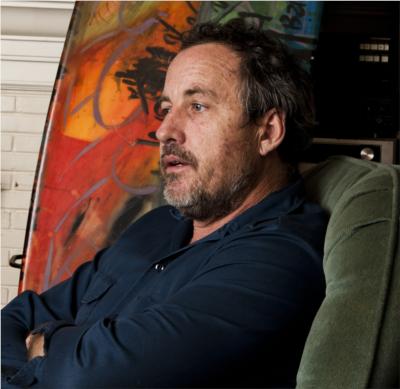
David Michael Hinnebusch arrived at painting by a route that included Africa, punk rock, and a long struggle with addiction. Born in Pittsburgh in August 1964[1], he grew up in an unusually peripatetic household: his father, an African linguistics scholar, relocated the family from Pennsylvania to Tanzania, back to Pittsburgh, then to Kenya, before finally accepting a professorship at UCLA. Los Angeles was where Hinnebusch came of age, and the city's subcultures absorbed him.
Biography
In 1983 he formed Entropy, a skater-hardcore punk band, throwing himself into the Los Angeles underground music and film scene. The autobiographical urgency of that milieu never left his work. Sobriety arrived in 1989 after years of struggle, and painting followed: a means of processing the debris of the previous decade and of channelling the same restless energy that had gone into punk into something that would last.
His style is expressionistic, mixing media freely, the compositions raw and frontal in the manner of Neo-Expressionism. The subject matter draws heavily on his own history: the music scene, the chaos, the recovery. Between 1998 and 2008 he produced more than 400 works, a sustained burst of output for a Santa Monica studio that functioned as both archive and confessional. He has also self-published catalogues of his work, maintaining an independent practice outside institutional gallery structures.
Hinnebusch belongs to a generation of American[1] artists for whom authenticity meant biographical directness rather than formal distance.
Timeline
- 1964Born in Pittsburgh, Pennsylvania, in August. His father was an African linguistics scholar.
- 1983Formed Entropy, a skater-hardcore punk band, in Los Angeles.
- 1989Achieved sobriety after a long struggle with addiction.
- 1989Began painting as a means of processing past experiences.
- 1998Began a sustained period of artistic output, producing over 400 works in the following decade.
- 2008Concluded a period of intense artistic production at his Santa Monica studio.
- 2008Self-published catalogues of his work, maintaining an independent practice.
Notable Works
Tap to view larger.
Next stop
Browse the movements →
Every movement in the collection, from the Renaissance to Pop art.
Related Artists
_%E2%80%93_LOC.jpg)


Frequently Asked Questions
What should I know about David Michael Hinnebusch's prints?
David Michael Hinnebusch is an American[1] artist known for his printmaking, painting, and drawing. He was born in Cincinnati, Ohio, in 1948. Hinnebusch studied at the Art Academy of Cincinnati, earning a Bachelor of Fine Arts degree in 1971. He then attended Yale University, where he received a Master of Fine Arts degree in 1973. After his studies, Hinnebusch returned to Cincinnati. He taught at the Art Academy of Cincinnati for over 30 years. His prints often feature detailed, realistic imagery. Still life subjects appear frequently in his work. Hinnebusch's prints are created using various techniques, including etching and engraving. These methods allow for fine lines and tonal variations. His work can be found in many public and private collections. These include the Cincinnati Art Museum, the Indianapolis Museum of Art, and the Yale University Art Gallery. Hinnebusch's art has been exhibited in the United States and abroad.What style or movement did David Michael Hinnebusch belong to?
It is difficult to assign David Michael Hinnebusch to a single style or movement. Styles can be seen as responses to shared representations; a group of artists may develop similar techniques in response to similar goals. However, an artist's individual style also expresses their relation to the content of their work. Some art historians argue that a style is a historical particular, existing only during a specific period. After a movement concludes, artists can only paint "in the style of" that movement, rather than genuinely expressing it. For example, an artist who imitates abstract expressionism after its decline expresses a relationship to that style itself, not to the subject they are depicting. Without more information about Hinnebusch's working methods, artistic intentions, and the historical context of his art, it is impossible to place him definitively within a particular style or movement. Further research into his influences and artistic development would be needed.When did David Michael Hinnebusch live and work?
David Roland Smith, who later became known as David Michael Hinnebusch, was born on 9 March 1906, in Decatur, Indiana. He died on 23 May 1965, in an automobile accident near Bennington, Vermont. Smith studied at Ohio University, Athens, in 1924. During the summer of 1925, he worked as an automobile welder and riveter. In 1926, Smith moved to New York, where he studied at the Art Students League with Richard Lahey and John Sloan, and privately with Jan Matulka. He met John Graham in 1929, who introduced him to the welded steel sculpture of Picasso and Julio Gonzalez. That year, he bought a farm in Bolton Landing, near Lake George in upstate New York. Smith settled there permanently in 1940. Smith created sculpture for the WPA Federal Art Project in 1937. His first solo exhibition of drawings and welded steel sculpture took place at Marion Willard's East River Gallery in New York in 1938.Where can I see David Michael Hinnebusch's work?
To view works similar to David Michael Hinnebusch's, consider museums with collections of Art Deco and modernist art. In the United States, these include the Metropolitan Museum of Art (New York), the Museum of Modern Art (New York), the Los Angeles County Museum of Art, the Minneapolis Institute of Arts, the Charles Hosmer Morse Museum of American[1] Art (Winter Park, Florida), the Virginia Museum of Fine Arts (Richmond), and the Wolfsonian at Florida International University (Miami Beach). Also of note is the Yale University Art Gallery (New Haven, Connecticut), the Hirshhorn Museum and Sculpture Garden (Washington DC), and the National Museum of American Art (Washington DC). In Canada, the Royal Ontario Museum (Toronto) has relevant holdings. In the United Kingdom, visit the Victoria & Albert Museum (London), the Brighton Museum & Art Gallery, the Geffrye Museum (London), the Manchester Art Gallery, and the National Museums of Scotland (Edinburgh).Who did David Michael Hinnebusch influence?
David Michael Hinnebusch's artistic approach, as well as that of Wallace Berman, Edward Ruscha, and John Baldessari, helped transform photography from a medium constrained by the zone system into one entwined with American[1] consumerism, fashion, and even pornography. Heinecken confronted popular culture imagery, illustrating that photographic 'truth' was inevitably informed by cultural definition. Many of his ideas stemmed from an interest in randomness, chance, and arbitrary relationships. In his work, Heinecken revealed the cultural significance of two images coinciding. Heinecken's influence as a teacher at UCLA was also significant. He encouraged his students to approach art, especially photography, with experimentation and risk. His classroom became a place for dialogue and self-evaluation, an 'interpretive community' of instructors and students engaged in art-making and critique. At a Society for Photographic Education meeting in Chicago in 1965, Heinecken described his philosophy of art practice, stating that the chief aim of art is to refine a person's relationship to their existence through their work. He believed that the formal means towards that refinement must be open-ended, allowing for diverse manipulative directions.Why are David Michael Hinnebusch's works important today?
David Michael Hinnebusch (born 1948) is an American[1] artist known for his printmaking, specifically his serigraphs (screen prints). His work often depicts architectural subjects and cityscapes. Hinnebusch's prints are characterised by their clean lines and geometric forms. He reduces buildings and urban environments to their essential shapes. This approach results in images that are both abstract and representational. His prints offer a distilled view of the built environment. His work is important for several reasons. First, Hinnebusch's serigraphs demonstrate a mastery of the screen-printing technique. Second, his focus on architectural subjects provides a unique perspective on urban spaces. Third, his prints are aesthetically pleasing, with a strong sense of design and composition. Hinnebusch's prints appeal to those interested in architecture, urbanism, and fine art prints. His prints record a specific time in American art and culture.What was David Michael Hinnebusch's art style?
David Michael Hinnebusch's style is expressionistic, and he mixes media freely. His compositions are raw and frontal, in the manner of Neo-Expressionism.When was David Michael Hinnebusch born?
David Michael Hinnebusch was born in 1964[1].
Sources
Editorial draws on the following primary and tertiary references for David Michael Hinnebusch.
- [1] wikipedia Wikipedia: David Michael Hinnebusch Used for: biography, birth dates, death dates, identifiers, movement attribution, nationality.
- [2] book Palmer, Allison Lee, Historical Dictionary of Neoclassical Art and Architecture Used for: biography.
- [3] book Milam, Jennifer Dawn, Historical Dictionary of Rococo Art Used for: biography.
Editorial overseen by Solis Prints. Sources verified 2026-10-16. Click a source for details, or hover over [N] in the page above to preview.
Editorial standardsMethodologyCorrectionsAI disclosureAbout the editorial team