



David Scott
David Scott died in March 1849[2] at forty-two, leaving behind a body of work so ambitious in its range that it suggested a career still in its early stages. Born in Edinburgh in 1806[2] to the engraver Robert Scott, he trained first under his father before studying at the Trustees' Academy and spending an extended period in Rome from 1832[2], where he absorbed the grand historical manner he would spend his brief career pushing toward its limits.
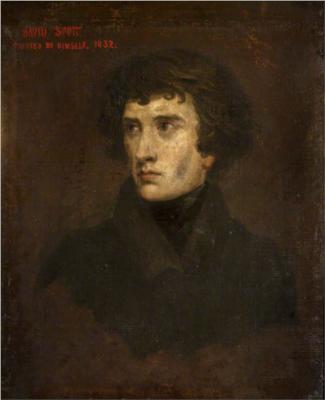
Biography
His subjects were drawn from literature, mythology, and scripture: not the polite corners of each but their most extreme passages. The 1842[2] painting "Vasco da Gama Encountering the Spirit of the Storm," now at Trinity House in Leith, shows the Portuguese explorer confronting the monstrous Adamastor, a scene from Camoes's "Lusiad" that combined physical drama with symbolic weight in ways that struck critics as both compelling and eccentric. A similar ambition drove the thirty-seven etchings he produced as illustrations to Coleridge's "Rime of the Ancient Mariner" in 1837, where the visual language answered the poem's intensity rather than merely illustrating its narrative.
Scott was elected to the Royal Scottish Academy in 1829[2], and "Descent from the Cross" (1835) and "Queen Elizabeth at the Globe Theatre" (1840) added to a reputation that remained contested. His combination of imaginative reach and technical force made him admired by a minority and puzzling to a majority. He died without achieving the recognition he sought; forty illustrations for "The Pilgrim's Progress" were published posthumously in 1850.
His brother, the painter and poet William Bell Scott, designed the monument to his memory, erected in Dean Cemetery, Edinburgh, in 1860.
Timeline
- 1806Born in Edinburgh to Robert Scott, an engraver.
- 1829Elected to the Royal Scottish Academy.
- 1832Moved to Rome for an extended period to study art.
- 1835Painted "Descent from the Cross".
- 1837Produced thirty-seven etchings as illustrations for Coleridge's "Rime of the Ancient Mariner".
- 1840Painted "Queen Elizabeth at the Globe Theatre".
- 1842Painted "Vasco da Gama Encountering the Spirit of the Storm", now at Trinity House in Leith.
- 1849Died in March, aged 42.
- 1850Forty illustrations for "The Pilgrim's Progress" were published posthumously.
Notable Works
Tap to view larger.
Next stop
Browse the movements →
Every movement in the collection, from the Renaissance to Pop art.
Related Artists


Frequently Asked Questions
What is David Scott known for?
David Scott is known for his ambitious paintings and etchings that combined physical drama with symbolic weight. His thirty-seven etchings illustrating Coleridge's "Rime of the Ancient Mariner" are particularly notable, as is his 1842[2] painting "Vasco da Gama Encountering the Spirit of the Storm."What is David Scott's most famous work?
David Wilkie, born in Fife in 1785, forms a Scottish artistic triumvirate with Henry Raeburn and Allan Ramsay. Wilkie is known for moralising domestic scenes in the manner of seventeenth-century Dutch painters such as Adriaen van Ostade and Gerard ter Borch; his art has parallels in the poetry of Robert Burns and Sir Walter Scott. His 1813[2] oil-on-panel painting, *The Letter of Introduction*, is among his best-known works. It appeals to viewers' emotions by contrasting the ruddy candour of a young man with the sceptical distrust of an elderly gentleman. The painting is in the collection of the National Gallery of Scotland, Edinburgh. J. M. W. Turner painted *Peace Burial at Sea* to express his grief at learning of Wilkie’s death in 1841.What should I know about David Scott's prints?
David Scott (born in Edinburgh, 1811[2]; died 1890) was a painter, etcher, illustrator, critic, and poet. The younger brother of an artist, whose works he also engraved, Scott studied with his father and at the Trustees Academy in Edinburgh. He later moved to London, where he etched, engraved, and painted. Scott was a prolific etcher, particularly of book illustrations. Examples include Hall’s *Book of British Ballads* (1842), his own *Poems* (1854), Bunyan’s *Pilgrim’s Progress* (1857), and Bible illustrations (1866). The British Museum holds a collection of three bound volumes, annotated by Scott, which form the most complete record of his printed work. This collection contains 107 etchings and 83 reproductions and wood engravings after his designs. His portrait etchings are particularly well regarded. The British Museum owns etched portraits of Swinburne (dated 1860), Christina Rossetti (aged seven), Dante Gabriel Rossetti (aged twenty-five), Lawrence Alma-Tadema and his wife Laura, and Alice Boyd (1862). In 1878, he reproduced some work by William Blake, whose style he admired.What style or movement did David Scott belong to?
David Scott was part of the Neoclassical movement. He initially admired Rococo artists such as François Boucher. However, his style shifted after training with Joseph-Marie Vien and at the Académie Royale de Peinture et de Sculpture. His earlier work, such as Combat of Mars and Minerva, still showed Rococo influences, with its light colour, loose brushwork, and asymmetrical composition. After returning to Paris in the 1780s, his paintings, such as Oath of the Horatii, displayed Neoclassical characteristics. These included serious subject matter, subdued colour, tight brushwork, and clear linear perspective. David's approach involved focusing attention on individual figures rather than overall theatrical interaction, a quality of late Baroque and Rococo styles. He aimed for unity through geometric shapes and subtle repetition, moving away from the anxious rigidity of earlier works. His exposure to discoveries at Ostia, Hadrian’s villa, Herculaneum, and Pompeii further shaped his Neoclassical style.What techniques or materials did David Scott use?
David Scott had experience with metalwork before he formally studied painting. His knowledge of metalwork came from factory experience. He duplicated factory production equipment in his workshop. Scott's early constructions in the 1930s used lead, brass, and aluminium, sometimes combined with stone and coral. By the mid-1930s, he was primarily using gas welding. Arc welding appeared in his work around 1939. Scott described his method as functional, like the making of a motor car. He aimed to arrive at a functional form in the most efficient manner. He used castings, forging, riveting, arc and gas welding, brazing, silver solder, bolts, screws, and shrink fits. Scott used steel, which could be stainless, painted, lacquered, waxed, processed, or electroplated. Steel can be cast, and it has high tensile strength. Soft steel can bend, yet have a tensile strength of 30,000 pounds to one square inch. It can be drawn, cupped, spun, and forged. It can be cut and patterned by acetylene gas and oxygen and welded both electrically and by the acetylene oxygen process. It can be chiselled, ground, filed, and polished. Welds can possess greater strength than the parent metal.When did David Scott live and work?
David Scott (1806[2]-1849[2]) was a Scottish historical painter. He was born in Edinburgh, the son of Robert Scott, an engraver. He trained as an artist in his father's studio, and later at the Trustees' Academy. Scott began exhibiting his work in Edinburgh in the 1820s. His early paintings show an interest in historical and literary subjects. In the 1830s, he spent time in Italy, where he studied the works of the Old Masters. This experience had a significant impact on his artistic style. He began to produce larger, more ambitious compositions. Upon his return to Scotland, Scott continued to paint historical and allegorical subjects. He sought commissions for public buildings. He completed a series of paintings for the Scottish National Gallery. These paintings illustrate scenes from Scottish history. Scott's work was not always well-received during his lifetime. Some critics found his style to be unconventional. Since his death, his reputation has grown. He is now considered to be one of the most important Scottish painters of the 19th century.Where can I see David Scott's work?
It is difficult to say where you can view the art of David Scott, as there are many artists with that name. However, several museums hold collections of Pop Art and Art Deco works, movements with which he is associated. You can view Art Deco works at the Charles Hosmer Morse Museum of American Art (Winter Park, Florida), the Los Angeles County Museum of Art, the Metropolitan Museum of Art (New York), the Minneapolis Institute of Arts, the Museum of Modern Art (New York), the Royal Ontario Museum (Toronto), the Virginia Museum of Fine Arts (Richmond), and the Wolfsonian at Florida International University (Miami Beach). In the UK, you might try the Bakelite Museum (Williton), Brighton Museum & Art Gallery, the Geffrye Museum (London), Manchester Art Gallery, the National Museums of Scotland (Edinburgh), and the Victoria & Albert Museum (London). Pop Art is held at the Menil Collection (Houston), the Centre Georges Pompidou (Paris), and the Gagosian Gallery (New York).Where was David Scott from?
David Scott's daughters, Harriet and Helena Scott, grew up in Sydney, around the Rocks area. Their father, Alexander Walker Scott, was educated at Cambridge University. The family later moved to Ash Island, near Newcastle, at the mouth of the Hunter River, in 1846[2]. There, Alexander devoted himself to natural history, particularly entomology. Their home was visited by distinguished artists and scientists. Ludwig Leichhardt, a naturalist and explorer, visited Ash Island in 1842; he described it as a 'romantic place'. Both Harriet and Helena showed an aptitude for art, and were home-tutored. They also had lessons from Conrad Martens, a well-known painter in the colony. Their mother, Harriet Calcott, also painted botanical subjects.Who did David Scott influence?
David Scott's direct influence is difficult to trace, but some South African artists working in the 1960s emulated the style of earlier black modernists. Gerard Sekoto, in particular, was regarded as a father figure by many, due to his success and move to Paris. Artists such as Ephraim Ngatane, Isaac Hlatshwayo, and Louis Maqhubela, associated with the "township art" movement, followed a model of depicting everyday life in black urban areas. This style, often executed in watercolour or graphic media, differed from the more expressionistic forms used by artists like Ezrom Legae and Sidney Kumalo. David Koloane, who began his career in the late 1960s, worked with Louis Maqhubela and later founded the first black-run gallery in Johannesburg in 1977. He witnessed many art movements in South Africa from the 1960s onward. The work of artists like Sekoto, Ngatane, and Dumile Feni also served as examples for later generations, especially those who gained recognition before apartheid.Who was David Scott?
David Scott (1785-1841[2]) was a Scottish artist. David Wilkie, Henry Raeburn, and Allan Ramsay form a triumvirate of Scottish art. Wilkie, the son of a minister in Fife, specialised in moralising domestic scenes in the manner of seventeenth-century Dutch genre painters; Adriaen van Ostade and Gerard ter Borch. Much of Wilkie’s art found its parallel in the poetry of Robert Burns and Sir Walter Scott. One example is *The Letter of Introduction*. In it, a young man presents a letter to an elderly gentleman, who regards him with suspicion, an attitude reflected by his dog. The painting appeals to our emotions by juxtaposing the lad’s innocent country candour with the old man’s sidelong glance of sceptical distrust, suggestive of a life spent in the corrupt city. J. M. W. Turner painted *Peace-Burial at Sea* to express his grief at learning about Wilkie’s death while coming home from a trip to the Middle East.Why are David Scott's works important today?
It is difficult to assess David Scott's importance without more information about his work. However, some broader factors about contemporary art may be relevant. Contemporary art often reflects current events and social issues. The rise in popularity of African American art since the 2008 debut of the exhibition '30 Americans' demonstrates the power of art to change the trajectory of art history. This landmark exhibition, which toured the United States for over a decade, increased the appetite for African American art among museum audiences and collectors. The collecting vision of the Rubell Museum in Miami, with its nearly 100,000 square feet of exhibition space, resonates with that of Albert Barnes. This resonance clarifies the ways in which major museums are still failing to collect expansively and aggressively in areas that will ensure their continued relevance. The power of art historians and critics to influence an artist's career trajectory is also a factor.What was David Scott's art style?
David Scott absorbed the grand historical manner during his time in Rome. He spent his career pushing this style toward its limits.
Sources
Editorial draws on the following primary and tertiary references for David Scott.
- [1] museum Paisley Museum Used for: museum holdings.
- [2] wikipedia Wikipedia: David Scott Used for: biography, birth dates, death dates, identifiers, movement attribution, nationality.
- [3] book Beard, Lee, 1973- author, Butler, Adam, author; Van Cleave, Claire, author; Fortenberry, Diane, author; Stirling, Susan, author, Beard, Lee, 1973- author, Butler, Adam, author; Van Cleave, Claire, author; Fortenberry, Diane, author; Stirling, Susan, author - The Art Book_ New Edition, Mini Format Used for: biography.
- [4] book Milam, Jennifer Dawn, Historical Dictionary of Rococo Art Used for: biography.
- [5] book Masterpieces of western art : a history of art in 900 individual studies from the Gothic to the present day Used for: biography.
Editorial overseen by Solis Prints. Sources verified 2026-09-30. Click a source for details, or hover over [N] in the page above to preview.
Editorial standardsMethodologyCorrectionsAI disclosureAbout the editorial team