



Desiderio da Settignano
Desiderio da Settignano came from a village north-east of Florence that had long supplied the city with stonemasons and carvers. Born around 1430[1], he trained with Donatello and worked exclusively in marble, carving his way to a reputation for delicacy that would outlast his short life; he died in 1464[1], still in his early thirties.
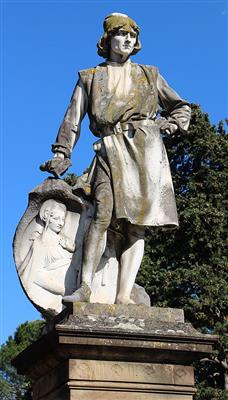
Biography
Where Donatello was volatile and expressive, Desiderio specialised in quiet refinement. His portraits of young women and children carried a lightness that his teacher never attempted, and Vasari observed that he was "one of the fortunate few who, without labor, achieved loveliness." The comparison was not merely flattering: a girl's bust in the Bargello's Donatello room shows a finish that demonstrably exceeds the older master's on similar subjects.
His portrait of Marietta Strozzi, a young Florentine heiress, exists in three versions, one of which is now at the National Gallery of Art in Washington DC. His relief of the Young Christ with Saint John, also at the NGA, barely exceeds a quarter of an inch in depth, yet achieves what has been called a "vaporous, apparitionlike quality" in the Christ figure's head.
Desiderio died young enough that his full range was never tested. Verrocchio's later synthesis of Donatello's vitality with Desiderio's delicacy suggests that practitioners in the generation after him recognised exactly what had been lost. His specialisation was narrow but without equal in fifteenth-century Florence.
Timeline
- 1430Born in Settignano, near Florence. His family had a long history of stonemasons and carvers.
- 1430Trained with Donatello.
- 1430Worked exclusively in marble.
- 1430Created a portrait of Marietta Strozzi, a young Florentine heiress; three versions of this work exist.
- 1430Created a relief of the "Young Christ with Saint John".
- 1464Died in Florence in his early thirties. The cause of death is not specified.
Notable Works
Tap to view larger.
Next stop
Browse the movements →
Every movement in the collection, from the Renaissance to Pop art.
Related Artists




Frequently Asked Questions
What is Desiderio da Settignano known for?
Desiderio da Settignano is known for his delicacy in marble carving. He specialised in quiet refinement, particularly in portraits of young women and children. According to Vasari, he was "one of the fortunate few who, without labor, achieved loveliness."What is Desiderio da Settignano's most famous work?
Desiderio da Settignano (circa 1430[1]-1464[1]) was a Florentine sculptor of the early Renaissance. Although he died young, he is regarded as one of the most important sculptors of his generation. While it is difficult to name one single "most famous" work, several pieces are particularly well known. These include the *Marsuppini Tomb* in the Basilica di Santa Croce, Florence, noted for its innovative design and delicate carving. His *Bust of a Young Woman* in the Bargello Museum, Florence, is also highly regarded; it shows his skill in capturing naturalism and emotion. Other significant works include the *Tabernacle of the Sacrament* in the church of San Lorenzo, Florence, and various marble reliefs of the Madonna and Child. These demonstrate Desiderio's talent for creating gentle, intimate scenes. His style is characterised by its grace, technical skill, and emotional expressiveness, influencing later sculptors.What should I know about Desiderio da Settignano's prints?
Desiderio da Settignano (circa 1430[1]-1464[1]) was a Florentine sculptor of the early Renaissance. He died young, and his direct printmaking activity is little known. However, like other Italian Renaissance workshops, his sculptures were sometimes copied in prints by professional printmakers. These prints after his works circulated his artistic ideas to a wider audience. Printmaking during the Italian Renaissance served varied purposes. Print collections allowed those with knowledge of ancient sculpture to see a wide range of works at one time. The quality of prints varied, with draughtsmen and engravers signing their work. Sculpture galleries sometimes became associated with academies, where artists could study both sculpture and engraving. The publication of prints extended the reach of these academies, disseminating knowledge and artistic styles beyond their physical locations.What style or movement did Desiderio da Settignano belong to?
Desiderio da Settignano (1428-1464[1]) is associated with the Early Renaissance style, also known as the Quattrocento. He was a student of Donatello, and, like other sculptors of the period, such as Nanni di Banco, he drew inspiration from classical antiquity. Desiderio's style is characterised by its delicacy and charm, particularly in his portrayals of youthful figures. He worked exclusively in marble, and is especially known for his portraits of women and children. Giorgio Vasari noted that Desiderio achieved loveliness without labour. While Donatello explored dramatic energy and movement, Desiderio focused on refinement. His work features an exquisite finish, a quality that distinguishes him from Donatello. Examples of his work include portraits of Marietta Strozzi, and reliefs such as the Young Christ with Saint John, where the shallow relief creates an ethereal quality.What techniques or materials did Desiderio da Settignano use?
Desiderio da Settignano worked primarily with marble. Like other Renaissance sculptors, he employed a subtractive carving method. The sculptor would begin by drawing or painting an outline on one side of a rectangular block. Assistants would then use axes to cut away the surplus stone. The basic form of the figure was established in rough using punches struck with mallets. The form would be gradually defined using claw chisels and drills. Fine details and smooth surfaces would then be achieved with flat chisels. The slow process of smoothing and polishing continued as the workshop team used metal rasps, emery (crushed stone), and pumice. Donatello's *St George Killing the Dragon* (c. 1415) uses *rilievo schiacciato* (shallow relief) to create atmospheric perspective. Figures in the foreground are carved away from the block. The background is suggested by exploiting the grainy texture of the marble through incisions. Until about 1500, sculptors typically enhanced stone carvings by gilding or colouring the eyes, hair, and other details.What was Desiderio da Settignano known for?
Desiderio da Settignano (circa 1430[1]-1464[1]) was an Italian Renaissance sculptor. Born Desiderio de Bartolomeo di Francesco Settignano, he is best known for his marble work. He trained in the Florentine workshop of Donatello. Desiderio's style is characterised by its delicate surfaces. His sculptures often have a soft, almost dreamlike quality. He was a master of low relief (rilievo schiacciato). This technique allowed him to create a sense of depth with minimal carving. Desiderio's most famous works include his marble tabernacle for the Florentine church of San Lorenzo. Completed posthumously by assistants, the tabernacle shows his skill in combining architectural elements with sculptural decoration. Other notable pieces include his portrait busts of children and women, such as the marble bust of Marietta Strozzi. These busts are celebrated for their naturalism and emotional expressiveness. Although his career was short, his contributions had an impact on the development of Renaissance sculpture, especially in Florence.When did Desiderio da Settignano live and work?
Desiderio da Settignano was born in Settignano, near Florence, around 1430[1], and he died in Florence in 1464[1]. His short career occurred during the early Italian Renaissance. Desiderio's family were stonemasons. He likely trained in a workshop, perhaps with Donatello or Bernardo Rossellino. He became a master in the Florentine sculptors' guild in 1457. His sculptures are admired for their technical skill, surface finish, and emotional expression. His work often features children and Madonnas. Desiderio worked primarily in marble, and he is known for his low-relief carving technique (rilievo schiacciato). Major works by Desiderio include the Tomb of Carlo Marsuppini in Santa Croce, Florence, and the tabernacle of the Sacrament in San Lorenzo, also in Florence. The Louvre Museum in Paris holds his marble bust of a young boy. The Victoria and Albert Museum in London has a relief of the Madonna and Child. These works display his talent for capturing human emotion and his mastery of marble carving.Where can I see Desiderio da Settignano's work?
Desiderio da Settignano (circa 1430[1]-1464[1]) was a Florentine sculptor of the Early Renaissance. Although his career was short, due to his early death, his marble sculpture was highly regarded. Many examples of Desiderio's sculpture remain in Florence. The Museo del Bargello holds several important works. These include the marble bust of Marietta Strozzi, and the relief of the *Martyrdom of Saint John the Baptist*. The Louvre, in Paris, also possesses a marble bust of a *Young Woman* by Desiderio. Desiderio's work can be seen in religious settings, too. His tomb of Carlo Marsuppini (completed 1453) is located in the Basilica di Santa Croce, Florence. The church of San Lorenzo, Florence, contains Desiderio's marble tabernacle of the Sacrament. This piece, finished by assistants after Desiderio's death, shows his skill in combining delicate details with a larger architectural structure. These Florentine locations offer the most comprehensive view of his artistic output.Where was Desiderio da Settignano from?
Desiderio da Settignano, an Italian Renaissance sculptor, was from Settignano, a village near Florence. He was born there circa 1430[1]; his birth name was Desiderio di Bartolomeo di Francesco Barducci. Settignano, known for its quarries, had a strong connection to stoneworking and sculpture. Giorgio Vasari, in his *Lives of the Artists*, noted Desiderio's origins. Vasari stated that Desiderio was "born in Settignano, a village three miles distant from Florence, which is full of stone cutters and sculptors". This environment likely influenced Desiderio's early exposure to sculpture. Desiderio's career was centred in Florence. He became a master sculptor, working primarily in marble. His sculptures often featured delicate and refined details. He died in Florence in 1464[1]. Although his career was cut short, his contributions to Renaissance sculpture are significant, particularly his influence on portraiture and relief sculpture.Who did Desiderio da Settignano influence?
Desiderio da Settignano (circa 1430[1]-1464[1]) was a sculptor working in Florence. Vasari said of him, 'He was one of the fortunate few who, without labour, achieved loveliness.' He was a student of Donatello, though less versatile. Desiderio specialised in youthful figures, working only in marble. His portraits of young women and children display delicacy and charm. One example is the portrait of Marietta Strozzi; three versions exist, including one at the National Gallery of Art. Another is his relief of the Young Christ with Saint John, also at the National Gallery of Art. Antonio Rossellino (circa 1427-1478[1]) and Andrea del Verrocchio (1435-1488) were influenced by Desiderio's style. Verrocchio combined Donatello's vitality with Desiderio's delicacy, achieving what some consider a supreme achievement.Who influenced Desiderio da Settignano?
Desiderio da Settignano (circa 1430[1]-1464[1]) was part of a generation of sculptors indebted to Donatello. However, these artists developed highly individual styles. Desiderio's work is marked by delicacy and refinement, especially in his portraits of women and children. According to Vasari, Desiderio was one of the fortunate few who achieved loveliness without labour. His specialty was youthful figures, working exclusively in marble. Examples include the portrait of Marietta Strozzi, a young heiress, and the relief of the Young Christ with Saint John. In the latter, the relief is very shallow, giving the head of Christ an ethereal quality. A girl's bust in the Museo Nazionale shows an exquisite finish, a quality that Donatello did not attain or aspire to.Who was Desiderio da Settignano?
Desiderio da Settignano (circa 1430[1]-1464[1]) was a sculptor in Florence. He came from Settignano, a town that produced stonemasons and carvers. He was a student of Donatello, though less versatile. Desiderio specialised in youthful figures, and worked only in marble. Giorgio Vasari wrote that Desiderio "was one of the fortunate few who, without labour, achieved loveliness." Desiderio was successful with portraits of young women and children. One example is his portrait of Marietta Strozzi, of which there are three versions; one is held at the National Gallery of Art. Marietta Strozzi was a young heiress. Desiderio's relief of the Young Christ with Saint John is also at the National Gallery of Art. His work is known for its delicacy and refinement. A girl's bust in the Museo Nazionale shows a finish that Donatello did not achieve or aspire to.
Sources
Editorial draws on the following primary and tertiary references for Desiderio da Settignano.
- [1] wikipedia Wikipedia: Desiderio da Settignano Used for: biography, birth dates, death dates, identifiers, movement attribution, nationality.
- [2] book Judith Anne Testa, An Art Lover's Guide to Florence Used for: biography.
- [3] book Ferdinand Schevill, Medieval and Renaissance Florence 2 Used for: biography, stylistic analysis.
- [4] book Miles J. Unger, Michelangelo Used for: stylistic analysis.
- [5] book Christensen, Erwin Ottomar, 1890-, The history of Western art Used for: biography, stylistic analysis.
Editorial overseen by Solis Prints. Sources verified 2026-09-22. Click a source for details, or hover over [N] in the page above to preview.
Editorial standardsMethodologyCorrectionsAI disclosureAbout the editorial team