



Dirck van Baburen
- Utrecht Caravaggism
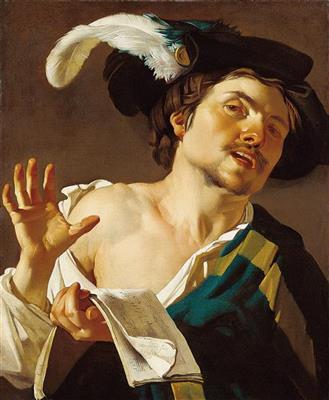
Dirck van Baburen arrived in Rome around 1612[1], a young painter from Utrecht stepping into the world Caravaggio had upended just a decade earlier. He had trained under Paulus Moreelse, one of the founders of Utrecht's painters' guild, who had himself been in Rome in the 1590s and seen Caravaggio's early work. In Rome, Baburen shared quarters near Santa Maria del Popolo with fellow Dutchman David de Haen, giving him direct access to the two Caravaggio canvases in the Cerasi Chapel. He also became parish neighbours with Bartolomeo Manfredi, Caravaggio's most systematic follower.
Biography
The commissions came quickly. Marchese Vincenzo Giustiniani, who owned more Caravaggio paintings than any other collector in Rome, commissioned a Christ Washing the Feet of the Apostles (1615[1], Gemäldegalerie, Berlin). Cardinal Scipione Borghese followed with a Capture of Christ (1615). The defining project was the decoration of the Chapel of the Pietà at San Pietro in Montorio (1617), a collaborative scheme with de Haen for the Spanish Cussida family, to which Baburen contributed three large canvases including the Entombment. A letter of around 1620 by Giustiniani names "Teodoro" (Baburen's Italian alias) alongside Rubens, Ribera, and Honthorst as painters who work directly from nature.
Baburen returned to Utrecht in 1622[1] and almost immediately abandoned religious subjects for the genre scenes that sold in the Dutch[1] market. The Procuress (1622, Museum of Fine Arts, Boston) updates a traditional moralising subject through the Caravaggist vocabulary: three-quarter figures pushed close to the picture plane, dramatic chiaroscuro, and a broad application of cool colour. The painting later appeared twice in the background of canvases by Vermeer.
He died in Utrecht in 1624[1], aged around 29. The brevity of his career makes what he produced in Rome and Utrecht all the more concentrated.
Timeline
- 1595Born in Utrecht.
- 1612Arrived in Rome, having trained with Paulus Moreelse.
- 1615Marchese Vincenzo Giustiniani commissioned "Christ Washing the Feet of the Apostles". Cardinal Scipione Borghese commissioned "Capture of Christ".
- 1617Contributed three canvases, including "Entombment", to the Chapel of the Pietà at San Pietro in Montorio.
- 1622Returned to Utrecht and painted "The Procuress".
- 1624Died in Utrecht, aged around 29. The cause of death is not mentioned.
Notable Works
Tap to view larger.
Next stop
Browse the movements →
Every movement in the collection, from the Renaissance to Pop art.
Related Artists


Frequently Asked Questions
What is Dirck van Baburen known for?
Dirck van Baburen is known for painting in the Caravaggist style after his arrival in Rome around 1612[1]. He received commissions from Marchese Vincenzo Giustiniani and Cardinal Scipione Borghese, and he contributed three large canvases to the Chapel of the Pietà at San Pietro in Montorio.What is Dirck van Baburen's most famous work?
It is difficult to name Dirck van Baburen's single 'most famous work' with certainty. He produced several history paintings and genre scenes that are well known. He was a member of the Utrecht School, painting in a style influenced by Caravaggio. His paintings include religious subjects, such as *Christ and the Woman Taken in Adultery*, as well as mythological scenes, including several versions of *Apollo and Daphne*. He also produced history paintings, such as *The Continence of Scipio*. These works are held in major museum collections, including the Louvre in Paris, the Musée Condé in Chantilly, the Pushkin Museum in Moscow, and the Metropolitan Museum of Art in New York.What style or movement did Dirck van Baburen belong to?
Dirck van Baburen is associated with the Utrecht Caravaggisti, a group of Dutch[1] artists active in Utrecht during the early 17th century. He likely trained with Paulus Moreelse, who had earlier exposure to Caravaggism. Around 1612[1], Baburen went to Rome, where he began painting in the style of Caravaggio. In Rome, he shared living quarters with David de Haen, and he became acquainted with Bartolomeo Manfredi, a close follower of Caravaggio. Baburen's Roman patrons included Marchese Vincenzo Giustiniani and Cardinal Scipione Borghese. He received a commission, shared with de Haen, to decorate the Chapel of the Pietà in the Spanish Church of San Pietro in Montorio (1617). Baburen remained in Rome until 1622, then returned to Utrecht, where he became one of the main figures of the Utrecht Caravaggisti, along with Hendrick Terbrugghen, Gerrit van Honthorst, and Jan van Bijlert. The group brought the Caravaggist style to Holland, using marked chiaroscuro, half-figures, dark backgrounds, and depictions of musicians and gamblers.What techniques or materials did Dirck van Baburen use?
Dirck van Baburen's painting methods involved techniques typical of the early 17th century. Like other Baroque painters, he likely loaded his palette with a limited number of tints, using them only for the specific passage he planned to complete in that stage of the work. Examination of paintings from the period reveals the use of materials like linseed oil, and sometimes walnut oil for delicate tints. Resin-oil varnishes were favoured, considered more suitable for harsher Northern climates. Pigments used at the time included those derived from minerals, such as the copper-based verdigris, and the mercuric sulphide vermillion. These materials were commonly available from apothecaries and specialist dealers. The preparation and handling of these pigments, rather than their manufacture, occupied most painters.What was Dirck van Baburen known for?
Dirck van Baburen (circa 1595[1]-1624[1]) was a Dutch[1] painter known for his involvement with the Utrecht Caravaggisti. He trained in Utrecht with Paulus Moreelse, who had earlier encountered Caravaggio's work in Rome. Around 1612[1], Baburen travelled to Rome, where he painted in the Caravaggist style. He shared lodgings with David de Haen, near Santa Maria del Popolo church, where Caravaggio's Cerasi Chapel works could be studied. Baburen's exposure to Bartolomeo Manfredi, a close follower of Caravaggio, further influenced his artistic direction. In Rome, Baburen secured patronage from Marchese Vincenzo Giustiniani, for whom he painted 'Christ Washing the Feet of the Apostles' (1615), and Cardinal Scipione Borghese, who commissioned 'The Capture of Christ' (1615). With De Haen, he contributed to the decoration of the Pietà Chapel in San Pietro in Montorio (1617), creating 'Christ in the Mount of Olives', 'Road to Calvary', and 'Entombment'. Returning to Utrecht by 1622, Baburen shifted towards genre scenes, exemplified by 'The Procuress' (1622), updating the theme of prostitution with Caravaggist elements. In 1622, along with Hendrick Terbrugghen, he executed a series of emperors' portraits for Prince Frederick Henry of Orange.When did Dirck van Baburen live and work?
Dirck van Baburen was a Dutch[1] Golden Age painter. He was born around 1595[1] in Wijk bij Duurstede, near Utrecht. He died relatively young, in 1624[1], in Utrecht. Baburen may have been a pupil of Paulus Moreelse. Around 1611[1], he is recorded in the Utrecht Guild of Saint Luke. Sometime between 1612 and 1615, he travelled to Rome. There, he associated with other Dutch and Flemish painters, who were known as the "Bentvueghels". These artists gave each other nicknames; Baburen's was "Biervlieg" or "beer fly". In Rome, he encountered the work of Caravaggio and his followers. He worked with other northern European painters such as David de Haen and the Fleming, Jan van Bylert. Baburen returned to Utrecht by 1620, and became a leading figure in the Utrecht Caravaggisti movement; these painters adopted Caravaggio's style. He received commissions for history paintings, and collaborated with other artists, such as Dirck Jaspersz van Baburen, on decorative schemes. His career was short, but he was influential on other Utrecht painters, such as Hendrick ter Brugghen and Gerard van Honthorst.Where can I see Dirck van Baburen's work?
Dirck van Baburen's paintings can be found in numerous collections. In the United Kingdom, you can find his work at the National Gallery, and the Dulwich College Picture Gallery, both in London; and in Hovingham Hall, in Yorkshire. Elsewhere in Europe, Baburen's paintings are in the collections of the Staatliche Kunstsammlungen in Dresden; the National Gallery of Ireland, in Dublin; the Hermitage Museum, in Leningrad; and the Prado, in Madrid. In the United States, you can view his work at the Detroit Institute of Arts; the Wadsworth Atheneum, in Hartford; and the Nelson Gallery-Atkins Museum, in Kansas City. These are just some of the locations where Baburen's art is accessible to the public.Where was Dirck van Baburen from?
Dirck Jaspersz. van Baburen was born in Wijk bij Duurstede, near Utrecht, around 1595[1]. His date of birth is approximated from documents relating to his age at death. By 1611[1], Baburen was registered as a student of Paulus Moreelse in the Utrecht Guild of Saint Luke. Utrecht was then a centre of artistic exchange between the Dutch[1] Republic and Italy. Around 1612, Baburen travelled to Rome. There, he associated with other Dutch and Flemish painters, including David de Haen and Jan van Bylert. He also came into contact with artists in the circle of Bartolomeo Manfredi, an important influence on his style. Baburen secured commissions from Vincenzo Giustiniani, a banker and collector; these included an altarpiece for the chapel in Giustiniani's Roman palace. He also painted classical and allegorical subjects for Giustiniani. Baburen's time in Rome was important for developing his artistic style, particularly his use of dramatic lighting and naturalistic figures. He returned to Utrecht by 1620, where he continued to paint religious scenes and genre works until his death in 1624[1].Who did Dirck van Baburen influence?
Dirck van Baburen's artistic development occurred in two phases: first in Rome, then later in Utrecht. While in Rome around 1612[1], Baburen absorbed the style of Caravaggio and his circle. He shared lodgings with David de Haen, and he became acquainted with Bartolomeo Manfredi, a close follower of Caravaggio. Baburen secured commissions from Marchese Vincenzo Giustiniani and Cardinal Scipione Borghese. Pietro Cussida commissioned Baburen and de Haen to decorate a chapel in San Pietro in Montorio around 1617. After 1622, Baburen returned to Utrecht, where he, Hendrick ter Brugghen, and Gerard van Honthorst became the leading figures of the Utrecht Caravaggisti. They painted half-length figures set against dark backgrounds, using strong contrasts of light and shadow. Baburen's paintings influenced Johannes Vermeer, who included Baburen's 'Procuress' in the background of some of his works.Who influenced Dirck van Baburen?
Dirck van Baburen trained with Paulus Moreelse in Utrecht. Moreelse had visited Rome in the 1590s, when Caravaggio was active there; this may have provided Baburen's initial exposure to Caravaggism. Baburen went to Rome around 1612[1]. There, he shared accommodation with David de Haen near Santa Maria del Popolo, where Caravaggio's works were available for study. Baburen also became acquainted with Bartolomeo Manfredi, a close follower of Caravaggio. In Rome, Baburen secured patronage from Marchese Vincenzo Giustiniani, for whom he painted *Christ Washing the Feet of the Apostles* (1615), and Cardinal Scipione Borghese, who commissioned *The Capture of Christ* (1615). He shared a commission with de Haen to decorate the Chapel of the Pietà in San Pietro in Montorio (1617) for the Cussida family, contributing *Christ in the Mount of Olives*, *Road to Calvary*, and *Entombment*. Jusepe de Ribera's work also influenced him. Both artists lived in Rome between 1612 and 1616, worked briefly in Parma, and enjoyed the patronage of Pietro Cussida and Vincenzo Giustiniani. Giustiniani linked Ribera and Baburen's styles in a letter around 1620.Who was Dirck van Baburen?
Dirck van Baburen (circa 1595[1]-1624[1]) was a Dutch[1] painter, believed to have been born in Utrecht. He trained with Paulus Moreelse, one of the founders of the Utrecht painters' guild. Around 1612[1], Baburen travelled to Rome, where he began painting in the Caravaggist style. He may have been exposed to Caravaggism in Moreelse's studio, as Moreelse had visited Rome in the 1590s. In Rome, Baburen shared accommodation with David de Haen, near the church of Santa Maria del Popolo; Caravaggio's works in the Cerasi Chapel were available for study there. Baburen also became acquainted with Bartolomeo Manfredi, a follower of Caravaggio. Baburen's patrons in Rome included Marchese Vincenzo Giustiniani, for whom he painted Christ Washing the Feet of the Apostles (1615), and Cardinal Scipione Borghese, who commissioned The Capture of Christ (1615). With de Haen, he decorated the Chapel of the Pietà in the Spanish Church of San Pietro in Montorio (1617) for the Cussida family, contributing Christ in the Mount of Olives, Road to Calvary, and Entombment. Baburen returned to Utrecht in 1622 and, like other Utrecht Caravaggisti, shifted from religious subjects to genre painting. His best-known work, The Procuress (1622), depicts a scene of prostitution. In 1622, with Hendrick Terbrugghen, he painted a series of portraits of emperors for Prince Frederick Henry of Orange. He died in 1624, leaving approximately 20 attributed works.Why are Dirck van Baburen's works important today?
Dirck van Baburen (c.1595[1]-1624[1]) was a Dutch[1] painter and one of the main figures of the Utrecht Caravaggisti. These artists were heavily influenced by the work of the Italian painter Caravaggio. Baburen, along with Hendrick ter Brugghen and Gerrit van Honthorst, brought Caravaggism from Italy to the Netherlands, informing later Dutch masters, such as Rembrandt van Rijn. Caravaggio's impact is seen in the Dutch artists' use of dramatic lighting effects and realistic depictions. Interest in Caravaggio declined during much of the eighteenth and the first half of the nineteenth century, but it saw a revival with the rise of modern art in the twentieth century. This renewed appreciation also extended to the Utrecht Caravaggisti, including Baburen. The ambiguities and antinomies in Caravaggio's paintings, rather than just his realistic style, have influenced modern art and continue to resonate today.
Sources
Editorial draws on the following primary and tertiary references for Dirck van Baburen.
- [1] wikipedia Wikipedia: Dirck van Baburen Used for: biography, birth dates, death dates, identifiers, movement attribution, nationality.
- [2] book Lilian H. Zirpolo, Historical Dictionary of Baroque Art and Architecture Used for: biography, stylistic analysis.
- [3] book Masterpieces of western art : a history of art in 900 individual studies from the Gothic to the present day Used for: biography.
- [4] book Schütz, Karl, author, Vermeer, Johannes, 1632-1675. Paintings; Taschen, Benedikt, book producer, Schütz, Karl, author, Vermeer, Johannes, 1632-1675. Paintings; Taschen, Benedikt, book producer - Vermeer _ the complete works Used for: biography, stylistic analysis.
- [5] book Author unknown, The Primacy of the Image in Northern European Art, 1400-1700: Essays in Honor of Larry Silver Used for: biography, stylistic analysis.
Editorial overseen by Solis Prints. Sources verified 2026-09-21. Click a source for details, or hover over [N] in the page above to preview.
Editorial standardsMethodologyCorrectionsAI disclosureAbout the editorial team