



Dolfi Trost
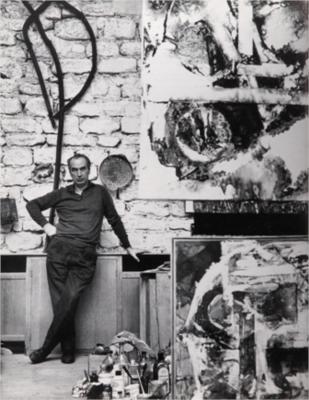
Dolfi Trost spent much of his life evading the authorities of one country or another, and his art was built on an equivalent refusal. Born in Romania in 1916[1], he became one of the central figures of the Infra-Noir group, the Romanian[1] Surrealist circle that included Gherasim Luca, Gellu Naum, Victor Brauner, and Virgil Teodorescu. Where André Breton's Paris group still argued for automatism guided by Freudian theory, Trost pushed further: he proposed that objective chance alone, stripped of psychoanalytic interpretation, could dissolve the artificial border between waking and dream life.
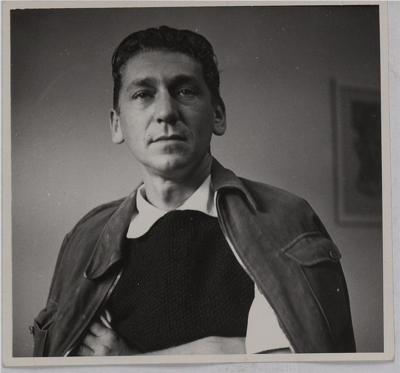
Biography
His most important theoretical work, "Vision dans le cristal" (Vision in a Crystal, 1945[1]), carried the subtitle "Obsessive Oneiromancy" and set out this position at length. The same year he exhibited his "coloured graphies", marks produced by the involuntary movement of the hand with no prior intention, which he termed "surautomatism." In "Le profil navigable" he went further still, arguing for a concrete negation of painting itself.
The political conditions of postwar Romania made continuation impossible. In the winter of 1947[1]–48, Trost and Luca attempted to cross the western border illegally and failed. They eventually left Romania for Israel in 1950, and moved to Paris in 1952. Trost later made his way to the United States, living in New York and Chicago. He died in 1966[1], his influence on French and American Surrealism largely unacknowledged outside specialist circles. Michael Finkenthal's monograph of 2013 remains the primary study of his work.
Timeline
- 1916Born in Romania.
- 1945Published his most important theoretical work, "Vision dans le cristal", subtitled "Obsessive Oneiromancy".
- 1945Exhibited his "coloured graphies", marks produced by the involuntary movement of the hand, which he termed "surautomatism".
- 1947Attempted to cross the western border of Romania illegally with Gherasim Luca; the attempt failed.
- 1950Left Romania for Israel.
- 1952Moved to Paris.
- 1966Died, with his influence on French and American Surrealism largely unacknowledged outside specialist circles.
Notable Works
Tap to view larger.
Next stop
Browse the movements →
Every movement in the collection, from the Renaissance to Pop art.
Related Artists


Frequently Asked Questions
What is Dolfi Trost's most famous work?
It is difficult to name one single work as Dolfi Trost's most famous. He was a versatile artist active across a range of genres. Trost's work includes religious scenes, landscapes, and peasant genre scenes. He is known for a rich, thick application of paint. His *Judith*, dating from around 1625, is one of his best-known works. Several copies were made by the artist himself for princely collections. It depicts Judith as a flamboyant Baroque heroine, with contrasting momentum between the decapitated body of Holofernes and Judith's twisting body. Her dress is wide and rippling, illuminating the whole painting. The eye follows the swirling movement of folds and creases, coming to rest on the round neckline and the soft, smooth, gleaming skin of the young woman. Other notable works include *Venus Dressing*, *Peasants Fighting*, and *Peasant Wedding Feast*.What should I know about Dolfi Trost's prints?
Dolfi Trost was an artist who created prints, but details about his work are scarce in the provided references. Printmaking is a broad category, encompassing techniques such as engraving. Engravings involve cutting a design into a surface, often a metal plate, and then using ink to transfer that design to paper. Many early prints were reproductions of paintings or drawings. For example, several plates in the Galleria Giustiniana (a collection of engravings after classical sculptures and paintings) were made by printmakers after designs by other artists, such as Michel Natalis's engraving after Giovanni Lanfranco, and Theodore Matham's frontispiece after François Duquesnoy. Prints also served as illustrations in books on diverse subjects, from Roman topography to numismatics. Artists like Hendrik Goltzius contributed illustrations to books, as seen in his prints for H. Goltzius's Julius Caesar. Prints could also function as travel posters, such as those produced for the Hamburg-America Line. Without specific examples, it's difficult to characterise Dolfi Trost's prints further.What style or movement did Dolfi Trost belong to?
It is difficult to assign Dolfi Trost to a single artistic movement. His work has some connections with Italian movements of the mid-20th century; however, these connections are not definitive. After the Second World War, many Italian artists explored abstraction. Some artists, like those connected with the Gruppo Origine, pursued non-figurative art. Others engaged with Art Informel, incorporating emotive colour and metaphoric depth. Still others, like Lucio Fontana and Piero Manzoni, explored Spazialismo and the Movimento Nucleare, which pushed the boundaries of accepted artistic conventions through radical visual languages. Trost's use of discarded materials and creation of 'fanciful machinery' has been compared to Metaphysical art, reminiscent of Giorgio de Chirico. However, without more information, it is hard to definitively place Trost within a specific movement.What techniques or materials did Dolfi Trost use?
Dolfi Trost employed a range of materials and methods in his art. Some of his techniques included mixing oil paint with turpentine and applying it with a fine lettering brush into troughs created by a palette knife. He also used a palette knife to produce all of the 'drawing', sometimes exposing the primed canvas. Trost's portrait of Dhotel demonstrates his use of *haute pâte*, which involved a thick mixture of oil paint, turpentine, colour washes, and granular raw material sprinkled over and mixed into the surface before any drawing was attempted. The final layer of cream colour was applied to the head and shoulders before the contours and features were drawn in with a palette knife. For dense black backgrounds, he used an elaborate combination of oil paint, ashes, sand, and coal-dust. Touches of pure crimson red were added to the blackened lines. He also dragged thick cream paint mixtures with a broad spatula over the crumbly surface of the paint and material.What was Dolfi Trost known for?
Dolfi Trost, born in Austria-Hungary in 1906, was a painter, graphic artist, and writer. He is best known for his association with the Viennese Surrealist movement. After the Second World War, Trost became a member of the Art Club of Vienna and participated in their exhibitions. He also joined the "Hundsgruppe", an avant-garde group. In 1950[1], he co-founded the "Galerie der Menschen", a venue intended to present Austrian modern art to a wider audience. His work often explored themes of alienation, anxiety, and the absurdity of modern life, reflecting the influence of Surrealist and Expressionist styles. Trost employed a range of media, including painting, collage, and assemblage, to create unsettling and dreamlike imagery. He also wrote poetry and prose, often incorporating his literary work into his visual art. He died in Vienna in 1990.Where can I see Dolfi Trost's work?
It is difficult to pinpoint exactly where you might find works by Dolfi Trost. However, several museums feature collections of Art Deco works, an artistic style with which Trost is associated. These include institutions in the United States, Canada, and the United Kingdom. In the United States, you could try the Charles Hosmer Morse Museum of American Art (Winter Park, Florida), the Los Angeles County Museum of Art (Los Angeles), the Metropolitan Museum of Art (New York), the Minneapolis Institute of Arts, the Museum of Modern Art (New York), the Virginia Museum of Fine Arts (Richmond), or the Wolfsonian at Florida International University (Miami Beach). In Canada, the Royal Ontario Museum (Toronto) may hold relevant pieces. In the United Kingdom, possible locations are the Bakelite Museum (Williton), the Brighton Museum & Art Gallery, the Geffrye Museum (London), the Manchester Art Gallery, the National Museums of Scotland (Edinburgh), and the Victoria & Albert Museum (London).Where was Dolfi Trost from?
Dolfi Trost was a Romanian[1] artist and theorist. He was active in the Romanian Surrealist movement. With Gherasim Luca, Trost attempted to cross the Romanian border illegally in the winter of 1947[1]-1948[1]. After this unsuccessful attempt, they requested permission to immigrate to Israel. They were initially refused, but were finally able to leave Romania for Israel in 1950. By 1952, Trost had moved to Paris; it became a centre for his intellectual and artistic life. During this period, Trost, along with Luca, sent letters and original works to André Breton. These communications contained descriptions of Surrealist activities in Romania, as well as theoretical essays. One such essay, from August 1951, was Trost’s *L’âge de la reverie* (*The Age of Daydreaming*). Trost later claimed to be the founder of the Romanian Surrealist group. He notified Breton of his break-up with Luca, after which they found their separate ways to Paris. Later in life, Trost moved to the United States, living in New York and Chicago.Who did Dolfi Trost influence?
Dolfi Trost's direct influence is difficult to trace with precision. However, some connections can be made to broader artistic movements and individual artists. Trost's work, particularly his use of scrap metal to create fantastical machinery, has been compared to the Metaphysical art tradition in Italy. This connects him, albeit indirectly, to artists such as Giorgio de Chirico, Francis Picabia, and Marcel Duchamp, who also explored similar themes of non-functional machines and strange juxtapositions. Furthermore, Trost's aesthetic of materials consumed by time aligns him with the Art Informel movement. This movement encompassed a range of artists, including Alberto Burri, whose work with unconventional materials challenged traditional notions of painting and sculpture. Trost's exploration of discarded materials and the passage of time resonates with the concerns of Art Informel, suggesting a shared sensibility.Who was Dolfi Trost?
Dolfi Trost (1916[1]-1966[1]) was a Romanian[1] Surrealist theorist and artist. His most important contribution to the movement was *Vision dans le cristal* (1945[1]), also known as *Oniromancie obsessionelle*. In it, Trost argued for eliminating the separation between day and night, and between the conscious and subconscious mind. Trost favoured objective chance and automatism over Freudian psychoanalysis. He believed these were better routes to finding images that revealed the secrets of the objective world. His theoretical essay *Le profil navigable: Negation concrete de la peinture* argued against images made using traditional painting methods. He replaced these with the "surautomatism" of his "coloured graphies". These works, exhibited in 1945, were produced by involuntary hand movements, done without intention or reflection. In 1947-1948[1], Trost and Gherasim Luca unsuccessfully attempted to cross the Romanian border. In 1950, they emigrated to Israel, then moved to Paris in 1952. Trost claimed to be the founder of the Romanian Surrealist group. He notified André Breton of his break-up with Luca; this damaged Luca's standing within Surrealist circles for a time. Trost later moved to the United States, living in New York and Chicago.Why are Dolfi Trost's works important today?
Dolfi Trost was a member of the Futurist movement, which sought to break from conventional 19th-century aesthetics. Futurism's importance now lies in its impact on modern art and its anticipation of later trends. Futurist ideas influenced painting, sculpture, and theatre. The Manifestos, though extreme, served as a weapon against existing forms. They advocated for dynamism, speed, and a synthesis of objects and images. Prampolini, Balla, and Depero pioneered Futurist scenography. Bragaglia's Teatro degli Indipendenti explored new technical possibilities. Marinetti's synthetic theatre influenced theatre design, and his "evenings" awakened academic theatres. Futurism's concepts resonate in areas such as collage sculpture, mobiles, action painting, and musique concrete. Sant'Elia's architectural vision prefigured the designs of later decades. The movement's emphasis on new materials is reflected in the use of glass in modern buildings.What was Dolfi Trost's art style?
Trost produced "coloured graphies", marks made by involuntary hand movements without prior intention, which he termed "surautomatism."
Sources
Editorial draws on the following primary and tertiary references for Dolfi Trost.
- [1] wikipedia Wikipedia: Dolfi Trost Used for: biography, birth dates, death dates, identifiers, movement attribution, nationality.
- [2] book Ernst Hans Gombrich, Fritz Saxl, Aby Warburg _ an intellectual biography Used for: biography.
- [3] book Clough, Rosa Trillo, 1906-, Futurism: the story of a modern art movement ; a new appraisal Used for: biography.
- [4] book Gianlorenzo Bernini: new aspects of his art and thought : a commemorative volume Used for: biography.
- [5] book guggenheim-peggygu00alle Used for: biography.
- [6] book guggenheim-twopri00weis Used for: biography.
- [7] book Masterpieces of western art : a history of art in 900 individual studies from the Gothic to the present day Used for: biography.
Editorial overseen by Solis Prints. Sources verified 2026-09-30. Click a source for details, or hover over [N] in the page above to preview.
Editorial standardsMethodologyCorrectionsAI disclosureAbout the editorial team